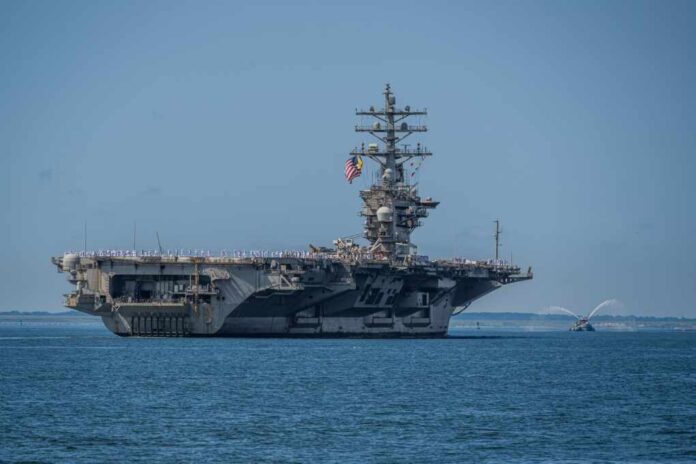
A $5.5 billion U.S. Navy aircraft carrier was ‘sunk’ by an $80 million Canadian submarine, exposing vulnerabilities in American naval defenses.
Story Highlights
- A Canadian submarine infiltrated the USS Dwight D. Eisenhower’s defenses during a 1981 NATO exercise.
- The incident highlighted the vulnerability of U.S. carriers to conventional submarines.
- Exercise findings spurred reevaluations of anti-submarine warfare tactics.
- This event continues to influence modern naval strategy and training.
Canadian Submarine’s Tactical Triumph
In 1981, during the NATO exercise “Ocean Venture,” a Canadian Oberon-class diesel-electric submarine demonstrated its stealth capabilities by slipping past the anti-submarine warfare (ASW) defenses of the USS Dwight D. Eisenhower. Running on battery power, the Canadian sub managed to exploit gaps in the U.S. carrier’s protective screen, simulating a successful torpedo attack that exercise umpires ruled as a “sinking” of the carrier. This war-game scenario highlighted potential vulnerabilities in the U.S. Navy’s carrier defenses.
The incident, though a simulated exercise, had significant implications. It underscored the threat posed by conventional diesel-electric submarines, particularly in littoral waters. The Oberon-class sub’s success was attributed to its quiet operations and tactical maneuvering, challenging the assumption of carrier invulnerability. The U.S. Navy’s reliance on nuclear-powered carriers as the cornerstone of its maritime dominance faced scrutiny, as this exercise revealed potential gaps in ASW tactics and readiness.
$5,500,000,000 Nuclear Navy Aircraft Carrier ‘Sunk’ by $80,000,000 Canadian Diesel Submarine On ‘Battery Power’https://t.co/rDJuh0WrAU
— Harry Kazianis (@GrecianFormula) January 9, 2026
Implications for Modern Naval Strategy
This Cold War-era exercise has continued to resonate in contemporary naval strategy discussions. The vulnerability narrative set forth by this event has been used to advocate for diversified naval fleets and enhanced ASW capabilities. With modern adversaries like China deploying advanced diesel-electric and air-independent propulsion (AIP) submarines, the lessons from 1981 remain relevant. Analysts argue that these submarines could disrupt U.S. carrier operations, necessitating a reevaluation of current defense strategies.
The U.S. Navy has since increased emphasis on training against quiet submarines, incorporating lessons from the Canadian sub’s success. Exercises now include more realistic scenarios that account for the stealth capabilities of diesel-electric subs, ensuring that carrier strike groups are better prepared to counter such threats. The event serves as a cautionary tale, reminding military planners of the need for continuous adaptation and improvement in ASW tactics.
Continued Influence and Strategic Adjustments
The 1981 exercise has become a case study in naval warfare, illustrating the asymmetry between high-cost carriers and relatively inexpensive submarines. This cost disparity fuels ongoing debates over defense spending efficiency and the strategic value of aircraft carriers. Critics argue that carriers are increasingly vulnerable in modern maritime environments, while proponents highlight their power projection capabilities. Ultimately, the incident reinforces the importance of integrated ASW operations and the need for allied cooperation in maintaining maritime security.
As the U.S. Navy continues to adapt its strategies, the lessons from the Canadian sub’s simulated “sinking” of the Eisenhower remain a pivotal reference point. The event underscores the ever-present challenges in naval warfare and the necessity for innovation in defense planning.
Sources:
$5,500,000,000 Nuclear Navy Aircraft Carrier ‘Sunk’ by $80,000,000 Canadian Diesel Sub On ‘Battery Power’
$5,500,000,000 Nuclear U.S. Navy Aircraft Carrier ‘Sunk’ by $80,000,000 Canadian Diesel Submarine On ‘Battery Power’
Canada Conducted a Simulated Sinking of a Navy Aircraft Carrier
Submarine: Canada Sank US Navy Aircraft Carrier in Wargame