

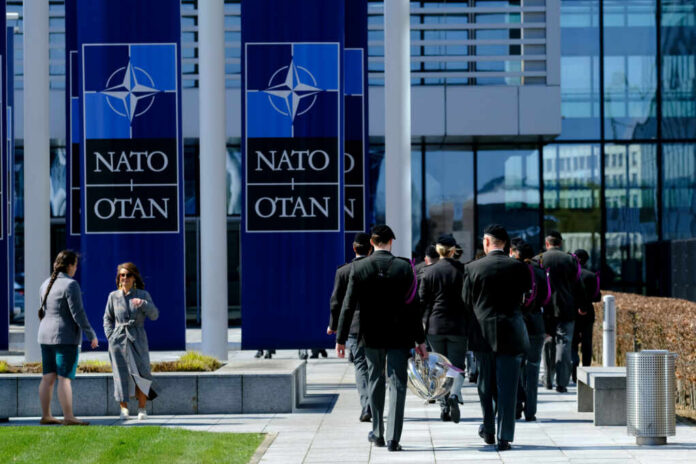
NATO’s top official just drew a bright line: the alliance won’t join Trump’s Iran campaign—even as Europe argues over whether America is saving them or dragging them into another Middle East mess.
Story Snapshot
- NATO Secretary General Mark Rutte said the US-Israel campaign against Iran is “important” for degrading Iran’s nuclear and missile threat, but NATO as an alliance will not be involved.
- Iran retaliated within 24 hours of the opening strikes, hitting Israel, Jordan, and multiple US bases and partner locations across the Gulf region.
- European leaders signaled divisions: some back the objectives, while others warn of escalation, legal concerns, and the risk of a long war.
- US officials have pressed allies to support the effort, while analysts warn the campaign’s multiple goals could complicate an exit strategy.
Rutte’s Message: Strategic Value, No NATO War
Mark Rutte’s central point was straightforward: NATO will not enter the US-Israel conflict with Iran as an alliance, even if individual member states choose to assist. Rutte still described the campaign as “important” because Iran’s nuclear ambitions and ballistic missile capabilities threaten regional stability and pose an existential danger to Israel. That framing matters, because it acknowledges the threat without turning a US-led operation into an Article 5-style NATO commitment.
Rutte’s posture also reflects a core NATO reality: alliance unity is hardest to maintain when operations move beyond direct collective defense. NATO can coordinate deterrence and defense across its members, but it cannot easily force consensus on a fast-moving war with regime-change rhetoric. By separating “NATO involvement” from “national support,” Rutte left room for cooperation while trying to prevent a split that would weaken the alliance’s credibility elsewhere.
What Triggered the Flashpoint: “Operation Epic Fury” and Rapid Retaliation
The escalation accelerated after President Trump launched “Operation Epic Fury,” describing objectives that go beyond limited strikes—degrading Iran’s military capabilities, reducing proxy power, and pushing for regime change. According to the research summary, Trump announced the strikes without congressional or UN approval and publicly urged Iran’s Revolutionary Guards to surrender while calling for Iranians to overthrow the regime. Iran retaliated quickly, striking Israel, Jordan, and US positions across Qatar, the UAE, Bahrain, and Kuwait.
Those details explain why allied governments are reacting cautiously: the campaign is not presented as a narrow mission with a single measurable endpoint. When a war’s stated aims include regime change, the timeline and cost become harder to predict, and the risk of retaliatory attacks expands beyond the primary battlefield. The research also notes uncertainty around leadership outcomes, including reporting that Iran formed a three-person council to govern if the regime survives the initial phase—an indicator Tehran is planning for continuity under pressure.
European Fault Lines: Support for Aims vs. Fear of a Quagmire
Reporting summarized in the research shows a widening gap between US pressure for allied backing and Europe’s political caution. Defense Secretary Pete Hegseth criticized NATO partners for “hemming and hawing,” arguing hesitation contrasts with Israel’s decisiveness. At the same time, leaders in France and elsewhere emphasized de-escalation and warned of grave consequences for peace. Germany’s chancellor reportedly shared the strategic aims but voiced fear of getting trapped in a prolonged conflict—an echo of hard lessons from Iraq and Libya.
The research also flags a key limitation: claims of “widespread support” are not clearly supported by the underlying sourcing summarized, even as Rutte calls the operation “important.” That gap matters for readers trying to separate public messaging from actual allied commitments. If support is real, it should show up in concrete measures—air-defense deployments, logistics, intelligence sharing, basing permissions, and parliamentary approvals—rather than broad rhetorical nods. The available material focuses more on divisions than on a unified coalition.
Turkey’s Balancing Act and NATO’s Southern Flank
Turkey’s role highlights how complicated “alliance unity” becomes during a regional war. The research notes a call between Rutte and Turkish President Recep Tayyip Erdoğan focused on Iran and regional security, with Rutte reiterating NATO’s deterrence posture while maintaining that NATO is not entering the war. Separate reporting summarized in the research describes Erdoğan warning about destabilization, underscoring Ankara’s concern that a wider conflict could trigger spillover across borders, energy routes, and migration channels.
For NATO, Turkey is not a side character—it anchors the southern flank and sits closest to several likely second-order effects, from terrorism threats to refugee flows. Rutte’s insistence on a “360-degree” security view signals NATO’s intent to protect members from backlash without formally joining a US-led offensive. That distinction may sound technical, but it becomes crucial if Iran or its proxies expand attacks and allies demand protection without endorsing escalation.
Strategic Risks: Multiple Objectives, Unclear End State
Analysts cited in the research argue that time can favor Iran if the campaign drifts or if goals multiply faster than they can be achieved. The strategic critique is not that Iran is harmless—Rutte’s comments emphasize the opposite—but that combining regime change, capability destruction, and proxy suppression raises the probability of unintended consequences. The same analysis raises practical questions about sustaining operations, managing economic disruption, and stabilizing the region if Iran’s leadership structure fractures rather than cleanly collapses.
For a conservative audience that values constitutional guardrails and clear national interests, the unanswered questions are not academic. The research explicitly notes the strikes were announced without congressional or UN approval, which is precisely the kind of issue that can boomerang into domestic political conflict even when the target is a hostile regime. The bottom line is that NATO’s “not involved” stance reduces alliance entanglement, but it does not eliminate blowback risk for US forces, allies, and energy markets if the war broadens.
Sources:
Trump presses NATO partners to support; Hegseth blasts hesitation
Strategic Challenges of U.S. Military Campaign Against Iran
Iran International report (March 2026) on Rutte-Erdogan call and regional security
NATO’s Rutte rules out alliance involvement in US-Iran conflict as surveillance shifts (03-02-2026)