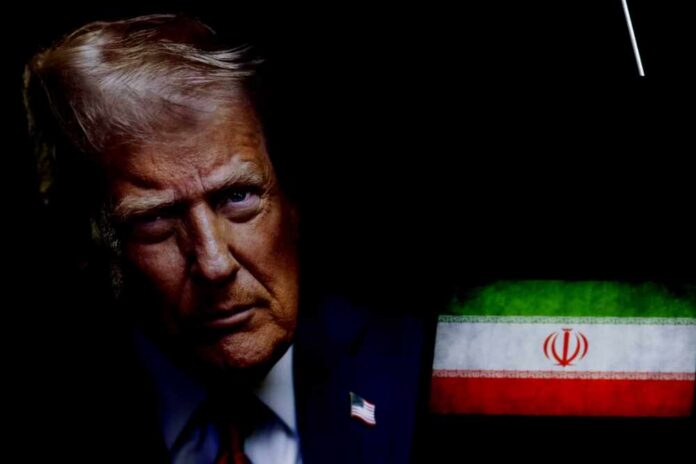
President Trump just hit pause on strikes against Iran’s power grid based on “very good” talks that Iran says don’t even exist—leaving Americans to wonder who’s steering this war and why.
Quick Take
- Trump says the U.S. is in “good and productive” talks with Iran and ordered a 5-day delay of planned strikes on Iranian power plants and energy infrastructure.
- Iran’s foreign ministry and state-linked media immediately denied any negotiations, calling Trump’s claim a tactic to buy time and lower energy prices.
- The announcement lands on Day 24 of the Iran war, after U.S.-Israel strikes and Iranian counterstrikes widened the conflict across the region.
- Key details remain unverified, including who would be negotiating for Iran after Khamenei’s death and what “a deal” would require.
Trump’s 5-Day Strike Pause Tied to Unconfirmed “Talks”
President Donald Trump said March 23, 2026, that the United States is engaged in “good and productive” talks with Iran aimed at ending the war, and he directed the Pentagon to postpone planned strikes on Iranian power plants and energy infrastructure for five days. Trump also told reporters there was a “very good chance” of a deal, including a claim that the U.S. would take possession of Iran’s enriched uranium. The administration has not publicly provided verification of the talks’ venue, participants, or terms.
The immediate friction is credibility: Iran responded through its foreign ministry and Tasnim-linked reporting with a flat denial that negotiations are underway. Iranian officials framed Trump’s statement as a maneuver—described as an attempt to reduce energy prices and delay military action—rather than a true diplomatic channel. With both sides issuing incompatible accounts in real time, Americans are left with competing narratives about whether Washington is pausing to pursue peace, pausing to manage markets, or pausing because the war’s next steps carry major costs.
How the War Reached “Day 24” and Why Energy Targets Matter
The current moment sits on top of a fast-moving escalation. In late February, talks in Geneva reportedly showed “substantial progress” through Omani mediation, with Iran offering an enrichment pause and monitoring, followed by Trump’s public dissatisfaction. On Feb. 28, the U.S. and Israel launched Operation Epic Fury strikes on Iran, after which Iran retaliated against Israel and struck at U.S. bases and Gulf states. The latest pause is notable because it focuses on energy infrastructure, not nuclear facilities, and because energy strikes could ripple directly into global prices.
Energy targets are a strategic lever because they can pressure a government quickly while raising ethical and operational risks. Destroying power plants and grid infrastructure can cascade into civilian hardship, complicate medical services, and destabilize basic public order—effects that do not stay neatly “military.” For U.S. voters already exhausted by high costs and uncertainty, any perception that war planning is linked to energy price management will intensify distrust. The research also indicates earlier actions were taken without clear congressional authorization, which is a constitutional flashpoint for conservatives who expect war powers to be debated openly.
The Negotiation Problem: Who Speaks for Tehran After Khamenei?
One obstacle to evaluating Trump’s claim is Iran’s leadership transition after Ayatollah Ali Khamenei’s reported death during the early strikes. The research describes a vacuum with a new supreme leader selection underway, raising basic questions about who could credibly commit Iran to terms that would end active hostilities. Iran’s foreign minister, Abbas Araghchi, is cited as denying current talks even while prior diplomacy had been in motion. That mismatch does not prove talks are impossible, but it shows why “backchannel” claims are hard to validate and easy to politicize.
What MAGA Voters Are Wrestling With: War Aims, Israel, and the Constitution
The internal conservative split is being driven less by sympathy for Tehran than by hard lessons from decades of open-ended conflict. Many Trump voters backed promises to end endless wars and stop nation-building, yet the U.S. is now in a major regional war with unclear endpoints: zero enrichment, uranium seizure, missile limits, and proxy restrictions have all been floated as objectives. Israel’s security concerns remain central, but some supporters are openly asking whether America’s role is drifting from deterrence into regime-change logic—without the kind of transparent constitutional process voters expect.
Independent verification also complicates the case for escalation. The research cites IAEA Director-General Rafael Grossi stating inspectors saw no evidence of a structured Iranian nuclear weapons program while urging restraint. That does not settle the dispute over Iran’s enrichment level or intentions, but it does raise the bar for explaining why specific strikes are necessary and what outcome is realistic. If the administration can pause strikes for five days based on “talks,” voters will want clarity on why those talks cannot be described clearly enough to be tested against reality.
For now, the country is watching a familiar pattern: a White House announcement meant to signal progress, an adversary’s denial meant to signal strength, and a public left to absorb the economic and constitutional consequences. If talks are real, the administration can prove it with verifiable benchmarks—who is negotiating, what is being offered, and what Congress is being told. If talks are not real, the strike pause becomes a different kind of risk: it signals hesitation in a war where miscalculation can widen fast, and where Americans are demanding an exit strategy that matches the promises they voted for.
Sources:
Trump Strikes Iran Amid Nuclear Talks
2025–2026 Iran–United States negotiations
Watch: Trump speaking to reporters about Iran