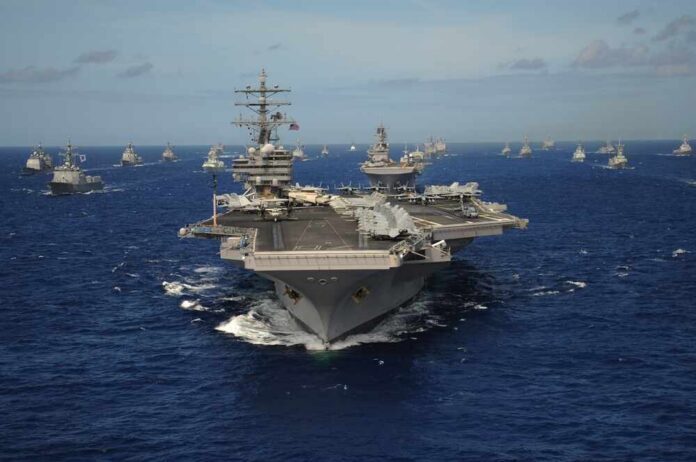
The Navy’s $13 billion supercarrier USS Gerald R. Ford limped into a Greek port for emergency repairs after a nine-month deployment riddled with fires and sewage failures, raising serious questions about whether this war-weary administration rushed America’s most advanced warship into combat before it was ready.
Story Snapshot
- USS Gerald R. Ford suffered non-combat fire and sewage problems during extended Red Sea deployment in Iran conflict
- Navy extended deployment twice to nine months, forcing crew into grinding operations against Iranian-backed threats
- Ship now docked in Greece for repairs after withdrawal from Operation Epic Fury combat zone
- Technical issues plague world’s most advanced carrier despite Navy claims of full mission capability
Another Endless War Nobody Voted For
The USS Gerald R. Ford deployed to the Red Sea in February 2026 as part of Operation Epic Fury, a joint U.S.-Israel military operation against Iran that most Americans never asked for. The deployment came as the Trump administration, despite campaign promises to avoid new foreign entanglements, found itself drawn into yet another Middle Eastern conflict. The Ford’s high-intensity operations involved launching F/A-18E/F Super Hornets to neutralize Iranian-backed drone threats, putting the carrier and its 4,539-member crew directly in harm’s way for a war that has fractured the MAGA base.
Technical Failures Mount During Combat Operations
In March 2026, a non-combat fire broke out aboard the Ford while the ship maintained operations at full capacity. The incident occurred alongside reported sewage system problems, raising concerns about quality-of-life conditions for sailors already stretched thin by extended combat duty. These malfunctions emerged on what the Navy bills as the world’s most technologically advanced warship, equipped with electromagnetic aircraft launch systems, advanced arresting gear, and dual-band radar. The vessel’s cutting-edge A1B nuclear reactors and automation systems were supposed to reduce crew requirements and increase efficiency, yet basic shipboard systems failed under operational stress.
The Navy extended the Ford’s deployment twice, ultimately stretching it to nine months before the ship exited the Red Sea through the Suez Canal in early April 2026. This extended timeline forced sailors to endure prolonged separation from families while dealing with onboard maintenance issues that should have been addressed in port. The U.S. 6th Fleet confirmed the Ford arrived at Souda Bay, Greece, for “efficient assessment, repairs, and resupply,” a diplomatic way of acknowledging the ship desperately needed attention after months of high-tempo operations.
Rushed Into War or Combat Ready?
The Ford-class carrier represents a generational leap from the aging Nimitz-class fleet, with electromagnetic aircraft launch systems replacing traditional steam catapults and a design promising 33 percent higher sortie generation rates. The lead ship was laid down in 2005, delivered in May 2017 after delays, and commissioned in July 2017 during the first Trump administration. After years of testing to resolve early reliability issues with launch and arresting systems, the Ford completed its first deployment in May 2023. Just three years later, the Navy threw it into high-intensity combat against Iranian threats.
Military experts tout the Ford as the “most capable, adaptable, lethal platform” in the fleet, with combat operations validating significantly higher sortie rates and effective drone neutralization capabilities. The ship’s EMALS system enabled precise control for launching both manned aircraft and unmanned aerial vehicles, proving its technological advantages in real combat conditions. However, the fire and sewage failures suggest the Navy may have prioritized demonstrating the ship’s combat capabilities over ensuring all systems could withstand prolonged deployment stress. This decision placed sailors at unnecessary risk while validating a $13 billion investment that has yet to prove it can operate without critical failures.
Crew Pays the Price for Leadership Decisions
While Pentagon brass and defense contractors celebrate the Ford’s combat performance, the 4,539 sailors aboard endured nine months of extended duty dealing with fire hazards and sewage problems far from home. The Navy maintains the ship remained “fully mission capable” throughout, but that designation rings hollow to families who watched deployments extended twice while their loved ones managed emergencies. This scenario exemplifies the disconnect between Washington’s foreign policy decisions and the real human cost borne by service members, a pattern that has exhausted many Americans tired of endless overseas commitments that drain national resources and sacrifice American lives for questionable strategic gains.
The Ford’s current status in Greek port underscores the maintenance burden of operating advanced weapons systems in sustained combat. Repair costs at Souda Bay add to the already substantial investment in the Ford-class program, which aims to replace the entire Nimitz fleet with carriers designed for crisis response and deterrence. The ship’s combat test in the Red Sea will accelerate adoption of electromagnetic launch systems in future Ford-class carriers like the John F. Kennedy, but it also highlights the gap between laboratory performance and battlefield reliability that often emerges when new systems face real-world stress.
Sources:
Gerald R. Ford-Class Aircraft Carrier – Military.com
Gerald R Ford-class – Naval Technology
Gerald R. Ford-class aircraft carrier – Wikipedia
US Navy’s Most Advanced Aircraft Carrier Long Deployment Port – Business Insider
USS Gerald R. Ford – Wikipedia
USS Gerald R. Ford CVN 78 – U.S. Fleet Forces Command