
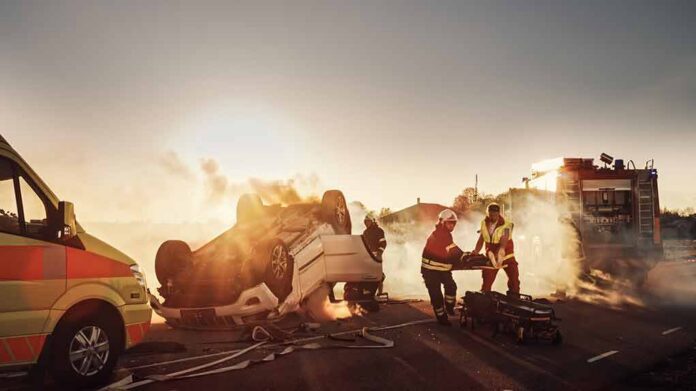
A fuel tanker crashed and exploded on Cairo’s Ring Road, killing at least 31 people and torching vehicles in minutes, officials said.
Story Snapshot
- Egypt’s Health Ministry reported at least 31 people dead after a tanker fire near Cairo.
- The crash and fire happened Wednesday on the Ring Road above Tunnel 10 in the Warraq area.
- Ambulances rushed victims to hospitals as flames spread to many nearby vehicles.
- Injury counts varied across outlets, but all confirm a mass-casualty highway disaster.
Deadly Crash And Fire On Cairo’s Ring Road
Egyptian authorities said a tanker carrying petroleum products crashed on Wednesday, November 25, 2026, on the Ring Road around Cairo, igniting a fast-moving fire that killed at least 31 people. Reporters placed the site above Tunnel 10 in the Warraq district of Imbaba, Giza, a busy stretch that funnels commuter and freight traffic around the capital. Photos and videos showed cars burned to shells and smoke rising over the highway as first responders fought the blaze.
Egypt’s Petroleum Ministry said the tanker was privately operated and veered off the roadway before crashing and exploding. The Health Ministry said ambulances moved victims to several hospitals as firefighters worked to contain flames that spread across lanes and into nearby traffic. The rapid spread of fire suggested a large fuel load and intense heat. The identity of the driver and the operating company were not included in the reports available so far.
Casualty Counts And Emergency Response
Egypt’s Health Ministry placed the death toll at a minimum of 31, a figure repeated by multiple international outlets covering the scene the same day. Injury totals differed, with one outlet reporting 15 injured and another citing 21; a separate report, drawing on prosecution information, mentioned 25 injured. Such gaps are common during fast-moving mass-casualty events as hospitals register patients and agencies reconcile lists. Authorities reportedly deployed 39 ambulances to transport the wounded.
Reports also described extensive damage to vehicles trapped near the tanker when it ignited. One account, citing the Public Prosecution, said the fire burned at least 27 cars and motorcycles as flames rolled across the roadway and underpasses. Traffic on the Ring Road, already dense, grew chaotic as drivers tried to escape the heat and smoke. Police closed lanes for hours to allow rescue crews and investigators to work through the wreckage.
Location Details And What We Know About Cause
Outlets located the crash near Tunnel 10 in the Al-Warraq area northwest of central Cairo, a corridor that connects several neighborhoods to the greater Giza governorate. The Petroleum Ministry’s early account said the tanker veered off the road before impact, but it did not explain what led to the loss of control or whether any other vehicle played a role. Officials did not disclose what exact fuel the tanker carried, the quantity on board, or the inspection status of the truck and trailer.
Egypt detains driver suspected of causing Cairo fuel tanker crash and inferno that left 31 dead https://t.co/J6dt1V4Moy #FoxNews
— Greg Gibbons (@GregGibbon53629) November 26, 2026
Investigators will review traffic camera footage, vehicle records, and on-scene evidence to determine the chain of events. Fires of this type often destroy key parts, making cause analysis harder. In past tanker cases, speed, lane changes, mechanical failure, and road design have each played roles. Until authorities release a final report with names, manifests, and tests, the public record will remain limited to the central facts: a tanker crashed, fuel ignited, and dozens died.
Why This Disaster Fits A Wider Road-Safety Pattern
This crash highlights a wider regional problem: high road-death rates and heavy truck traffic on crowded urban highways. World Health Organization materials show Egypt has faced persistently high road traffic mortality compared with many countries, with thousands of deaths recorded each year. That backdrop helps explain why a single crash can turn into a major tragedy. When a vehicle carries fuel, an ordinary collision can quickly become a mass-casualty fire, as seen on the Ring Road.
Fuel-tanker incidents share common risks. Large volumes of flammable liquid can spill, vaporize, and ignite, sending fire across lanes and into stalled cars. Heat can weaken structures and complicate rescue work. Casualty counts often shift after the first day as hospitals update records and responders identify victims. The Cairo crash follows that pattern, with consistent reporting on deaths and location, and some variation in injury totals as official figures evolve.
Accountability, Transparency, And Next Steps
Egyptian authorities will need to answer core questions that matter in any tanker crash. Investigators will look at driver training, hours behind the wheel, and whether the operator followed safety rules for hazardous cargo. They will check maintenance logs, brake and tire condition, and the tanker’s loading records. Clear public findings can support safer routes, better barriers, and stricter checks for fuel transport through dense urban corridors like the Ring Road.
For families and commuters, the priority is simple: prevent the next fire. Better enforcement, improved road design, and emergency access lanes can save lives. Clearer reporting standards can also reduce confusion in the first hours after a disaster. In Cairo, the facts already point to a stark lesson: when heavy trucks mix with packed traffic, a single mistake can kill dozens. Stronger rules and real oversight can turn that lesson into action.
Sources:
youtube.com, afp.com, upi.com, us.cnn.com, en.wikipedia.org, nytimes.com, applications.emro.who.int