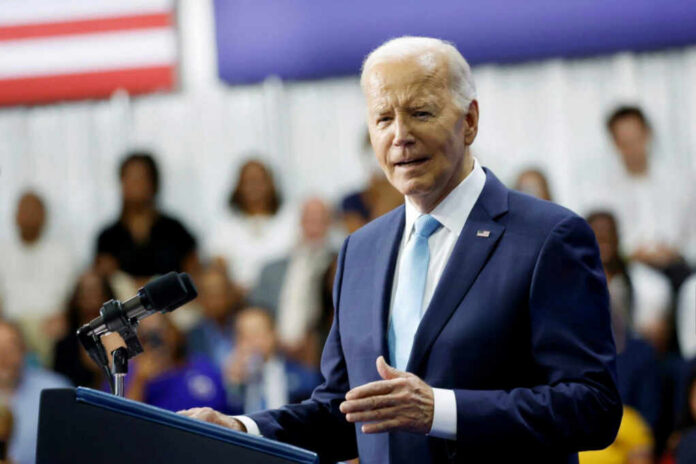
Joe Biden used Jesse Jackson’s memorial to put his own stuttering story back in the spotlight—reminding Americans how quickly political legacy-making can overshadow the hard questions voters still have about leadership, accountability, and national direction.
Story Snapshot
- Biden spoke March 6, 2026, at Rev. Jesse Jackson Sr.’s memorial service at House of Hope in Chicago.
- He recounted childhood stuttering and the social stigma around it, tying that experience to Jackson’s message of perseverance.
- Former presidents Bill Clinton and Barack Obama also attended and participated in honoring Jackson’s life and legacy.
- Reports cited Jackson’s prolonged health struggles, including Parkinson’s disease and progressive supranuclear palsy (PSP).
Biden’s Chicago appearance reframed the memorial around personal adversity
Former President Joe Biden delivered remarks Friday, March 6, 2026, at the memorial service for Rev. Jesse Jackson Sr. at House of Hope in Chicago. Biden’s tribute centered on perseverance, but the most discussed portion was personal: he described living with a childhood stutter and the way it affected how others treated him. Biden’s account connected Jackson’s public message—don’t quit after setbacks—to a private struggle many Americans recognize.
Biden told mourners he had been a decent student and athlete but stuttered, then described the familiar insult people attach to speech difficulties—being assumed “stupid.” He used that memory to emphasize resilience and self-respect, arguing that stumbles do not define a person’s worth or capacity. In the service setting, the story functioned as both a tribute to Jackson and a reminder that politics often elevates biography as proof of character.
Jackson’s final years and the service’s “People’s Celebration” theme
Rev. Jesse Jackson Sr. died after years of serious health challenges, including Parkinson’s disease and progressive supranuclear palsy, a rare neurological disorder. Coverage of the memorial highlighted that reality alongside the celebratory tone of the event, which was billed as “The People’s Celebration.” Biden referenced Jackson’s physical decline, recalling moments when Jackson used a wheelchair yet remained spiritually and emotionally committed to his mission, leaning on faith amid suffering.
The memorial brought together major Democratic figures and multiple former presidents, underscoring Jackson’s long-standing influence in that party’s leadership circles. Biden described a decades-long relationship with Jackson, saying they came up as leaders together, sometimes disagreed on views, yet aligned on questions of race. The gathering, heavy with political and cultural symbolism, placed Jackson’s legacy in the national spotlight again—framed as a call to persist and keep pushing forward.
The message Biden emphasized: character, judgment, and “don’t give up”
Biden’s remarks repeatedly returned to Jackson’s core message: “Don’t give up.” He also credited Jackson with leaving behind a moral framework—character, judgment, honesty—and urged listeners not to “kid” themselves about right and wrong. Biden argued that collective effort can accomplish more than cynics assume, stressing that unity makes difficult goals possible. The practical takeaway of the speech was less about policy and more about personal grit paired with civic engagement.
In a politically divided era, that kind of language plays differently depending on the audience. Biden’s call for working together can be read as a general appeal for national cohesion, but the research available does not include follow-up reporting showing how attendees or the broader public reacted to the speech in real time. With limited documented response, the measurable impact here is the moment itself: a high-profile memorial where biography and moral exhortation did most of the work.
What this moment says about post-presidency narratives in 2026
Biden’s stutter story is well known, and he has referenced it publicly for years. At Jackson’s memorial, he used it again as a bridge between personal struggle and public leadership, effectively shaping how viewers interpret both his own legacy and Jackson’s. For Americans frustrated by years of elite messaging and carefully curated narratives, this format can feel familiar: emotional storytelling that leaves unanswered what lessons should translate into concrete governance.
The available sources describe the event, quote Biden’s themes, and confirm the service’s setting and participants, but they do not provide outside expert evaluation or sustained analysis of how the remarks landed beyond the ceremony. What can be said from the record is straightforward: Biden praised Jackson as determined and unafraid, credited him with moral clarity, and urged people to continue the work—language consistent with a political movement focused on legacy, institutions, and long-term activism.
That matters because public ceremonies often signal what political leaders want remembered. In 2026, with President Trump back in office and the Biden administration in the rearview, Democratic figures are still defining their story lines—especially around perseverance, social justice, and institutional continuity. Conservative voters watching these memorial moments tend to ask a different question: whether the country is better off after the policies and priorities that accompanied those narratives, and whether sentiment is being used to avoid accountability.
Sources:
Jesse Jackson funeral Chicago President Joe Biden full remarks
Former presidents Clinton, Obama, Biden honor late Rev. Jesse Jackson
Jesse Jackson Chicago Funeral: Obama, Biden, Clinton to …