

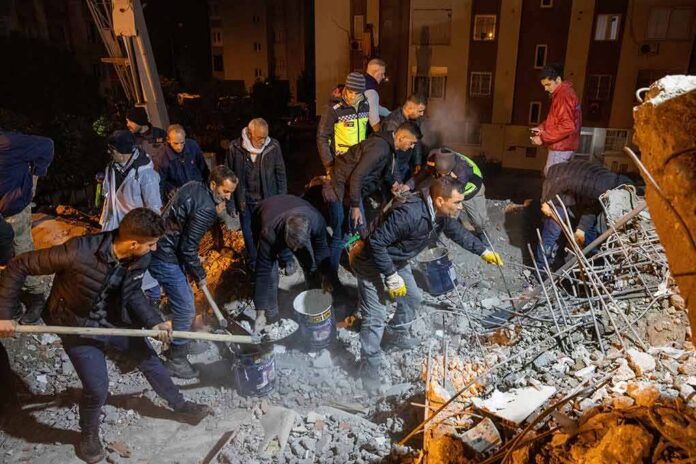
Eight people are confirmed dead after a Brooklyn building collapsed as rescuers worked through the night to find victims in the rubble.
Story Snapshot
- Firefighters launched a major rescue after a three-story building collapsed in Flatbush.
- Officials reported rising casualties as crews searched dangerous voids and debris.
- City records tied the site to a nearby excavation and demolition project under review.
- The cause remains under investigation by New York City agencies.
Confirmed Collapse, Rising Death Toll, and Rescue Effort
New York City officials said a mixed-use building at 1321 Flatbush Avenue collapsed after a 911 call at 4:01 p.m., prompting a large technical-rescue response by the Fire Department of the City of New York. Firefighters arrived within about a minute and began tunneling through debris to reach people who were trapped. Agencies updated casualty counts as the search continued, with multiple deaths and many injuries confirmed while crews worked in unstable conditions.
Firefighters and emergency medical workers operated with police, building inspectors, housing officials, utility crews, and the Red Cross. Reports described more than 250 responders at the scene supporting searches, victim care, and site safety. One firefighter was reported injured during operations. Officials emphasized patient tracking and family support while they expanded the search grid and shored up dangerous sections to prevent secondary collapse during rescues.
What We Know About the Building and Location
City records identified the structure as a three-story, mixed-use building with four residential units and five total units. The site sits on Flatbush Avenue in a dense commercial and residential corridor. Reporters on scene described a chaotic debris field with collapsed floors and void spaces where rescuers focused their work. Some outlets initially differed on whether the collapse was partial or complete, which can happen during fast-moving emergencies.
Officials stressed clear timelines and coordinated command as the incident unfolded. Dispatch records cited by local reports noted rapid arrival, immediate searches, and rolling updates from incident command. Crews used thermal imaging, listening devices, and hand tools to reduce the risk of further collapse while checking every accessible pocket. Hospitals received multiple patients with various injuries as the evening turned into an overnight operation.
Cause Under Investigation and the Role of Nearby Construction
The New York City Department of Buildings said investigators and engineers were at the site, issued a stop-work order, and opened a formal inquiry. The department and police said the cause of the collapse had not been determined. Coverage highlighted that demolition and excavation had been underway next door in recent months, including a previously cited violation and fines. Proximity and past violations are now part of the review but are not, by themselves, proof of causation.
Separate reports detailed that city inspectors had flagged the neighboring site earlier this year and that excavation was planned to reach significant depth for a new project. Engineering practice requires careful support of excavation to protect adjacent structures. Investigators will examine soil support, foundation conditions, and construction sequences to see whether nearby work affected the building’s stability. Officials said they would release findings after field work and analysis conclude.
Why This Matters for Public Safety and Accountability
Major cities face pressure to build more homes and stores, but that growth depends on strict safety. When a building fails, families lose loved ones, small businesses collapse, and whole blocks lose trust. People on the left and the right share a basic demand: rules must be enforced the same for everyone, and corners cannot be cut. This collapse raises hard questions about inspections, contractor compliance, and whether risk warnings were caught and fixed fast enough.
Clear, steady information also matters. During rescue operations, casualty counts can change. That is normal in a live scene, but agencies must keep updates precise and timely so families and neighbors are not left in the dark. City leaders promised a full accounting. The test ahead is simple: show the public the records, the engineering, and the timeline. If mistakes were made, fix them and hold the right people to account, before the next job breaks ground.
Sources:
washingtontimes.com, abc7news.com, ny1.com, abc12.com, nydailynews.com, abc7ny.com, whmi.com