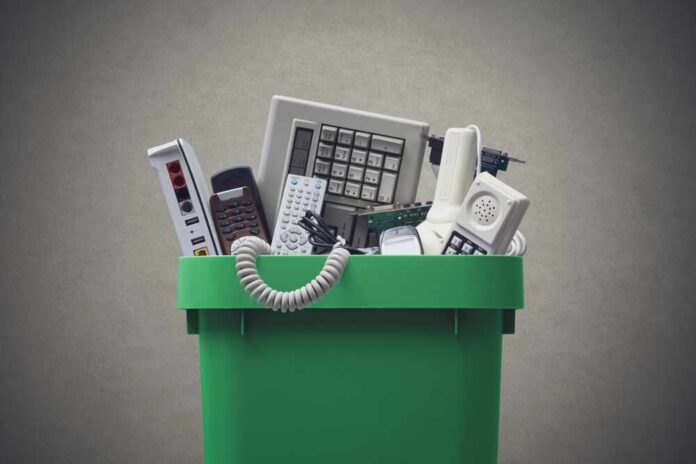
India is trying to turn yesterday’s junk phones and laptops into strategic minerals—because relying on foreign supply chains for lithium, cobalt, and rare earths has become a national vulnerability.
Story Snapshot
- India approved a $170 million incentive plan to scale “urban mining” from e-waste into critical minerals used in batteries and advanced tech.
- Extended Producer Responsibility (EPR) rules are pushing manufacturers to collect e-waste and route it to registered recyclers, shifting activity away from informal scrapyards.
- Officials and industry say formal recycling is rising, but UN-linked data suggests most e-waste still flows through informal channels—highlighting tracking and enforcement gaps.
- India’s target is new recycling capacity of at least 270,000 tons per year and about 40,000 tons per year of recovered critical minerals, a partial hedge against import dependence.
Why India Is Treating Old Electronics Like a Strategic Resource
India’s push centers on a hard reality: the country is heavily dependent on imports for minerals that power modern life, from EV batteries to defense electronics. Reporting and policy analysis describe “near-total” or “100%” import dependence for lithium, cobalt, and nickel, plus major imports of rare earth compounds. India is also generating massive volumes of electronic waste, with official estimates near 1.5 million metric tons annually and outside experts arguing the real total is far higher.
That combination—rising e-waste and insecure supply—explains the “junk to high-tech” framing. The government’s bet is that discarded devices can become a domestic feedstock for high-value materials, not just low-end scrap. Formal recyclers say advanced processes can recover many more elements than traditional metal stripping, including battery-linked materials and rare earths that informal workshops typically leave behind or destroy through unsafe handling.
$170 Million Incentives and the Machinery of a Formal Recycling Industry
The centerpiece is a $170 million (15 billion rupee) incentive scheme approved in September 2025 to build critical-mineral recycling capacity over six years, running from fiscal 2025–26 through 2030–31. The plan includes capital subsidies of up to 20% for plant and equipment and operational incentives tied to sales. Large entities face higher caps than small firms, and a portion of the funding is reserved for small or new recyclers to broaden participation.
Government expectations are ambitious: “at least” 270,000 tons per year of new recycling capacity and around 40,000 tons per year of recovered critical minerals. Those numbers matter because they define what success looks like—measurable output, not just announcements. They also set the boundaries of what this plan can realistically achieve. Even if targets are met, published analysis indicates recycling will reduce import vulnerability but is unlikely to make India fully self-sufficient in critical minerals.
EPR Rules Put the Burden on Manufacturers—And the Courts Are Involved
India’s incentive plan builds on Extended Producer Responsibility rules that require electronics makers to collect end-of-life products and channel them to government-registered recyclers. Industry operators describe EPR as the primary catalyst for bringing scale into formal recycling. At the same time, reporting shows some electronics giants have challenged aspects of the e-waste rules in court, reflecting the predictable friction when governments move compliance costs from taxpayers to producers.
That tension is a useful reminder for American readers watching similar policy debates at home: when regulators mandate collection and processing, companies often respond with lawsuits, lobbying, or higher consumer prices. The research provided does not quantify consumer price impacts in India, and it would be speculation to claim them. What is clear is that enforcement and compliance are central to whether e-waste is routed into advanced recovery systems or continues to leak into informal markets.
The Informal Sector Still Dominates—and That Limits What “Urban Mining” Can Deliver
The biggest obstacle is the entrenched informal recycling economy. Before EPR took hold, stakeholders say about 99% of e-waste was handled informally. Some industry voices now claim roughly 60% has shifted into formal channels. But a UN Development Program note cited in reporting indicates more than 80% may still be processed informally. The contradiction likely reflects measurement differences and weak tracking rather than a simple “who’s lying” storyline.
Junk to high-tech: India bets on e-waste for critical mineralshttps://t.co/OwJbYT0ASu
— Economic Times (@EconomicTimes) February 18, 2026
Either way, the direction is the same: as long as informal traders capture devices first, the highest-value minerals may never reach facilities capable of extracting them cleanly. Informal workshops often focus on copper and aluminum—the quick cash metals—while critical minerals require more sophisticated processes and careful dismantling to preserve value. Some authorized recyclers are attempting to train and integrate informal workers, but the research shows the transition remains incomplete and difficult to verify at scale.
Sources:
Junk to High-Tech: India Bets on E-Waste for Critical Minerals
India approves $170mn critical minerals recycling plan
E-waste recycling and India’s critical minerals mission
India Should Double Down On Rare Earth Recycling
Why are electronics giants taking India’s e-waste rules to court?
Scenarios Towards Viksit Bharat and Net Zero: Critical Mineral Assessment Demand and Supply
Junk to high-tech: India bets on e-waste for critical minerals
Advancing Circular Economy of Waste Electronic and Electrical Equipment (E-waste) and Lithium-Ion Batteries in India