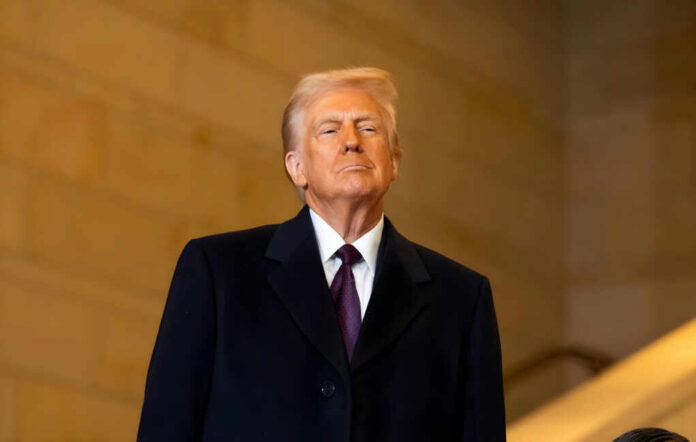
President Trump is warning Iran that the “hard” part of Operation Epic Fury is still ahead—an escalation that could reshape the Middle East and test America’s resolve at home.
Story Snapshot
- President Trump says U.S. forces will be “hitting Iran hard” over the next week as Operation Epic Fury expands beyond initial strikes.
- The White House frames the campaign as “peace through strength” aimed at Iran’s nuclear infrastructure, missile forces, naval assets, and proxy terror networks.
- Iran’s reported retaliation has been heavy in missiles and drones, raising the risk of wider conflict and threats to regional shipping routes.
- Republican lawmakers largely back the operation’s stated goal of preventing a nuclear Iran, while civil-liberties groups argue Congress must authorize major hostilities.
Trump Signals a New Phase of Strikes
President Donald Trump said U.S. forces will be striking Iranian targets intensely “over the next week,” signaling a sharper phase in Operation Epic Fury as the conflict enters mid-March. The White House has cast the campaign as a direct response to decades of Iranian aggression and as an effort to eliminate what the administration calls an imminent nuclear threat. Trump has also publicly raised the possibility of forcing Iran to accept unconditional surrender.
U.S. messaging has emphasized speed, pressure, and overwhelming capability—language designed to deter Tehran while reassuring allies that Washington intends to finish the mission. Public statements have also indicated the operation is not confined to a single night of airstrikes. Defense planning described in the research points to a multi-week campaign that can expand if Iran continues missile launches or proxy attacks across the region.
What Operation Epic Fury Targets—and Why It’s Different
Operation Epic Fury began with coordinated U.S. missiles and drones alongside Israeli air activity, according to the compiled timeline. The target set described in the research includes Iran’s nuclear facilities, ballistic missile arsenal, naval forces, and proxy networks used to threaten Israel, Gulf partners, and U.S. interests. The White House has argued diplomacy failed after talks collapsed, and the administration says it is acting to prevent Iran from reaching a nuclear threshold.
The operation stands apart from earlier episodes like the 2020 Soleimani strike because the rhetoric is broader and more explicit. The research indicates regime-change language has been used publicly, and allied involvement is highlighted as a coalition effort with Israel and partners such as Saudi Arabia. Trump has also acknowledged potential U.S. casualties, suggesting the administration is preparing the public for a sustained fight rather than a limited “one-and-done” engagement.
Retaliation, Risk of Wider War, and the Energy Shock Factor
Iran’s response, as summarized in the research, has included large-scale missile and drone launches since the opening strikes. Those barrages elevate the probability of escalation through miscalculation, proxy actions, or attacks near critical infrastructure and shipping lanes. The research also flags the vulnerability of energy markets if naval engagements expand or if the conflict disrupts Gulf transit routes, a direct pocketbook concern for Americans still sensitive to inflation shocks.
Military pressure can degrade capabilities, but it can also produce second- and third-order consequences: more regional air-defense interceptions, more strikes on launch sites, and more pressure on U.S. bases and partners. The research notes uncertainty around casualty reporting and the difficulty of independently confirming battlefield claims in real time. That uncertainty can complicate public understanding and heighten domestic disagreement about duration, cost, and end-state.
Congress, Constitutional Limits, and Competing Narratives at Home
Republican lawmakers cited in the research have broadly defended the operation’s stated objective of stopping a nuclear Iran and protecting U.S. troops and allies from proxy violence. That support reflects a familiar conservative argument: deterrence works when America demonstrates the will to act, and adversaries become more dangerous when they believe Washington is paralyzed by indecision. The administration’s “peace through strength” framing fits that worldview and echoes older Cold War logic.
Civil-liberties critics, including the ACLU as referenced in the research, argue major hostilities require congressional authorization and warn against executive overreach. That dispute matters to conservatives who care about constitutional separation of powers even when they support a strong commander-in-chief. The available research does not provide a full legal adjudication or court outcome, so the central unresolved question remains political: whether Congress moves to formalize, limit, or fund the campaign as the next week of strikes unfolds.
US President Donald Trump says US forces will be carrying out intense strikes against Iranian targets in the coming days, as the war that has cascaded throughout the Mideast region headed into its third week. https://t.co/sTpHjkTKZ9
— Al Arabiya English (@AlArabiya_Eng) March 13, 2026
For voters frustrated by years of global disorder, the administration’s case is that preventing a nuclear Iran reduces long-term risk and protects U.S. interests without repeating the nation-building failures of past eras. The counterpoint, also reflected in the research, is that stated goals can blur—toppling a regime, installing “new leadership,” or simply degrading nuclear capacity are not identical outcomes. Until officials clarify the end-state and Congress signals its role, Americans should expect more volatility abroad and sharper debate at home.
Sources:
ACLU condemns President Trump’s unconstitutional military strikes on Iran
A Guide to Trump’s Second Term Military Strikes and Actions