

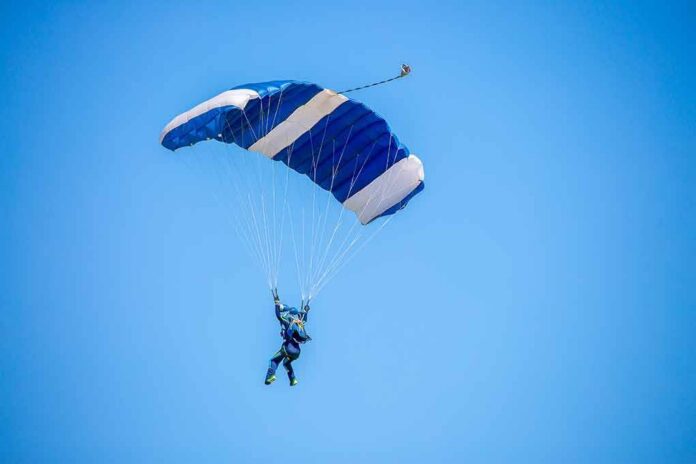
Low-canopy collisions are among the most unforgiving failures in skydiving: once parachutes entangle within a few seconds of landing, there is almost no altitude left to fix anything, and survivability drops to near zero. That is the core mechanism behind the Lake Elsinore tragedy — a normal skydive that turned fatal in the final 150 feet.
The Short Version
- Two licensed skydivers collided under canopy near 150 feet above Skydive Elsinore; their parachutes entangled and both later died at the hospital.
- The host facility reported no indication of equipment malfunction; the jump and openings were described as normal until the collision.
- The event occurred around midday during an organized jump at the Lake Elsinore drop zone in Riverside County.
- While skydiving’s fatality rate is low overall, canopy collisions are a persistent minority cause of deaths in the sport.
What happened over Lake Elsinore
According to contemporaneous accounts attributed to Skydive Elsinore and carried by multiple outlets, the jump progressed normally through freefall and parachute deployment. As the two skydivers set up to land, they collided at roughly 150 feet above ground level; their parachutes became entangled, removing the aerodynamic control and drag needed to complete a survivable flare and touchdown. First responders reported both jumpers suffered traumatic injuries and were transported to a hospital, where they were pronounced dead.
The facility stated there was no indication of gear malfunction and emphasized that the freefall and openings were routine. That framing — normal jump, low-altitude collision, canopy entanglement, no sign of equipment failure — was consistently reported by regional and national outlets in the immediate aftermath. Authorities noted the investigation was active, but the timing, location, and basic sequence were not in dispute: midday, Friday, over Skydive Elsinore, during an organized event in Lake Elsinore, California.
Why 150 feet leaves no margin
Under a fully inflated, properly controlled parachute, landing is deliberately routine: pilots align with the wind, maintain separation, and execute a flare — a brief, higher-input control stroke that converts forward speed into lift and reduces descent rate just before touchdown. Entanglement at 150 feet catastrophically disrupts that plan. At that height, time aloft is measured in a few seconds, not tens of seconds; the aerodynamic interference between two canopies can induce partial or total collapse, line tension anomalies, and unpredictable yaw and roll, all while altitude unwinds too fast to cut away and deploy a reserve meaningfully. Even if a reserve were somehow cleanly deployed, typical reserve inflation heights are engineered for decisively higher altitudes than the final segment of a landing pattern.
Collision mechanics at low altitude also compound the problem. Relative motion between canopies — often created by differing pattern legs, turn rates, or approach speeds — introduces angular momentum that an entangled pair cannot easily dissipate. The resulting configuration may descend faster, oscillate, or develop a diving turn, any of which erases the controlled, progressive flare required to land without severe injury.
How skydiving manages traffic under canopy
Modern drop zones are, in effect, small aerial traffic systems. Pilots are briefed to fly standardized landing patterns — downwind, base, final — relative to a windsock or designated landing direction. Separation is managed at multiple layers: exit order and timing in the aircraft, horizontal separation in freefall, deployment altitudes, and then canopy flight discipline. Under canopy, right-of-way norms prioritize lower jumpers on final; faster canopies (often smaller, sportier wings) are expected to avoid overtaking conflicts. The aim is to prevent converging flight paths during the highest-workload phase: the last 500 feet to landing.
When conflicts do arise, they cluster in two moments. The first is immediately after deployment, when jumpers are still sorting headings and airspace; the second is near landing, where pattern misreads, unexpected turns, or speed differentials can compress separation. The Lake Elsinore reporting places the incident in that second zone — a collision close to the ground after normal openings — which aligns with one of the sport’s known risk points.
Where this tragedy fits in the broader safety record
Skydiving risk is best understood in rates, not anecdotes. The U.S. Parachute Association recorded nine civilian fatalities among roughly 3.88 million jumps in 2024 — about 0.23 deaths per 100,000 jumps — and 16 fatalities in 2025 on an estimated 3.47 million jumps, about 0.46 per 100,000. The year-to-year number moves, but the long arc has trended safer with better gear, training, and procedures. Within those totals, canopy collisions are a persistent yet minority category, generally in the low-teens percentage of fatalities over multi-year windows — a reminder that the danger is concentrated in a few mechanisms rather than distributed at random.
That pattern matters for prevention. Freefall mishaps garner attention, but the discipline that keeps people alive most often plays out under canopy: pattern predictability, conservative decision-making, and deconfliction between dissimilar wings. When fatalities reappear in this category, they tend to spur renewed emphasis on landing area management, coaching on approach speeds, and enforcement of local traffic rules.
Equipment, weather, and the boundaries of the record
The facility’s early statement said there was no indication of equipment failure; multiple outlets repeated that description. That squares with the reported narrative: routine openings and controlled flight until the moment of collision. Weather briefly surfaced in local coverage — winds were observed in the region that day — but officials did not tie conditions to the crash in their statements. As a rule, wind becomes causal when it drives unexpected downwind landings, turbulence, or cross-traffic that breaks pattern discipline; in the absence of such findings, the load-bearing facts here remain the collision and entanglement sequence.
Accident investigations in parachuting typically confirm — or challenge — those initial descriptions with hard artifacts: recovered gear inspections, canopy and line-set analyses, witness interviews, GPS/altimeter traces, and any video from the aircraft, helmets, or the landing area. But even before such documents are public, the mechanism described at Lake Elsinore is fully consistent with known canopy-collision dynamics and the rapid loss of recoverability at very low altitude.
🪂 TWO SKYDIVERS KILLED IN MIDair COLLISION
Two experienced skydivers died after their parachutes became entangled just 150 feet above the ground in Lake Elsinore, California.
Both were pronounced dead at a hospital.#California #Skydiving #News pic.twitter.com/jN4MRCxmC4
— Truckers Weather (@TruckersWx) November 8, 2026
Lessons the community already knows — and must keep enforcing
Two operational lessons recur after events like this. First, speed and traffic stratification matter. Mixing high-performance landings with standard patterns in the same slice of airspace elevates closure rates and reduces reaction time; many drop zones respond by segregating landing areas or sequences to separate fast wings from slower, larger canopies. Second, pattern integrity must trump convenience. Late base-to-final turns, S-turns on final, or improvised approaches to “make” a preferred touchdown point are classic precursors to last-second conflicts. Rigid adherence to briefed patterns, with a willingness to extend or go around under canopy, costs little and buys margins.
For experienced jumpers, the human factors are unglamorous but decisive: currency, workload management near traffic, and resisting the temptation to salvage a picture-perfect swoop when spacing is tight. For organizers, the job is architectural — build separation into exit orders, plan landing lanes with wind variability in mind, and enforce the rules on every load, not just after a scare. The Lake Elsinore sequence, as reported, is exactly the kind of low-altitude tangle those guardrails are designed to prevent.
What it means going forward
Nothing can make a low-canopy collision at 150 feet survivable with any reliability; the only durable defense is to engineer it out of the envelope. That means conservative, enforced spacing; pattern discipline; and clear deconfliction standards tailored to a drop zone’s mix of wings and skill levels. The sport’s safety record shows that diligence works — fatality rates can sit near or below half a death per hundred thousand jumps — but it also shows that lapses cluster in a handful of mechanisms that demand relentless attention.
The Lake Elsinore tragedy belongs to that small but stubborn category. A normal jump gave way, in seconds, to an unrecoverable problem in the last sliver of sky. That is precisely why the community builds its margins higher — hundreds of feet higher — than where these two lives were lost.
Sources:
nypost.com, people.com, abc7.com, latimes.com, jems.com, nytimes.com, edition.cnn.com, uspa.org