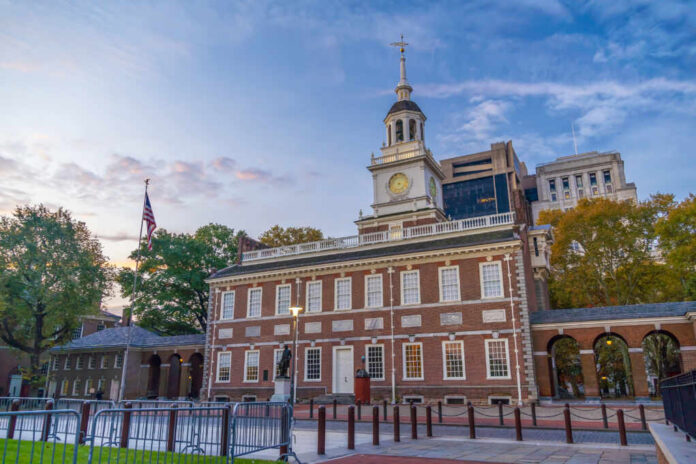
A federal judge just blocked the Trump administration from unilaterally scrubbing a politically sensitive piece of American history from a major national park site in Philadelphia.
Story Snapshot
- U.S. District Judge Cynthia Rufe ordered the National Park Service to restore the “Freedom and Slavery in the Making of the Nation” exhibit at the President’s House site in Philadelphia.
- The exhibit includes plaques telling the stories of nine enslaved people held by George Washington while the city served as the nation’s capital.
- The dispute stems from a March 2025 executive order directing agencies to remove content judged to “inappropriately disparage” Americans, part of a broader federal review of historical interpretation.
- The City of Philadelphia sued after the exhibit was dismantled on January 22, 2026; the judge’s order restores the status quo while litigation continues.
What the judge ordered—and why it matters
U.S. District Judge Cynthia Rufe ordered the Trump administration to restore slavery-related exhibits removed from the President’s House Site at Independence National Historical Park in Philadelphia. The order, issued while the lawsuit continues, focuses on whether federal officials had authority to dismantle the display without required consultation. Rufe’s decision also drew attention for referencing Orwell’s “1984,” underscoring the court’s concern that the government cannot treat public history as a switch to be flipped whenever politics change.
The decision matters beyond Philadelphia because it tests a basic constitutional principle conservatives usually defend: separation of powers and limits on executive authority. When Congress sets rules for how a federal site must be managed, an administration cannot simply override those guardrails through internal directives or messaging priorities. Even Americans who want patriotic museum storytelling should pause at the precedent of federal agencies removing law-governed content first and sorting out legal authority later.
The exhibit at the center of the fight
The President’s House Site commemorates the residence where George Washington and John Adams lived when Philadelphia served as the nation’s capital. For more than two decades, the “Freedom and Slavery in the Making of the Nation” exhibit has presented the stories of nine enslaved people owned by Washington at the residence, placing America’s founding ideals alongside the contradictions of the era. The display is not an academic sidebar; it is integrated into a high-traffic historic location tied to the nation’s early leadership.
National Park Service employees dismantled the exhibit on January 22, 2026, removing plaques detailing those nine lives. The City of Philadelphia filed suit soon after, arguing that the federal government violated legal and contractual obligations governing changes at the site. Judge Rufe ordered restoration but did not set a firm compliance deadline, leaving the practical timetable uncertain while the case proceeds and while observers anticipate an appeal by the administration.
The policy backdrop: an executive order and a wider federal review
The exhibit’s removal traces back to a March 2025 executive order directing the Interior Secretary to remove content from federal historical sites that “inappropriately disparage Americans past or living,” language the administration tied to concerns about “corrosive ideology.” Independence National Historical Park was explicitly cited as a target for review. The administration framed the effort as protecting Americans from politicized narratives, especially ahead of the country’s 250th anniversary celebrations in July 2026.
That broader initiative extended beyond Philadelphia. Reporting described the American Battle Monuments Commission removing a cemetery display in the Netherlands that addressed discrimination faced by African American WWII soldiers, and the White House launching a review of Smithsonian museums and exhibits to eliminate what officials described as “anti-American propaganda.” Those moves reveal the core tension: how to promote civic pride without letting any administration—Republican or Democrat—turn federal cultural institutions into tools for top-down narrative enforcement.
Politics aside, the court’s reasoning signals a legal constraint
Judge Rufe’s ruling emphasized that Congress limited the Interior Department’s ability to “unilaterally alter or control” the park site and required consultation with Philadelphia before changes. That legal point is why the case resonates with constitutional conservatives: it is less about whether a particular exhibit is flattering or uncomfortable and more about who holds decision-making authority under the law. A judge appointed by President George W. Bush ruling against a Republican administration also reinforces that the dispute is not easily dismissed as partisan reflex.
Public reactions followed familiar political lines. Philadelphia officials and Democratic leaders described the exhibit removal as “whitewashing,” while advocates for restoring the display argued the government was trying to erase inconvenient facts. At the same time, the administration’s stated goal—presenting a positive view of American history—reflects an understandable frustration with activist-driven reinterpretations that can slide into anti-American messaging. The unresolved challenge is building institutions that tell the full truth without becoming ideological battlegrounds.
Sources:
Trump administration must restore slavery exhibit at Philly’s President’s House, federal judge rules
Citing Orwell’s “1984,” judge orders Trump administration to return slavery exhibits removed from Philadelphia museum
Gov. Shapiro legal action Trump admin Independence National Histo
Trump administration ordered restore George Washington slavery exhibit Philadelphia
Statement on the Freedom and Slavery Exhibit Removal at Independence National Historical Park