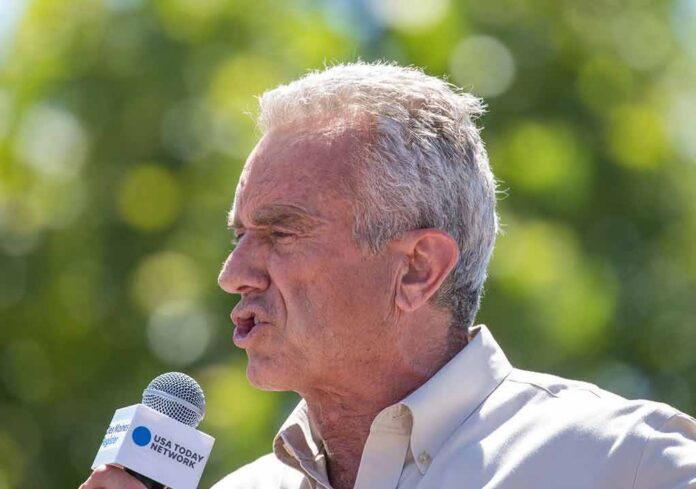
Faith talk in American politics isn’t an anomaly or a dog whistle; it’s a durable register candidates use to define moral stakes, signal identity, and set expectations for public life—and that is exactly how Vice President JD Vance used it in his Dallas keynote, where he framed prayer and family as part of the national character he wants to normalize in public again.
At a Glance
- Vance delivered the keynote address at the Republican midterm convention in Dallas, a formal stage for defining message and priorities.
- His remarks leaned into overtly faith-centered themes—gratitude, family, Christian identity—alongside policy contrasts and accomplishments.
- The headline line about not “rolling its eyes at people who pray” captures a broader appeal: restore social permission for public faith expression.
- Religious language has been a consistent feature of U.S. political rhetoric; Republicans have intensified its use since the 1980s, aiming to connect values with policy.
The Dallas Keynote: A formal platform for values and policy
Keynotes are where parties state first principles. In Dallas, Vance used his slot to marry a moral register—gratitude, family duty, and explicit Christian identity—to a contrastive political case about direction and results. Network and local coverage identified him as the convention’s keynote voice, underscoring the institutional weight of the moment. In on-air summaries and contemporaneous descriptions, Vance asked listeners for discernment rather than blanket agreement, arguing for evaluating “the contrast with the radicals” and “the achievements of the last 18 months” as a practical test of stewardship. That framing matters: it positions faith talk not as ornament, but as a lens through which to judge governance.
The throughline of the address—gratitude, family, Christian civic inheritance—tracks with transcripted excerpts and full-speech broadcasts from the event block, which described a speech that put identity and duty on the same plane as programmatic claims. Importantly, this was not a campaign rally quip captured on a rope line; it was staged party communication in which leaders curate exactly what they want remembered.
What the “don’t roll your eyes at people who pray” appeal is doing rhetorically
That single sentence compresses a broader proposition: public Christianity should be socially legible and civically permissible, not confined to the private sphere or treated as kitsch. In practice, such language serves multiple functions. It reassures religious voters their lived piety belongs in shared spaces—schools, town councils, civic ceremonies—without apology. It also draws a boundary against cultural elites presumed to stigmatize public prayer as performative or backward. The phrase is less a policy plank than a cultural permission structure: it tells adherents they can bring comprehensive moral vocabulary into arenas where technocratic speech has long dominated.
In modern Republican rhetoric, that move isn’t new; it is the continuation of a forty-year trend in which explicit religious signals—God references, prayer normalization, biblical allusions—have grown more frequent, particularly on the right, as politicians seek to fuse identity and agenda. Scholars have cataloged this trajectory across presidential campaigns and party communications since the Reagan era, emphasizing both its endurance and its strategic calibration to audience religiosity.
How religious language functions in U.S. political speech
Religious tropes in American politics aren’t merely ornamental; they are meaning-making devices. They locate policy in a moral cosmology, translate abstract tradeoffs into questions of duty and virtue, and tie personal narrative to public obligation. Research tracing presidential and campaign rhetoric from the mid-20th century forward shows persistent use of faith cues as identity bridges—sometimes as American civil religion (the shared language of providence and national purpose), sometimes as explicit doctrinal signaling to specific constituencies. The frequency and partisan coloration have shifted over time, with Republicans leaning into confessional markers more heavily since the 1980s while Democrats have tended to emphasize inclusive civil religious formulations or social-justice-inflected faith expressions.
That’s the ecosystem in which Vance’s Dallas message sits. When he thanks the faithful, centers family, and affirms a Christian inheritance, he is drawing from a long lineage of conservative rhetoric that offers moral clarity and community belonging as the predicate for law, education, and cultural norms. This is not conceptually exotic; it is the mainstream of right-of-center message architecture in the United States.
The setting and the stakes: why a keynote matters more than a clip
Venue disciplines rhetoric. A midterm convention keynote is written to travel—on cable, in local newscasts, and across social video. Coverage placed Vance’s remarks inside a program anchored by President Trump and designed to showcase governing achievements and a forward-looking platform; that raises the evidentiary weight of the values he chose to spotlight. ABC’s description of his appeal—assess contrasts, not demand litmus-test agreement—illustrates a classic keynote aim: unify a coalition around core commitments and a shared target, even when intramural differences persist.
The line that animated social media activity—about a country that doesn’t roll its eyes at prayer—lands because it is both culturally specific and unthreateningly universal to its intended audience: it implies no establishment of religion, only social respect for public devotion. In a media environment where short-form video often tears quotes from context, the keynote scaffold gives the fuller intent: this was a character claim about the kind of civic culture Republicans say they want to build, not a granular policy instruction.
Mechanism to message: how faith talk connects to governing claims
Faith-inflected appeals are not self-contained; they nest within policy narratives. In Dallas, Vance’s moral frame paired with contrasts on immigration, public order, and achievements under the administration’s first 18 months—an invitation to read those outcomes as the fruit of a certain moral and cultural posture. That pairing follows a common conservative sequence: assert a normative vision (family stability, religious liberty, social order), then argue that laws and executive priorities aligned with that vision produce tangible benefits. Historically, such sequencing isn’t random; it’s how coalitions with strong religious constituencies integrate moral intuition with policy justification.
Whether a listener embraces the theological premises is almost beside the point; the rhetorical structure is about causation and consequence. If a polity honors prayer and treats faith as a public good, the argument goes, then it reinforces the civic virtues necessary for self-government—gratitude, temperance, obligation—whose absence, conservatives contend, degrades institutions and outcomes. That is the logic animating Vance’s appeal.
"I want our children to grow up in a country that doesn't roll its eyes at people who pray."
Vice President JD Vance opens up about his faith, his hopes and dreams for his children and the future he wants for the country during his keynote address at the RNC Midterm Convention…
— Rightwingmadman (@Rightwingmadman) September 11, 2026
Why it resonates—and why it divides
Appeals like Vance’s resonate with voters who experience modern institutions—from schools to HR policies—as either indifferent or hostile to traditional religious expression. For them, hearing a vice president say prayer belongs in the open is not symbolism; it’s an affirmation of social dignity. At the same time, the same language can alarm critics who hear in it a latent preference for a confessional public square, fearing that normalization of public piety will slide into privileging a particular faith tradition over others. Those are real, long-running disagreements about the boundary between civil religion and confessional politics; they predate our current cycle by generations and recur because they involve identity as much as law.
Bottom line
The Dallas keynote did what party keynotes are designed to do: yoke identity to agenda. Vance put a clear stake in the ground—public faith is not a punchline—and used that moral footing to bolster a claims-based case for the administration’s direction and record. In the American tradition of political speech, that combination is neither new nor peripheral; it is how coalitions articulate who they are and what they intend to build next.
Sources:
facebook.com, youtube.com, transcripts.cnn.com, rev.com, nytimes.com, abc7ny.com, podcasts.happyscribe.com, fox7austin.com, wsj.com