

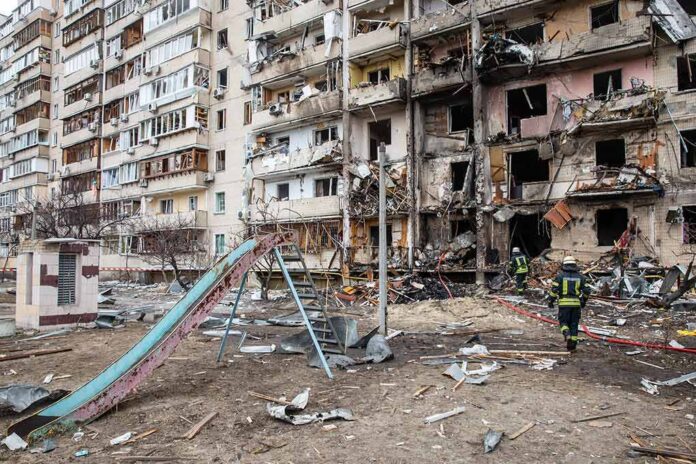
Overnight Russian missile and drone strikes set buildings ablaze across Ukraine, forcing firefighters to battle large urban fires and pulling survivors from the rubble.
Story Snapshot
- Russian salvos hit Kyiv and other regions, sparking fires and injuring civilians.
- Emergency crews fought major blazes at homes, warehouses, and shops.
- The air war’s pace and intensity have surged, with larger mixed salvos.
- Damage reports often change as authorities confirm casualties and cause.
What Happened Overnight
Ukrainian officials said Russia launched missiles and drones at Kyiv and nearby areas overnight, injuring at least 19 people and damaging multiple buildings. Firefighters worked through the night to contain fires started by falling debris and direct hits. In several districts, emergency crews evacuated residents from burning apartments and shops. Local authorities reported collapsed structures and scattered power outages. Air raid alerts sounded for hours as waves of drones and missiles forced people into shelters across the capital region.
Reuters reported that earlier strikes on Kyiv this month caused fires in several city districts, underscoring how blast waves and debris often ignite secondary blazes in dense neighborhoods. Photos from recent attacks show emergency workers hosing flames on blackened facades and clearing charred rubble. Fire damage extended beyond impact sites, with smoke and heat harming nearby homes and vehicles. Officials said rescue teams pulled survivors from collapsed sections while medics treated burn injuries and smoke inhalation at the scene.
Damage Beyond Kyiv
Associated Press reporting over recent weeks describes similar patterns in other cities. In Odesa, emergency services put out fires at warehouse stores and a residential building after air attacks, highlighting the risk to crowded markets and older housing blocks. In several Kyiv suburbs, strikes damaged warehouses and private homes across multiple locations, stretching fire crews and rescue teams. Officials said responders faced blocked streets, downed lines, and the constant threat of renewed strikes while trying to reach trapped residents.
Large structure fires have followed some of the deadliest attacks. After a warehouse strike west of Kyiv, authorities said explosions and flames tore through nearby homes and buildings, with the death toll later rising to 38 as recovery continued. Investigators linked the spread of fire to stored munitions that detonated, amplifying the blast and heat. The event showed how one strike can trigger chain reactions in mixed-use areas where industry, storage, and housing sit close together.
Why The Fires Keep Spreading
Analysts say Russia’s campaign relies on large, mixed salvos meant to overwhelm defenses and produce wide damage. The Center for Strategic and International Studies described a “new salvo war,” where average wave sizes have grown and intervals between major strikes have shortened, increasing pressure on responders and infrastructure. When debris rains across many blocks at once, local fire units get split among multiple calls, allowing small blazes to grow. That delay turns containable fires into larger urban incidents.
Counting casualties and mapping exact damage takes time in this environment. The Armed Conflict Location and Event Data Project notes that early tallies and fire reports can shift as access improves and search teams move through wreckage. Officials often confirm injuries first, then update fatalities as crews reach sealed rooms or basements. For residents, that means information arrives in fragments—first smoke and sirens, then neighborhood reports, and finally official counts after daylight searches finish.
What This Means For Civilians
Repeated strikes are grinding down housing, storage sites, and small businesses that anchor local life. Apartment fires displace families who cannot easily relocate or rebuild. Warehouse and market fires destroy goods and jobs overnight. Each new salvo also consumes scarce emergency resources. Crews must juggle rescue calls, fire suppression, and utility repairs while sirens keep returning. The cycle leaves communities in a constant state of risk and recovery, with little chance to get ahead of the damage.
Russian Drone Strikes Damage Homes and Civilian Infrastructure in Ukraine
On the night of September 26, Russia carried out another large-scale attack on Ukraine using strike drones, damaging civilian facilities and affecting civilians. In Kyiv, residential and non-residential… pic.twitter.com/co1TOz30aa
— newsreporter (@NewsReporterrr) September 26, 2026
For Americans watching from afar, the images of firefighters battling flames in the dark cut through the political noise. People on the left and right know that when basic safety breaks down, regular families pay the price first. The reports from Kyiv and other cities show how modern air wars reach deep into daily life. Until the pace of strikes slows, residents will face the same hard choices each night—hide, help a neighbor, and hope the fire skips their street.
Sources:
youtube.com, apnews.com, reuters.com, re-russia.net, cnn.com