

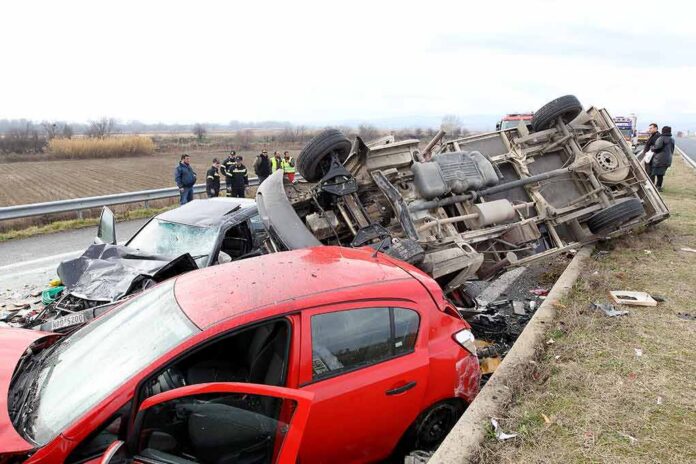
A New Mexico jury’s $47 million verdict for a badly injured National Guard veteran shows how one foggy-night crash can rewrite a family’s life and a company’s balance sheet.
Story Highlights
- A Rio Arriba County jury awarded $47 million to Austin Drewry after a 2022 tanker crash.
- Reports say the tanker was moving too fast for fog and failed to react in time.
- The driver was dismissed as a party; the case proceeded against two companies.
- The verdict reflects rising exposure for trucking firms in severe-injury cases.
Jury Verdict In High-Stakes Truck Crash Case
A Rio Arriba County jury in New Mexico found for plaintiff Austin Drewry and awarded $47 million after trial. The case stemmed from a head-on collision on Highway 128 near Carlsbad in November 2022 that left Drewry with major brain and spinal injuries, paralysis, and the need for constant care. The reported caption was Austin Drewry Jackson et al. v. Marcos Alejandro Romero et al., in the First Judicial District Court of New Mexico, and coverage identified the verdict as among the state’s larger truck-crash awards.
Reporting describes a simple but deadly setup: heavy fog, a tanker truck, and seconds to react. The plaintiff’s team argued the driver traveled too fast for the conditions, failed to recognize the oncoming vehicle, and did not brake or take evasive action soon enough. One report cites a deposition where the driver was over the posted 55 mile-per-hour limit and had prior discipline for speeding, which the plaintiff said pointed to preventable risk. Defense trial details were not included in the available reports.
Who Was Sued And Why That Matters
The suit proceeded against Pilot Thomas Logistics and Maxum Petroleum Operating Company, even though the individual driver was dismissed as a party by the judge before trial, according to coverage. That posture put the focus on company responsibility for on-road conduct and safety systems. Under common legal principles, a company may face liability for acts by an employee within the scope of work, and plaintiffs can also claim negligent hiring, training, or supervision where evidence supports it. The reports do not show the precise findings the jury made on each theory.
Pretrial settlement dynamics can shape public reaction to a big verdict. One outlet reported the companies offered $100,000 before trial, which the plaintiffs rejected. Without the full terms, it is unclear how insurers or the defense valued the risk. But the $47 million outcome underscores how catastrophic-injury cases can leap far above early offers when a jury finds fault and long-term care is required. This gap feeds a broader belief that large institutions protect their own until a jury forces accountability.
Fog, Speed, And The Broader Safety Picture
Federal trucking data show fog is recorded in a small share of crashes each year, but speed and loss of control are frequent factors in serious wrecks. A Federal Motor Carrier Safety Administration report to Congress found loss of control, often linked to traveling too fast, coded in about 29 percent of trucks studied in a causation sample. Another federal table shows “vision obscured” conditions are present in a minority of fatal-truck cases, while speeding appears in a meaningful share.
Weather rules are simple in practice: slow down when you cannot see. Plaintiffs say the tanker failed that test. Defense experts in similar cases often point to sudden hazards, limited sight distance, or actions by the other driver. The reporting here does not include the full reconstruction record, verdict form, or jury instructions. Even so, the bottom line is set: a New Mexico jury weighed the evidence and decided the companies must pay for lifelong care and losses tied to the crash.
Why This Case Resonates Beyond One Highway
This verdict lands in a trucking industry already facing “nuclear verdicts,” a term used for jury awards above $10 million. Industry observers report rising median awards driven by claims that reach beyond the crash into company safety culture and oversight. For families, these sums represent medical care, equipment, lost income, and home changes that can last decades. For companies, they pressure training, monitoring, and route management, especially in low-visibility conditions.
Austin Drewry has been bedridden since he was involved in a collision with a commercial tanker truck in November 2022. https://t.co/niJkXXEVbU
— Military.com (@Militarydotcom) October 14, 2026
For many Americans, this case taps a deeper worry: powerful players often escape consequences until a jury intervenes. People on the right see companies cutting corners while regulators miss basics. People on the left see injured workers and veterans fighting years for help. When a foggy night collides with a busy delivery schedule, the stakes are human, not political. A jury’s message here was clear: slow down, plan for hazards, and protect life first.
Sources:
military.com, dailymail.com, hoodline.com, newsbreak.com, govinfo.gov, carriersource.io, truckingrecord.com, web.ntsb.gov, fmcsa.dot.gov