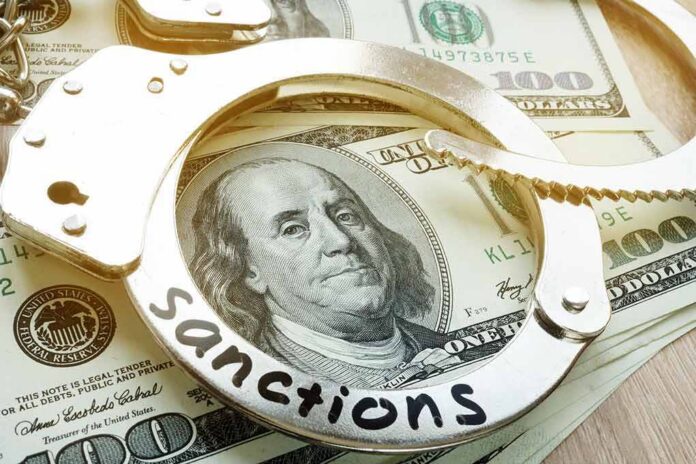
The United States sanctioned Rwanda’s defense ministry and a military bank for aiding the M23 rebel group in Congo, escalating a sanctions campaign that now targets the Rwandan state itself.
Story Highlights
- Treasury named Rwanda’s defense ministry and Zigama bank for supporting M23.
- Earlier actions hit the Rwanda Defence Force and M23-linked figures.
- U.S. says conflict minerals and finance networks fuel the war.
- United Nations reporting has flagged Rwandan military activity in Congo.
What Treasury Announced And Why It Matters
The U.S. Department of the Treasury said its sanctions target the Rwandan Ministry of Defence and Zigama Credit and Savings Society. Treasury said Zigama helped move money tied to support for the March 23 Movement, a U.S.- and United Nations-sanctioned rebel group in eastern Democratic Republic of the Congo. The action blocks property in the United States and bars most transactions with the named entities. Treasury framed the move as pressure to stop outside backing for M23.
The action builds on a March 2026 decision that designated the Rwanda Defence Force and several officers. Treasury then said the Rwanda Defence Force was supporting, training, and fighting alongside M23 in Congo. That step widened U.S. targeting from rebel leaders to a national military. Today’s listing of a ministry and a military bank deepens that shift toward state-level pressure on Rwanda’s security and finance arms.
Links To Minerals, Money, And Supply Chains
Treasury tied the support system around M23 to conflict minerals and cross-border finance. In 2025 and 2026, the department and other U.S. agencies noted that illicit gold and other minerals from eastern Congo help fund armed groups. A 2026 Treasury action singled out a Rwandan gold refinery network for enabling this trade. U.S. officials argue that cutting these routes can deny M23 steady cash and shrink the war economy that harms global supply chains.
Independent reporting has long flagged the role of smuggling and middlemen. U.S. Government Accountability Office reviews found that gold, tin, tungsten, and tantalum continue to bankroll violence despite past rules. Experts told the Government Accountability Office that security, ethnic ties, and profits keep the conflict going. These findings match Treasury’s claim that sanctions must hit both guns and the money that sustains them.
United Nations Findings And The Battlefield Picture
United Nations documents have raised alarms about Rwandan forces operating in Congo. A 2025 Security Council text cited concerns over advanced weapons, drones, and electronic interference linked to Rwanda Defence Forces, described by United Nations experts as violating an arms embargo. United Nations briefings also noted reporting that Rwanda exerted control over M23 operations. These details underline why Washington pairs names, networks, and battlefield conduct in its actions.
RWANDA FACES LATEST ROUND OF CONTINUED ONE-SIDED US SANCTIONS
On 28 October 2026 the U.S. Treasury’s OFAC sanctioned Rwanda’s Ministry of Defence and Zigama Credit and Savings Society, the latest in a series of one-sided measures targeting Kigali over alleged M23 support. pic.twitter.com/dDsubaqDj0
— NISHIMWE Frodouard (@NISHIMWEFR250) October 28, 2026
Rwanda rejects treating the Rwanda Defence Force and M23 as one actor and denies abuses tied to the force. Kigali has responded to past reports by disputing the claims and calling for independent probes. Treasury’s move does not resolve those disputes. It does set clear costs in dollars and access for any Rwandan state body the United States links to M23. That raises the stakes for banks, suppliers, and shippers that might touch the same channels.
What Changes Next For Policy And Markets
Sanctions on a defense ministry and a military bank reach deeper than naming rebel leaders. U.S. regulators can now deter third-country firms from dealing with listed entities. Companies that buy gold or other inputs with ties to eastern Congo face higher due diligence demands. For Americans across the political spectrum who see a global system that rewards insiders, this step shows Washington using financial tools to hit a war economy that exploits people and weakens trust in fair trade.
How This Fits The Bigger Pattern
Great Lakes conflicts often blend border security, proxy warfare, and resource extraction. The United States and the United Nations have, over many years, linked state actors, armed groups, and mineral routes in this region. Today’s listings follow that logic: press the state backers, squeeze the finance, and expose the trade that fuels violence. Whether this reduces fighting depends on enforcement and on regional talks that can lock in real security on the ground.
Sources:
insiderpaper.com, home.treasury.gov, state.gov, un.org, transcripts.un.org, yahoo.com, nampa.org, minaffet.gov.rw