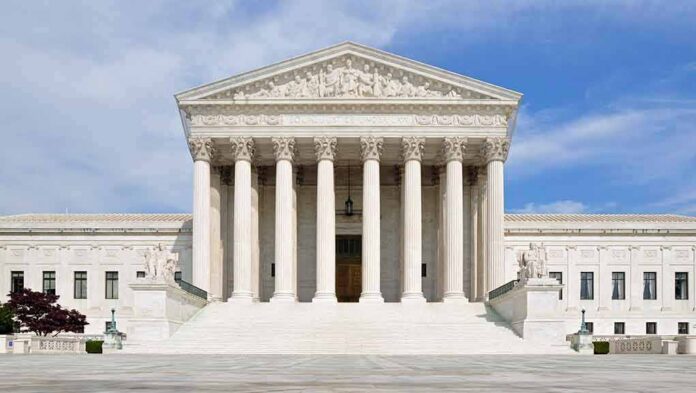
The Supreme Court will decide whether the government can hold long‑time U.S. residents without bond while it speeds removals, a ruling that could reshape due process for tens of thousands.
Story Snapshot
- The Court took a case testing if detainees can use habeas to challenge no-bond detention during removal cases.
- A key appeals court said these interior arrests fall under a statute that allows bond hearings, not mandatory lockup.
- The administration argues “applicants for admission” may be held without bond to enforce immigration law.
- Advocates say many courts have rejected mass no-bond detention, creating a clear split for the Court to resolve.
What The Supreme Court Agreed To Review
The Supreme Court received a petition in Trump v. Badar Khan Suri asking whether, despite a jurisdiction rule in immigration law, a person in removal can use habeas corpus to challenge detention when those claims overlap with removability issues. The case comes after a wave of challenges to the administration’s no-bond approach for certain arrestees. Reuters reported the government sought high court review to allow detention without bond chances for people arrested in the interior, even after years in the country.
The Suri dispute is narrow but important. It focuses on when and where federal courts can hear detention claims while removal cases unfold. The government says a specific statute channels review and blocks early habeas challenges. Opponents say the Constitution allows courts to hear claims about unlawful detention. The petition highlights how the label placed on a person—“applicant for admission” versus “already here”—can decide access to bond hearings and federal court review.
The Core Statutory Fight Over Bond
The Fourth Circuit’s published decision in Lopez Garcia v. Guadian said the government used the wrong statute. The court held that section 1226, not section 1225(b), governs detention for noncitizens arrested inside the United States after long presence, which means they must have a chance to seek bond from a neutral judge. The docket shows the appeals court expedited the case and set it for argument, signaling the issue’s weight and urgency for enforcement and rights alike.
The administration’s briefs urged a different reading. Government lawyers argued that all “applicants for admission” may be detained without bond under section 1225(b). They said this approach ensures appearance at hearings and supports removal operations for those not formally admitted at the border or a port of entry. Reuters reported the government asked the Supreme Court to endorse this approach after other courts pushed back, underscoring the national stakes and the live split among circuits.
Due Process Concerns From The Lower Courts
Across recent cases, judges have warned that prolonged detention without a chance for bond strains basic due process. The Fourth Circuit’s Lopez Garcia ruling emphasized that long‑present people arrested in the interior could not be locked up automatically without the opportunity to argue for release. Advocacy groups say multiple appeals courts and many trial judges have rejected the mass no‑bond theory, amplifying the concern that the policy sweeps in people with deep community ties and clean records.
The Suri matter adds a civil liberties layer. According to case summaries, Suri challenged his arrest and detention, and the appeals court affirmed a lower court order requiring his release on bail while his case moved forward. That record shows how courts can separate detention issues from the merits of removal, at least in some circuits, and how habeas review can secure interim relief when detention appears unlawful. The Supreme Court now faces whether such review fits within Congress’s limits.
Why This Case Matters Beyond Immigration Courts
This fight taps into a larger worry shared across the political spectrum: rules that change how government holds people should be clear, lawful, and accountable. Conservatives see a border and interior system that has failed for decades. Liberals see a detention network that can punish before a fair hearing. Both sides fear a federal system that moves people through complex processes with little transparency or recourse. The Supreme Court’s ruling will test those fears against Congress’s text and constitutional guardrails.
The Supreme Court agreed Thursday to take up a high-stakes immigration detention fight that could determine whether some immigrants arrested far from the border can be held for months, or longer, without ever getting a bond hearing.https://t.co/C3F2fYbLAu
— WSBT 22 (@WSBT) October 1, 2026
For families, employers, and local communities, the labels at issue are not abstract. A no-bond regime can mean months behind bars while cases crawl forward. A bond-hearing regime can mean release with conditions that protect public safety and ensure court appearances. The administration argues mandatory detention is vital to stop flight and maintain order. Opponents say individual bond hearings work and respect due process. The Court will now set the line between those competing claims.
Sources:
sfgate.com, courthousenews.com, courtlistener.com, ca4.uscourts.gov, supremecourt.report, immigrantjustice.org