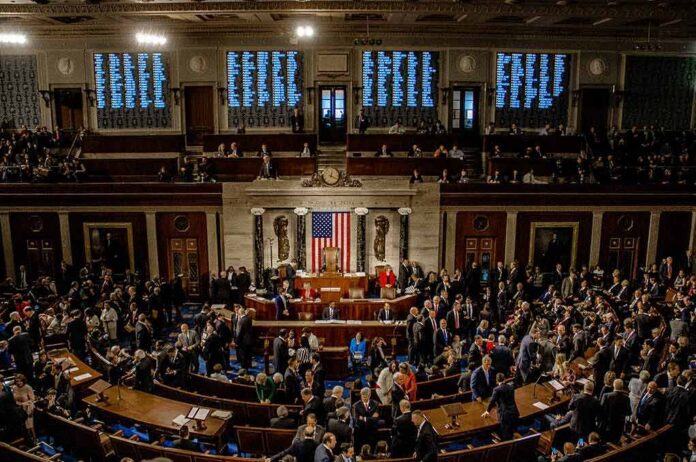
After a string of Capitol Hill scandals, Congress is now debating whether lawmakers should be banned from dating any staffer at all — raising fresh questions about power, privacy, and how far a failing political class should go in policing itself.
Story Snapshot
- House leaders in both parties are backing a new rule to bar members of Congress from romantic or sexual relationships with any congressional staffer, not just their own employees.
- Supporters say the ban is needed to prevent abuse in a workplace built on power imbalance and to rebuild public trust after repeated misconduct scandals involving elected officials.
- Critics note that House rules already forbid relationships with directly supervised staff, and warn a blanket ban may be more about image control than fixing deeper ethics failures.
- The debate taps into wider anger on the left and right that Washington’s “elite” writes strict rules for others while often dodging real accountability itself.
What Lawmakers Are Proposing Now
House leaders are pushing to expand ethics rules so that no member of Congress can have a romantic or sexual relationship with any congressional staffer, even if that staffer does not work for them or serve on their committee. Under current rules, the House Code of Official Conduct already bans members from such relationships with employees they directly supervise, with an exception for marriages. The new plan would erase that line and treat all staff relationships as off limits, closing what supporters call a dangerous loophole.
Speaker Mike Johnson has said he backs a full ban and called member–staff relationships “inappropriate” in any workplace, comparing Congress to corporate standards. Republican Conference Chair Lisa McClain and other House Republicans have also voiced support, helping give the idea momentum inside the majority party. On the Democratic side, leaders of the Democratic Women’s Caucus have welcomed Johnson’s stance and urged that the broader ban be folded into a larger package of sexual harassment reforms.
Why Supporters Say A Blanket Ban Is Needed
Supporters argue that any relationship between a lawmaker and a staffer carries a built-in power imbalance that can easily slide into coercion, favoritism, or retaliation, even when it looks “consensual” on paper. Staffers often depend on members for jobs, references, and future careers, which makes it hard to say no and harder still to complain if things go wrong. Backers also say the change is needed to repair public trust after repeated headlines about misconduct on Capitol Hill, where punishments often appear slow or light.
The push follows earlier steps after the #MeToo movement, when the House first banned relationships with directly supervised staff in 2018. Recent reporting about a senator’s relationships with staffers outside his direct supervision has renewed pressure to go further and shut down gray areas that are not clearly covered by current rules. More than 1,500 congressional staffers reportedly called for stronger protections, adding workplace pressure to the media spotlight and making it harder for leaders to ignore the issue.
Concerns About Overreach, Privacy, And Real Accountability
Critics of the new idea point out that Congress already bans relationships where the member has direct supervisory power, and say this rule was meant to target the clearest risk of abuse. Expanding that ban to all staffers — including those in other offices or even different parties — raises questions about personal privacy and whether the government as employer should control relationships that are not tied to actual misconduct. Some legal analysts warn about overbreadth but note that courts often give government workplaces wide room to set rules if they claim safety or integrity goals.
House Speaker Johnson backs ban on lawmakers dating any staffers:
Panel reacts.@jacob_wass@AlexThomp@mikedubke@meghan_hays9#DC #politics #dating #Work #metoo pic.twitter.com/39IaUqwht3— audie cornish (@AudieCornish) July 23, 2026
Many Americans across the political spectrum see another problem: Congress keeps writing new codes of conduct but rarely cleans up deeper corruption, from insider stock trading to special treatment for donors. People who already believe the “deep state” protects its own may view this dating ban as another surface fix that lets leaders say they are tough on ethics while lobbyist influence, wasteful spending, and self-dealing continue with little change. That growing frustration makes any new rule face a trust gap from the start.
How This Fits A Bigger Pattern Of Distrust
The fight over dating staffers is part of a wider pattern where Congress responds to scandal with narrow rules instead of broad reform. After each wave of misconduct stories, lawmakers tend to pass focused bans — on staff relationships, on some forms of harassment — rather than tackle the culture that lets powerful people dodge consequences. The risk is that, to many voters, these moves look more like public relations than real change, especially when serious abuses drag on for years before anyone is punished.
Both conservatives and liberals over 40 share a growing sense that Washington’s leaders care more about their own careers than about fixing the hard problems that block the American Dream. Many on the right resent years of “woke” rules and top-down mandates, and many on the left resent economic policies that widen the gap between rich and poor. In that climate, a rule telling lawmakers they cannot date staff may sound like common sense workplace policy — but it will not, on its own, convince a skeptical country that Congress is finally serious about cleaning up its own house.
Sources:
townhall.com, politico.com, usatoday.com, washingtondigest.com, congress.gov, foxnews.com