

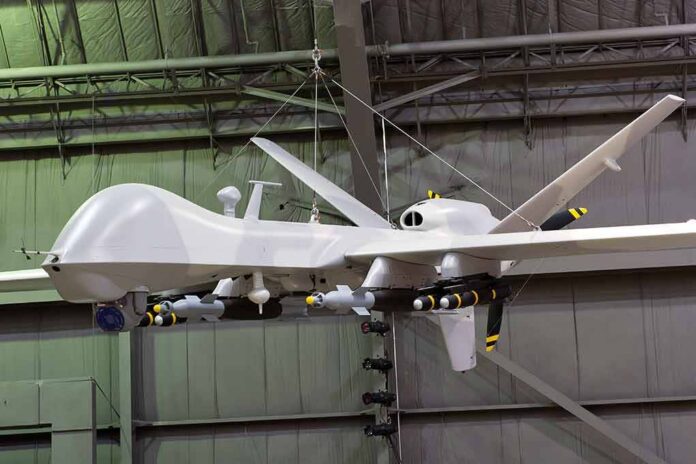
Anti-war protesters cut into a Pentagon-backed drone push by confronting Defense Secretary Pete Hegseth on stage, exposing the nation’s split over speed, secrecy, and the march to high-tech war.
Story Highlights
- Protesters interrupted Hegseth during a panel tied to a drone expansion drive.
- Pentagon policy aims to scale U.S.-made low-cost drones under Trump’s direction.
- Hegseth cites autonomous sea drone missions near Iran and Oman this summer.
- The plan sets large output targets and fixed-price buys to speed delivery.
What Sparked the Outburst at the Hegseth Panel
Anti-Iran war protesters interrupted a Pentagon panel featuring Defense Secretary Pete Hegseth, shouting that he was “not a warrior” but a “coward,” before security removed them. The disruption came as Hegseth champions a rapid buildout of low-cost, U.S.-made drones. The clash underscored a wider public concern: whether Washington is racing toward conflict while keeping citizens in the dark. Advocacy groups have warned that strikes and threats toward Iran risk a wider war.
Hegseth has framed the effort as urgent and practical. He points to new tactics, cheaper systems, and faster fielding as the path to protect U.S. forces and restore deterrence. That message is resonating inside government, where leaders say today’s battlefields reward small, smart, and expendable systems. The disagreement on stage, however, showed how even a technical policy can inflame fears that elites profit while regular people pay the price.
Inside the Pentagon’s Drone Expansion Plan
The Department of Defense says it will increase production of low-cost drones and parts in the United States, arm units with large numbers of small systems, and expand realistic training. Officials tie the plan to Hegseth’s July 2025 directive and a June 2025 executive order by President Trump, both aimed at speeding acquisition and boosting the domestic industrial base. The policy stresses cost, resilience, range, and firepower as the keys to battlefield edge.
The push comes with specific buying tools. A reported program aims to place about one billion dollars in fixed-price orders over four years, seeking multiple firms that can scale production fast. Supporters say fixed prices will hold costs down and spread awards beyond traditional contractors. Critics across the spectrum worry that speed can sidestep careful testing and oversight. The stakes are high because big public targets can magnify any delays or shortfalls.
Claims of Real-World Missions Near Iran
Hegseth has highlighted a private firm’s autonomous sea drone as proof that new suppliers can deliver and fight fast. He says Saronic delivered more than 300 Corsair vessels in a year and that a Corsair rescued two U.S. Army aviators near Oman. He also says a Corsair later joined a strike on a submarine and ship-maintenance site at Iran’s Bandar Abbas, which he framed as the first U.S. combat use of a sea drone. These are headline-making claims.
Those claims bolster the case for speed, but they also heighten public anxiety. People on the right and left both fear secret wars run by a small circle far from voter control. They worry that officials tout numbers while hiding costs, failures, and rules of engagement. The Pentagon, for its part, stresses that American-made drones and new training will help troops survive and win without sending large formations into harm’s way.
Why This Debate Feels Bigger Than Drones
Many Americans believe Washington serves insiders first. They see defense surges as good for contractors but distant from family budgets, wages, and safety. The protest flashpoint fits that mood. The plan’s promise of fast, cheap mass carries risk if oversight lags or if missions expand without a clear strategy. Analysts note the department has launched programs to scale domestic small drones and field hundreds of thousands of systems by 2027.
Supporters call that scale necessary to keep up with enemies who use swarms, jammers, and cyber tools. They say drones can save lives and deter attacks at lower cost than big platforms. Opponents see a march toward endless conflict with Iran and beyond. Both sides agree on one thing: government must prove results. Clear data on costs, testing, readiness, and mission outcomes would help rebuild trust while showing whether this rush truly makes America safer.
Sources:
stripes.com, kvue.com, csis.org, defence-industry.eu, war.gov