

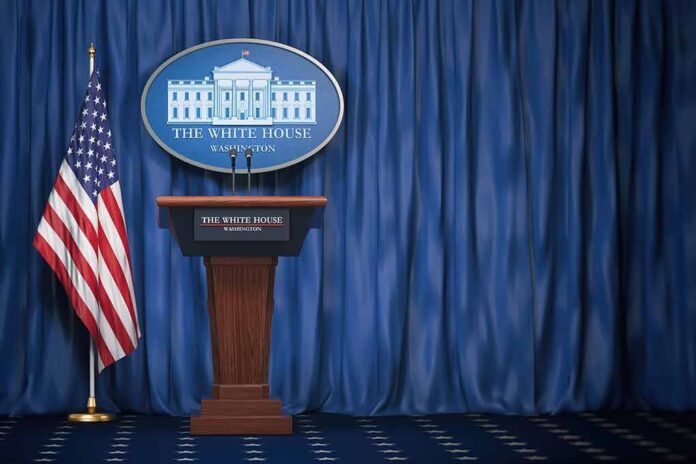
Presidents have always used the press secretary to project power as much as to provide information; President Trump’s public offer of the job to UFC chief Dana White made that logic explicit, turning the briefing room into a stage for combativeness and loyalty as political strategy.
At a Glance
- President Trump publicly offered UFC president and CEO Dana White the White House press secretary job in a Truth Social post.
- The post named a slate of UFC fighters Trump wanted as “assistants,” linking the team’s mission to partisan confrontation.
- Reporting describes the offer as public and personal; it did not come with a formal appointment announcement.
- CNN reported, citing a source familiar with the matter, that White declined the idea soon after the post.
What Trump Proposed, In His Own Words
Trump used his Truth Social account to declare that Dana White had been offered the job of White House press secretary, praising White as a “violent Fighter and Warrior” and asking him to “please take the job.” He paired the pitch with an unusual staffing request: bring a named group of UFC stars—Islam Makhachev, Khabib Nurmagomedov, Justin Gaethje, Daniel Cormier, Amanda Nunes, and Kayla Harrison—“even though some are not from our country,” to help “defend us against the Lunatic Left.” Multiple outlets reproduced the post and treated it as the authoritative source for the offer; contemporaneous accounts placed the president at his Florida club when he posted it.
The specificity is the point. By naming White and listing fighters, Trump made the press shop’s purpose—aggressive pushback, cultural signaling, and loyalty—overt. The press secretary is the administration’s public face, and in this framing, a sparring partner as much as a spokesperson. The rhetoric underscored that the role would be about combat as spectacle and message discipline, not just scheduling briefings or reciting policy.
Dana White, The Role, and What Actually Happened
White is a longtime Trump ally whose profile fits the president’s preference for figures who command media attention. Coverage identified him in his current capacity as UFC president and CEO, aligning the offer with Trump’s habit of elevating trusted loyalists and cultural figures to prominent communications slots. The available reporting establishes a public offer, not a consummated appointment; there was no immediate White House confirmation of a personnel move, and CNN, citing a source familiar with the matter, reported that White declined the idea.
This distinction matters less for what it says about paperwork than for what it shows about presidential communications in the modern era. The press secretary serves at the pleasure of the president and is not Senate-confirmed; presidents have chosen friends, campaign aides, journalists, and television figures for more than a half-century. The job has long since evolved from a background management post to a performative, daily encounter with a national and global audience.
How the Modern Press Secretary Works
The press secretary is the hinge between the presidency and the press corps—the front-of-house operator who translates presidential decisions into public narratives, arbitrates access, and absorbs incoming fire. Since the twentieth century’s professionalization of the White House press operation, the job has fused message discipline with crisis handling, requiring fluency in policy, law, and media dynamics. It is a political appointment, not statutory, and lives or dies on trust: with the president, with senior staff, and with a press corps that will press every inconsistency.
That hybrid—briefing-room performance plus backstage management—explains why presidents often reach into personal networks. Harry Truman turned to his friend Charlie Ross; Jimmy Carter brought Jody Powell from Georgia; more recently, administrations have favored campaign communicators or cable-tested personalities. In principle, a media-savvy sports executive could learn the rhythms. In practice, the work is grinding, unforgiving, and legalistic—less octagon than operating theater.
Why Choose a Fight Promoter for a Press Job?
Trump’s selection logic is legible. White is a proven promoter who understands how to sustain attention, frame conflict, and convert spectacle into audience. In political communication, those skills translate: define the adversary, create high-contrast narrative, reward allies with spotlight. Academic work on celebrity and politics underscores that name recognition and parasocial trust can amplify political messages, especially on social platforms where engagement is the coin of the realm. In that context, the list of UFC “assistants” functions as brand architecture—assigning the briefing room an unmistakable aesthetic of toughness and team loyalty.
But the press secretary is not solely a brand ambassador. The office manages embargoes, coordinates with agencies, vets statements for legal exposure, and navigates congressional oversight and national security sensitivities. Those demands reward institutional fluency as much as stagecraft. History shows outsiders can succeed when they combine presidential trust with a rapid acquisition of procedural mastery; it also shows the role chews up even experienced pros when the White House process is chaotic.
The Line Between Public Offer and Appointment
In the era of presidential social media, the line between signal and action can blur. A president can float personnel and policy in public to test reaction, fortify allies, or set the day’s narrative. Formally, however, an appointment becomes real when the White House integrates the hire into its structure—security clearances, ethics processes, reporting lines, payroll. None of that paperwork rides inside a social post. The coverage of the Dana White episode reflected that reality: a public offer from Trump, immediate attention, and then, according to CNN’s sourcing, a no from the would-be appointee.
The fighters named as prospective assistants sit even further from the realm of standard operating procedure. Some are not U.S. nationals, as Trump himself noted; the White House uses a mix of political appointees and career staff subject to federal employment and clearance rules. As political theater, the list worked; as staffing architecture, it raised obvious eligibility and role questions left unaddressed in the post.
• UFC President Dana White said he is flying to Washington to meet President Trump Monday regarding an offer of the White House Press Secretary role.
(2/2)
— Third Eye (@the_3rdeye) November 8, 2026
What This Episode Tells Us About Presidential Communications
First, that the press secretary has become a character in the presidency’s public narrative. Presidents now cast the role as an extension of their governing persona: combative or conciliatory, insider or disruptor. Trump’s overtly combative frame is not novel for him, but the clarity with which he mapped the briefing room onto a fight promotion was striking. Second, that celebrity capital remains a currency in politics. Research on celebrity endorsements and political messaging suggests that star power can increase attention and shape agenda salience, though its downstream effects on persuasion are mixed and context-dependent.
Finally, it shows the durability of institutional constraints. Rhetoric can accelerate attention; institutions absorb or deflect it. The White House press operation, built over nearly a century, still requires a professional apparatus beneath whatever face stands at the podium. Presidents can and do choose unconventional messengers. The system still demands they do the job.
Sources:
people.com, nytimes.com, edition.cnn.com, deadline.com, amp.dw.com, variety.com, wsfa.com, cambridge.org, sites.stat.columbia.edu