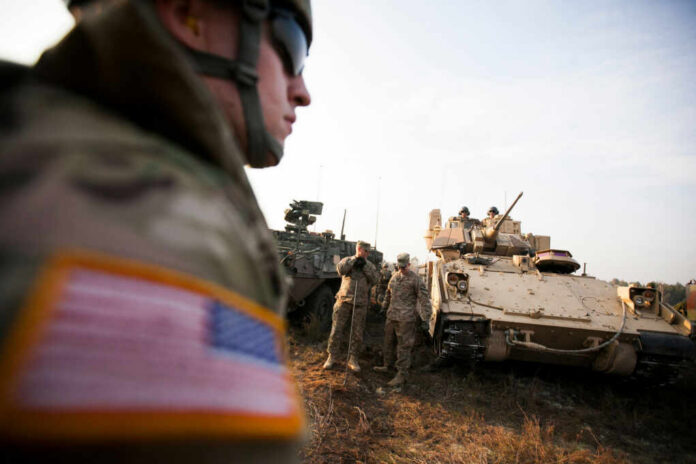
Allies cheered and critics griped as President Trump said 5,000 more U.S. troops will go to Poland—proof for many conservatives that America can support friends without bowing to Brussels’ bureaucratic second-guessing.
Story Snapshot
- Trump announced 5,000 additional troops for Poland after an earlier Poland rotation was canceled [1].
- The Pentagon said the United States retains a strong military presence in Poland, countering claims of NATO abandonment [1].
- Allies welcomed the move but pressed Washington for clearer coordination and details [3].
- Officials framed the shift as part of a Europe-wide redistribution, not a retreat [1][4].
What Trump Announced And Why It Matters To Conservatives
Trump publicly said the United States will send 5,000 additional troops to Poland, linking the decision to his support for Poland’s president and his relationship with him, as quoted by outlets from his Truth Social post [1]. That message followed a week after the Pentagon halted a 4,200-person Army brigade rotation to Poland, creating a headline-grabbing reversal [1]. For conservatives, the bottom line is straightforward: strengthen a faithful ally on NATO’s front line and signal deterrence without writing blank checks to indecisive European bureaucracies.
The Defense Department reinforced the core policy point even as reporters parsed the numbers. The Pentagon said the United States “retains a strong military presence in Poland,” which pushes back on narratives that Washington is stepping away from Europe [1]. Allies from Central and Eastern Europe publicly welcomed the announcement, with officials emphasizing it serves the United States’ own interests to keep forces in Europe where they contribute to deterrence and stability [3]. That reception underscores Poland’s role as a serious defense partner pulling its weight.
The Confusion: Additive Surge Or Force Swap?
Reporters and some European officials said they could not tell whether the 5,000 troops are truly in addition to existing deployments or a replacement for rotations elsewhere in Europe [1][3][5]. ABC News quoted officials noting that General Alexus Grynkewich said the 5,000 reduction would be “coming out of Europe,” implying a theater-wide force-management decision rather than a Poland-only surge [1]. That uncertainty is typical in posture changes announced before formal orders are publicly released, but it fuels criticism that communications moved faster than documentation.
NATO leaders simultaneously called the United States a strong ally while describing the messaging as confusing and urging clearer consultation [3][4]. This dual-track reaction—welcome the substance, question the rollout—captures the friction. It also highlights a dynamic conservatives know well: establishment critics seize on process complaints to overshadow the practical reality that more American capability forward, whether rotational or additive, improves deterrence and helps keep conflicts away from U.S. shores.
What We Know About The Broader Strategy And Poland’s Defense Link
Officials framed the changes as part of ongoing global force reviews to balance commitments and demands across theaters [4]. This aligns with a sovereignty-first posture: place American troops where they best serve American interests, and expect European partners to step up more for their own defense [4]. Coverage tied the troop story to Poland’s broader modernization, including recent arrivals of U.S.-made F-35 fighters under Poland’s multibillion-dollar procurement—evidence that Warsaw is investing seriously in capability, not just rhetoric [5].
That context matters for readers wary of endless commitments. A redistribution across Europe can still mean firmer defenses where they count most, and Poland has proven itself a reliable ally that spends, trains, and builds infrastructure to host forces responsibly. When the Pentagon says the United States maintains a strong presence in Poland, and allies welcome the reinforcement, the strategic signal to adversaries remains clear regardless of whether the package is labeled rotational or additive [1][3].
What’s Still Unclear—And How To Judge The Policy From Here
Key details remain unresolved in public: which specific units will deploy, exact timelines, and whether the 5,000 number nets an overall increase versus a Europe-to-Poland shift [1][3]. Reporting notes the lack of unit identifiers and formal documentation available to the public at this stage, a common gap between announcement and force-flow orders [1]. Until those orders surface, readers should evaluate two tested indicators: whether U.S. presence in Poland remains strong and whether allies closest to Russia welcome the move—both boxes are checked by current reporting [1][3].
TRUMP DEPLOYS 5,000 ADDITIONAL TROOPS TO POLAND — ABRUPT REVERSAL OF PENTAGON CUT
Trump announced the deployment on Truth Social, linking it to his endorsement of Poland's President Nawrocki. Comes days after the Pentagon cancelled a planned 4,000-troop deployment as part of a…
— STOCK DUTY (@stock_duty) May 22, 2026
For conservatives, the policy test is practical: does the move deter threats, respect taxpayers, and avoid open-ended commitments? Poland’s welcome, NATO’s acknowledgment that Europe must shoulder more, and Washington’s stated intent to manage forces globally point in the right direction [3][4]. The communications fog should lift as formal orders appear. Meanwhile, the signal sent is unmistakable: America stands with a serious ally prepared to invest in defense—and expects Europe to do the same.
Sources:
[1] Web – In apparent reversal, Trump says he’s sending 5,000 troops to Poland
[3] Web – NATO allies welcome Trump’s Poland troop announcement, but say …
[4] YouTube – NATO allies react to Trump’s sudden reversal on Poland …
[5] YouTube – Poland Welcomes Trump’s New Troop Promise After NATO Questions