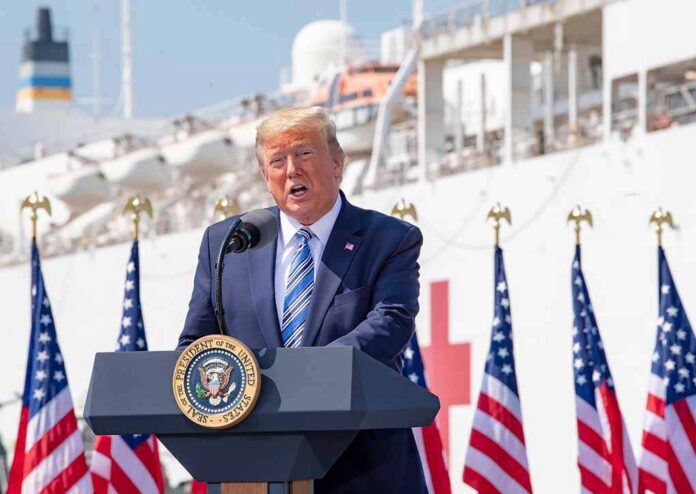
President Trump’s announced ban on CNN, MS NOW, and Politico has triggered a fresh First Amendment fight even as he denies trying to scare the press.
Story Snapshot
- Trump said the ban answers “constant” false reporting, not intimidation.
- Reporters asked if he aimed to intimidate; he said “No” and wants “honest press”.
- Outlets and experts framed the move as retaliation that tests press freedoms.
- Some reports said enforcement steps were unclear right after the announcement.
What Trump Said and How He Framed the Ban
President Trump announced he is banning CNN, MS NOW, and Politico from the White House, saying their “constant” fake reporting drove the decision. He told reporters the action was not to intimidate the media, answering “No, no, no, no,” and saying he wants “honest press” instead. He described the decision as a response to “cumulative stories” over time, not one incident, and argued the outlets publish one-sided negative coverage of his administration.
Trump suggested the ban could be revisited. He said the outlets could return if their reporting changes, signaling possible conditions for access based on coverage quality. His logic leans on his view that the organizations mislead audiences and ignore policy gains. He did not list specific articles or corrections in support during the remarks. That leaves the dispute centered on broad claims about bias and accuracy rather than documented errors tied to named stories.
How Newsrooms and Legal Analysts Are Responding
Major outlets and press-freedom advocates cast the ban as retaliation that conflicts with First Amendment protections for a free press. The New York Times reported a company spokesman accused the administration of trying to intimidate and punish critics through access limits. Reuters described the ban as Trump’s latest threat to an independent press and said experts saw legal conflict with constitutional rules guarding against viewpoint-based bans.
Several reports said enforcement steps were not immediately clear on day one. Coverage noted uncertainty over how the White House would restrict access and whether badges or entry were actually blocked in real time. That gap fueled dueling narratives. Supporters called the move justified pushback on false reporting. Critics said the lack of a clear policy made it look like symbolic punishment that still chills coverage by naming disfavored outlets.
Why Access Rules and Legal Standards Matter Now
Court rulings say the White House can set reasonable, neutral rules for press-area access. But government cannot deny or revoke access because of viewpoint or critical reporting. This line matters because it separates order-keeping from retaliation. If a ban targets coverage content rather than conduct or security, it risks being seen as viewpoint-based and unconstitutional. That is why lawyers focus on stated reasons, written policies, and evidence of neutral standards.
Past credential disputes are rare and often end up judged by process and motives. Officials who restrict access usually point to neutral criteria, like security or space, and share due-process steps. When reasons sound like payback for tough reporting, courts and the public tend to push back. This case now turns on documentation: the access rule used, any enforcement actions taken, and whether the government can show neutral, consistent standards rather than anger at coverage.
Sources:
bbc.com, reuters.com, fox29.com, nytimes.com, hklaw.com