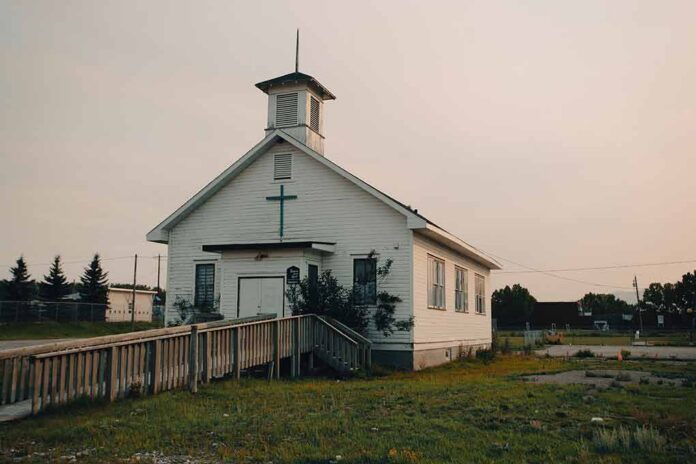
The Supreme Court will decide whether a Kentucky town can block a small Virgin Mary shrine under federal religious land-use law.
Story Snapshot
- The Supreme Court agreed to hear a dispute over a proposed Virgin Mary shrine in Kentucky.
- The Catholic group says building the shrine is a core religious exercise protected by federal law.
- The case tests how far local zoning boards can limit religious construction under federal rules.
- The ruling could set a nationwide standard for future church zoning fights.
What The Supreme Court Agreed To Review
The Supreme Court accepted a case asking if a town’s zoning decision can stop a Catholic group from building a small shrine next to its church in Park Hills, Kentucky. The justices will weigh claims under the Religious Land Use and Institutionalized Persons Act, a federal law that protects religious land uses from unfair local limits. The petition comes after the Supreme Court of Kentucky ruled against the group and let the local restriction stand.
The petition describes the project as a modest outdoor grotto for prayer and devotion to the Virgin Mary on land the group owns beside its church. Supporters argue that the law protects “any exercise of religion,” and that building a shrine for worship and meditation is exactly that kind of exercise. Several friend-of-the-court briefs say the lower courts used the wrong test and made judges decide what counts as “central” to a faith, which the statute does not require.
How The Dispute Reached Washington
The Missionaries of Saint John the Baptist sought local approval to build the shrine and initially received a green light from the city’s land-use board, despite neighbor objections. Later court challenges led to a state high court ruling that rejected the group’s federal claims, clearing the way for the shrine to be blocked. The group then asked the Supreme Court to review the state court’s reading of the federal protections for religious land use.
The filings ask the justices to clarify two key parts of the federal law. First, when a land-use rule places a “substantial burden” on religious exercise and must face strict scrutiny. Second, how the “equal terms” clause works, which requires cities to treat religious assemblies at least as well as comparable secular gatherings. The answers will guide local boards, churches, synagogues, mosques, and neighbors across the country.
Why The Stakes Extend Beyond One Grotto
Religious land-use fights are common because local boards balance traffic, noise, and neighborhood rules against faith groups’ needs to gather, pray, and build sacred spaces. Congress passed the Religious Land Use and Institutionalized Persons Act in 2000 to stop case-by-case zoning from becoming a backdoor barrier to worship. A clear Supreme Court rule could reduce years of costly fights and stop inconsistent rulings that leave churches and cities guessing.
The Supreme Court has agreed to hear three major cases next term, including a Religious Land Use case on a Kentucky shrine and a key immigration case about detentions without hearings. The decision will also address a dispute over how federal law protect… https://t.co/dQyeL96kda
— Jose A.B. Nolla 🌻🇵🇷 (@JoseABNolla) October 1, 2026
For many readers, this case touches a shared worry: government rules can feel arbitrary and stacked against ordinary people. Supporters of the shrine see an agency process that shifted under pressure and then hardened in court. Neighbors often fear change and more traffic. The Court’s decision will signal whether federal law still checks local power when it touches religious practice, and how much deference cities get when they claim safety or zoning concerns.
Sources:
supremecourt.gov, scotusblog.com, news.bloomberglaw.com, cincinnati.com