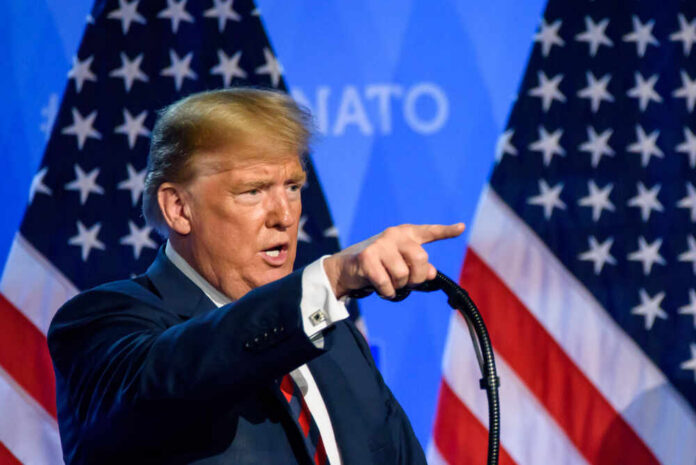
When a sitting president jokes that a congressman who “votes against me” finds that “it doesn’t work out well,” and the target is engaged to a Fox News star, many Americans hear less humor and more proof that the system serves the powerful first.
Story Snapshot
- President Trump used ominous language about Rep. Brian Fitzpatrick while answering a question from his fiancée, Fox News correspondent Jacqui Heinrich.
- Coverage split over whether the remark was a veiled threat or just another round of Trump-style political trash talk.
- The exchange highlights how politicians and media figures often live in the same social circle, deepening public distrust.
- Ambiguous rhetoric and sensational framing feed a cycle where ordinary citizens feel squeezed out of their own democracy.
What Trump Said, and How the Story Emerged
Reporting from several outlets describes the exchange taking place on May 21, 2025, as President Donald Trump spoke with reporters before leaving for Connecticut to deliver a commencement address at the United States Coast Guard Academy.[1] Fox News White House correspondent Jacqui Heinrich asked whether he had spoken with Israeli Prime Minister Benjamin Netanyahu. Trump pivoted, referring to her fiancé, Pennsylvania Republican Representative Brian Fitzpatrick, complaining he “votes against me all the time” and adding, “You know what happens with that? It doesn’t work out well.”[1]
News accounts agree that Trump framed Fitzpatrick’s voting record as the problem, characterizing him as a Republican who frequently defies the president.[1] The Philadelphia Inquirer summarized Trump as threatening Fitzpatrick politically, while The Independent labeled the remark a “veiled threat,” and The Daily Beast emphasized that he dodged Heinrich’s initial policy question by cracking about her husband instead.[1] Fox News later clarified that Heinrich and Fitzpatrick are engaged, not yet married, underscoring that Trump personalized his jab while getting basic facts about their relationship wrong.[1]
Why the Exchange Sounds Like a Threat to Many
For critics, the key phrase “it doesn’t work out well” ties a lawmaker’s supposedly independent votes to unspecified negative consequences, which they argue makes the language threatening rather than merely critical.[1] The quotes, as reported, do not contain a clear joke, softener, or follow-up clarification indicating that Trump meant only political disagreement.[1] Multiple outlets independently described the language using terms like “threatens” and “veiled threat,” reinforcing the impression that this was more than rough banter and was widely heard as menacing in real time.[1]
At the same time, the record in the provided reporting does not show an explicit statement about physical harm or illegal retaliation.[1] Trump spoke in front of a broader press pool, not in a private conversation, and there is no official transcript from the White House included here that might confirm tone or additional context.[1] No direct quotes from Heinrich, Fitzpatrick, or other present reporters are reported, so we lack sworn or on-the-record testimony about whether they personally felt threatened or simply insulted.[1] That gap leaves room for both readings to persist.
Ambiguous Rhetoric in a Distrusted System
This episode fits a now-familiar pattern in American politics where leaders use sharp, ambiguous language in front of cameras, then let the public fight over whether it was serious or “just talk.” Researchers and press observers have repeatedly noted how Trump often attacks journalists personally, turning them into characters in partisan fights instead of neutral questioners. That dynamic plays out vividly here: a factual question about foreign policy morphed into a public dig at the reporter’s partner in Congress, drawing attention away from substance and toward spectacle.
President Trump Calls Out Fox Reporter and WHCA VP Jacqui Heinrich over RINO Fiancé Rep. Brian Fitzpatrick https://t.co/ThCjR99Q7o via @BreitbartNews
— Edward Peitler (@EPeitler3827) May 21, 2026
For many Americans on both the right and the left, the details hit several raw nerves at once. A president with enormous power publicly pressures a member of Congress from his own party. A national news correspondent is personally entangled with the lawmaker he is criticizing. Major outlets then frame the exchange in the most explosive terms possible, knowing outrage drives clicks.[1] Citizens already convinced that “the elites” protect themselves first see one more example of politics as a club, not a service.
What This Reveals About Power, Parties, and the Press
For conservatives skeptical of Trump-era Republican leadership, Fitzpatrick’s willingness to vote against the president can look like ordinary independence—or like establishment disloyalty, depending on viewpoint.[1] For liberals and many independents, Trump’s warning-style rhetoric confirms their belief that he expects personal loyalty above constitutional duty, especially from lawmakers in his own party.[1] Either way, the public is left watching one powerful figure pressure another, while daily concerns about wages, immigration, health care, and debt remain unresolved.
The missing pieces also matter. Without a full, official transcript or complete video, the public debate is shaped mostly by short clips and charged headlines.[1][2] That vacuum rewards whoever shouts the loudest, not whoever is most accurate. Both critics and defenders can cherry-pick phrasing to fit their narrative about Trump, Fox News, and so-called “RINO” Republicans. What almost never gets addressed is the structural issue that bothers so many Americans: a government-media ecosystem where the same small group of political insiders, donors, and television personalities can fight loudly in public, then carry on with life largely untouched by the economic and social problems they leave unsolved.
Sources:
[1] Web – Donald Trump threatens Philly-area Republican Brian Fitzpatrick …
[2] YouTube – Trump lashed out at Fox News reporter and her fiancé, Rep. Brian …