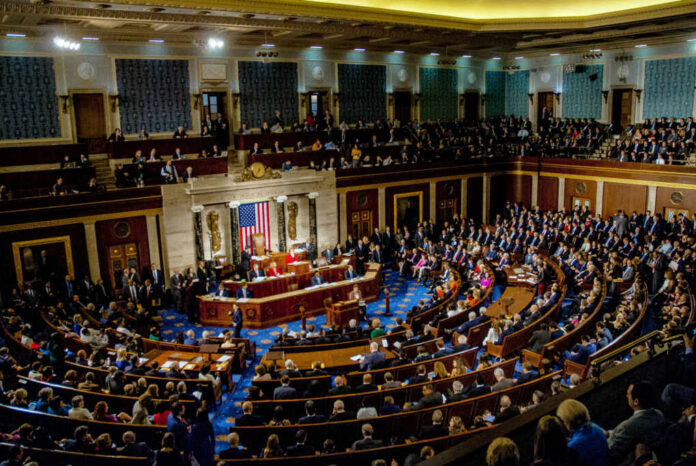
Amid a House clash over Hezbollah, Rep. Max Miller accused Rep. Rashida Tlaib of advocating for a terrorist regime—an explosive charge now rippling through Congress and conservative America.
Story Snapshot
- Rep. Max Miller said Tlaib “advocates for a terrorist regime,” triggering a floor meltdown during a Hezbollah debate [5][6].
- Tlaib objected, calling the accusation a direct attack on her character, while the chamber scrambled over decorum [5][6].
- Miller previously moved to censure Tlaib for antisemitic and anti-Israel remarks, establishing a documented pattern of confrontation [2].
- No primary-source Tlaib statement endorsing Hezbollah is included in the available record, leaving the factual core contested [5][6].
Hezbollah Debate Ignites a Personal Confrontation on the House Floor
House debate over Lebanon and Hezbollah erupted when Rep. Max Miller charged Rep. Rashida Tlaib with “advocating for a terrorist regime,” with reporters describing chaos and shouting on the floor as members reacted in real time [5][6]. Coverage of the exchange quotes Miller accusing Tlaib of sympathizing with terrorists during the argument. Tlaib immediately objected on decorum grounds, saying the words were a personal attack, and sought relief under House rules, intensifying a tense, high-stakes foreign policy fight [5][6].
Reporters covering the clash said the uproar halted normal proceedings, underscoring how debates over terrorism and Middle East policy regularly spill into character allegations in Congress [5][6]. Media accounts highlight the immediacy of Miller’s charge and Tlaib’s procedural response, reflecting a chamber where rhetorical escalation can overshadow policy substance. The incident unfolded as members argued over Hezbollah and United States posture toward Lebanon, a setting that often amplifies moral framing and demands for clarity on terrorism-related positions [6].
Miller’s Record of Confrontation With Tlaib Shapes the Moment
Rep. Miller has previously targeted Tlaib over Israel-related controversies, introducing a resolution to censure her for antisemitic and anti-Israel statements, a documented action that predated this week’s floor eruption [2]. Video from prior debates shows Miller forcefully challenging Tlaib’s rhetoric on Israel and terrorism, a through line that explains why his latest language landed with such force inside the chamber [3]. This established posture provides context: the accusation did not appear from nowhere, but from a sustained dispute about the boundaries of acceptable speech on Israel [2][3].
That prior censure push focused on antisemitic and anti-Israel remarks, not on explicit support for Hezbollah, which matters for today’s evidentiary standard [2]. The record offered in public coverage of the new clash includes Miller’s accusation and Tlaib’s objection, but it does not include a primary-source Tlaib quote endorsing Hezbollah. Consequently, the controversy is partly about proof: whether critics can point to specific statements that meet the threshold of “advocating for a terrorist regime,” or whether the charge reflects a broader reading of her positions [5][6].
What the Evidence Shows—and What It Does Not
Media summaries and clips document Miller’s accusation and the procedural turmoil that followed, but they do not present a Tlaib statement explicitly praising Hezbollah or endorsing the group’s objectives [5][6]. The absence of a direct quote in the available record does not resolve the dispute; it narrows it. The censure materials cited by Miller’s office address antisemitic and anti-Israel rhetoric, which can be morally adjacent to the terrorism debate but is analytically distinct from express advocacy for Hezbollah [2]. These distinctions matter in a serious Congress and for voters.
"You advocate for a terrorist regime every single day."
A House debate over Hezbollah suddenly exploded into a shouting match.
GOP Rep. Max Miller accused Rep. Rashida Tlaib of "advocating for terrorists on a daily basis" during remarks on the House floor, prompting immediate… pic.twitter.com/EXASimN7t0— LoudMouth_T_From_Tha_Lou (@TRUMPGIRL_STL) June 4, 2026
For conservatives, the stakes are constitutional and strategic. The United States must draw bright lines against terrorism while protecting robust debate that does not launder moral ambiguity about groups like Hezbollah. Clarity protects national security, American allies, and the First Amendment’s integrity. The path forward is straightforward: obtain the Congressional Record for the exact exchange, review full floor video, and examine Tlaib’s own statements on Lebanon and Hezbollah during this period to confirm whether the label “advocate” is factually supported—or a rhetorical overreach [5][6].
Sources:
[2] Web – Ilhan Omar slams GOP’s Max Miller for Palestine ‘parking lot’ comment
[3] Web – Congressman Miller Introduces Resolution to Censure …
[5] Web – Max Miller (politician) – Wikipedia
[6] Web – Max Miller Accuses Rashida Tlaib of Supporting Terrorism – Mediaite