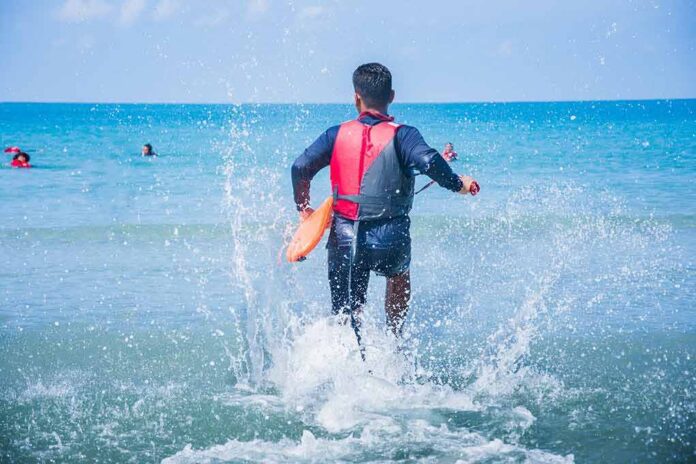
When someone vanishes into a rip current, instinct says sprint and dive; the data, and too many stories like this one, say the rescuer often pays the highest price.
The Short Version
- On August 15 at San Clemente’s Riviera Beach, 42-year-old father of five Josh Collette entered the surf to help a child caught in a rip current; the child made it out.
- Collette struck the bottom—rocks or a sandbar—and sustained a catastrophic neck injury, leaving him paralyzed from the neck down, according to family and contemporaneous reporting.
- Local community reporting corroborates the date, location, and a severe spinal cord injury, with the family seeking help for extensive recovery costs.
- Rip currents are the dominant cause of U.S. surf-beach rescues, a persistent, well-characterized hazard that lures would-be rescuers into deadly surf zones.
What Happened at Riviera Beach
On a summer Saturday at San Clemente’s Riviera Beach, a child—described as roughly seven years old—was swept into a rip current. Witness accounts relayed through reporting say that Josh Collette, 42, rushed into the Pacific to help. In the turbulent nearshore zone, he collided with the bottom, likely a shallow bar or submerged rock, and immediately feared a fractured neck. He was pulled from the water and transported for emergency care. Medical professionals later told the family he was paralyzed from the neck down. The child made it out of the rip alive.
Collette’s family has since described a long, costly road ahead—acute care, stabilization, and protracted rehabilitation—consistent with the clinical arc after high cervical spinal cord injury. Local community coverage corroborates the core facts: a San Clemente father of five suffered a severe spinal injury on Saturday, August 15; relatives appealed for help with medical and therapy expenses. While some clinical specifics remain private, the sequence—the rescue attempt, the bottom impact, the resulting paralysis, and the child’s survival—aligns with both the reporting and the known hazards of that stretch of coast.
Why Rip Currents Turn Helpers into Victims
Rip currents are not exotic or rare; they are the organizing force behind most lifeguard rescues on surf beaches in the United States. Analyses of long-running lifeguard incident data estimate that about 82% of surf-beach rescues involve rip currents, a proportion that has proven resilient across regions and years. Mechanistically, a rip is a seaward-flowing jet that forms when breaking waves pile water toward shore and pressure gradients force that water back offshore through channels between bars or alongside jetties. To the untrained eye, a rip can present as a deceptively calm “river” of green water amid whitewater—precisely the spot a tired swimmer or anxious rescuer might choose.
Two dynamics make bystander rescues precarious. First, once in the current, both rescuer and victim are exported seaward into deeper water; panic drives exhausting cross-wave swimming and futile head-on fights against the flow. Second, the surf zone itself is booby-trapped: shallow sandbars, shore break that slams bodies into the bottom, and cobble or reef that punish a head-first entry. That is the biomechanical recipe for cervical spine trauma—forced hyperflexion or axial loading when a wave plants a swimmer headfirst into sand or rock. San Clemente’s own marine-safety guidance underscores both the prevalence of rips and the correct countermeasure: do not fight the current; swim parallel to shore until you exit the jet, then angle landward with the waves.
San Clemente’s Hazard Landscape
The South Orange County coastline alternates between pocket beaches, groins, and bar-and-trough systems that evolve with swell and tide. In such settings, rips concentrate along structures and in channels; on high-energy days, they pulse as set waves drive strong feeder currents. City marine-safety advisories emphasize rip-current awareness and the need to consult lifeguards, pick guarded beaches, and understand local hazards before entering the water. Regional reporting routinely captures how quickly these forces escalate—rapid-onset rescues, heavy warnings, and nearshore chaos that turns casual play into emergencies in minutes.
When a rescuer sprints into that environment without fins, a flotation device, or backup, the physics impose a narrow margin for error. The safest approach, codified by lifesaving organizations, is counterintuitive but consistent: call or signal for trained help; encourage the victim to float; and, when feasible, extend flotation from shore rather than adding another swimmer to the rip. The rule is simple because the statistics demand it—help, but don’t become the second victim.
Spinal Injury in the Surf: Mechanism and Aftermath
Spinal cord injuries in beach rescues are rare relative to the enormous number of surf incidents, yet when they occur the consequences are life-altering. The typical mechanism in the shore zone is axial loading—head-first contact with a hard bottom as a breaking wave drives the body downward—or violent hyperflexion as the neck is forced into an extreme bend. In Collette’s case, the family’s description of a neck fracture and immediate paralysis is consistent with this pattern. Orange County’s hospital-based beach-safety materials routinely warn beachgoers to protect the head and neck, avoid head-first dives in shallow surf, and use hands-forward entries—a simple behavioral change that reduces catastrophic risk.
Clinical trajectories vary by injury level and completeness; high cervical trauma can impair breathing, movement, and autonomic functions. Modern trauma systems prioritize early stabilization, respiratory support, spinal imaging, and, when indicated, surgical decompression or fixation. Rehabilitation is long and nonlinear: strength where spared, adaptive technology, and relentless therapy. Families face not just medical bills but retrofits at home, caregiver time, specialized transport, and lost income—precisely the categories community appeals tend to emphasize in the first weeks after injury.
JUST IN: California father Josh Collette, 42, was paralyzed from the neck down after diving into the ocean at Riviera Beach in San Clemente on Aug. 15 to rescue a child caught in a rip current, his sister said. pic.twitter.com/fhF1Rb8H4r
— JUST IN (@justinnews67) August 24, 2026
What This Teaches About Preventing the Next Tragedy
Three practices consistently bend the risk curve. First, choose guarded beaches and talk to lifeguards before you swim; the presence of professional rescuers dramatically reduces fatal outcomes during aquatic incidents, both by deterring risky entries and by executing faster, better-equipped interventions. Second, learn the rip-current playbook: if caught, float to breathe, signal for help, and swim parallel to exit the jet before angling toward shore; if you’re helping from land, toss or extend a flotation aid, and call for lifeguards. Third, respect the shore break; never dive head-first into surf, and keep your hands forward to shield the head and neck when waves pitch you toward the bottom.
Those steps sound modest until you need them; then they are the difference between a frightening story and a family remade by loss. Collette’s act fits a pattern we see every summer: a split-second decision to put a child’s life first, taken in the most unforgiving part of the sea. The child survived. That is the triumph embedded in the tragedy. For the rest of us, the obligation is clear—honor the courage, learn the hazard, and change our default response so the next rescuer doesn’t become the next patient.
Sources:
nypost.com, abc7.com, sanclemente.gov, cbsnews.com, abcnews.com