

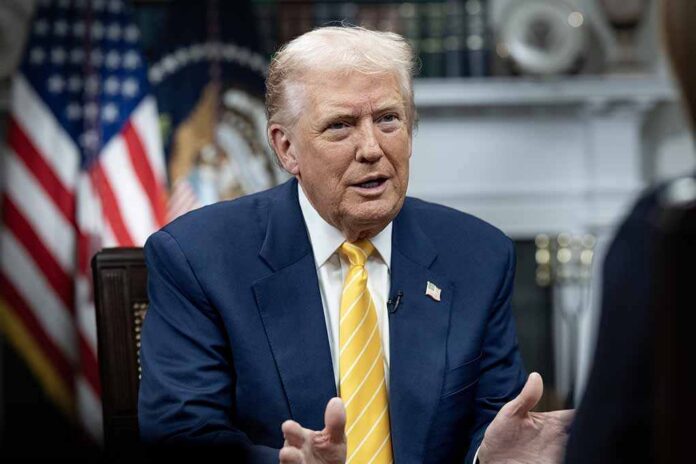
President Trump warned that U.S. companies that build data centers overseas will face a “tremendous tax,” tying the threat to national security and jobs at home.
Story Snapshot
- Trump said companies can build abroad “but” will face a “tremendous tax.”
- The White House cited national security and China as the core risk.
- Google’s multibillion-euro Finland plan was cited as a target example.
- No tax rate, timeline, or legal mechanism was announced.
What President Trump Announced At The White House
On November 20, 2026, President Trump said he would not allow American companies to build data centers in other countries. He then added that firms could still do so, but would face a “tremendous tax.” He linked the move to national security, warning about foreign control of advanced computing. The remarks came at the White House and were carried widely. Reporters noted the message mixed a ban with a tax threat, leaving the exact policy unclear.
Trump tied the warning to China, saying that if firms move compute capacity offshore, China would “take all of them.” He called for heavy penalties on companies that proceed. The comments fit a growing shift in policy from policing where chips are sold to where computing power sits and who can access it. A congressional report notes Chinese firms can rent remote access to advanced chips through data centers in third countries.
The Concrete Flashpoint: Google’s Finland Project
Trump pointed to a real project abroad. Google announced a multibillion-euro expansion tied to artificial intelligence capacity in Finland, including multiple data centers. He said his administration was “not allowing that to happen.” The cited plan highlights how tech giants place compute where power is cheap and stable, and where permits move faster. But the remarks did not detail whether any U.S. measure could attach a tax to a foreign-owned facility.
This focus on location lands in the middle of a larger buildout race. Data centers need stable power, land, and quick grid hookups. Analysts say the United States grid faces long connection queues and local fights over land use, noise, and water. Many communities still want the jobs and payments that come with large sites. Trump urged towns to “make them pay you” and keep the build inside American borders, not overseas.
Missing Pieces: How A “Tremendous Tax” Would Work
The announcement did not include key details. Trump did not name a tax rate, who would pay, when it would start, or what activity would be taxed. He did not cite a law or agency authority for such a levy. Without a bill, order, or rule, the comment stands as a policy intention, not an operative charge. Outlets reported that even senior officials had not been briefed on mechanics at the time of the event.
This legal gap matters. Taxing American firms for foreign construction raises complex issues of jurisdiction, treaties, and corporate structure. Congress could pass a targeted tax or penalty. Agencies could explore export controls, investment reviews, or sanctions paths already used for chips and sensitive tech. But news reports did not identify a chosen path. Until one appears, companies must weigh a clear warning without a clear rule.
Why This Hits A Nerve For Both Sides
Supporters of a tax see a simple goal: keep the money, power use, and jobs here. They argue that communities need leverage to win payments and new grid investment, not to lose both to foreign sites. Critics worry about overreach, trade blowback, and mixed signals to investors. They ask how a blanket tax would interact with chip export rules and security reviews that already target risky users and locations, including rentals of remote computing.
President Donald Trump on Friday announced that he would not permit American companies to build data centers in other countries and would impose taxes on them if they did so.
https://t.co/BlPO7NayFU— Jennifer Harashack (@OngLengImm) November 21, 2026
Behind the politics sits a hard math problem. Experts forecast data centers could use about seven to twelve percent of U.S. power by 2028. That surge demands faster interconnections, new lines, and more generation. If those needs stall, firms may keep looking abroad. If the United States speeds permits and adds firm power, more sites may come home without a punitive tax. Either way, placement now blends security, energy, and industry policy.
What To Watch Next
Watch for a formal plan from the White House, Treasury, or Commerce that sets definitions, rates, and timelines. Look for a bill in Congress that authorizes a targeted tax or a penalty with clear triggers. Track whether the administration uses existing tools, like export rules or investment screening, to limit risky users of offshore compute. And expect large tech firms to press for clarity so they can plan sites, power deals, and construction without sudden shocks.
Sources:
youtube.com, hk.ibtimes.com, us-brief.com, gizmodo.com, co.ibtimes.com, kivorent.news, bbc.co.uk, x.com, yahoo.com, longbridge.com, factlen.com, foreignpolicy.com