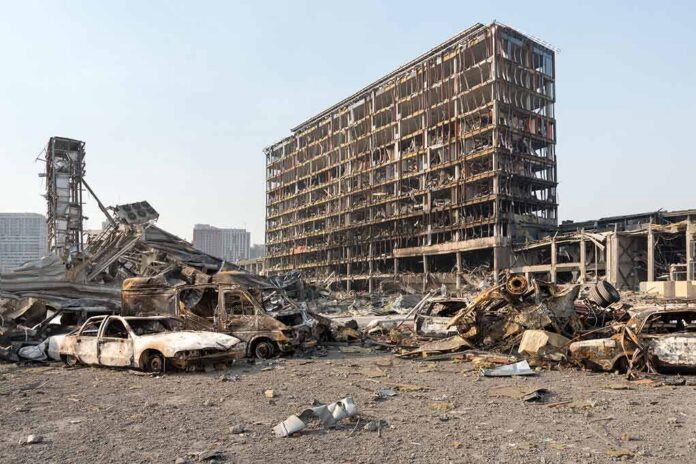
The most consequential fact about the Kyiv-region strike is not Russia’s stated intent but the target’s nature: Ukrainian government and industry representatives say they were gathered at a defense-event site when a ballistic missile hit. That places this incident squarely in the hardest category for war reporting and law-of-war analysis—where military purpose, dual-use activity, and civilian presence overlap in the same place.
At a Glance
- Ukrainian officials and defense-industry representatives say a missile hit a Kyiv-region site hosting a defense event, causing multiple fatalities and scores of injuries.
- Moscow frames recent Kyiv-area strikes as precision attacks on defense-industry infrastructure; it warned of “systematic” strikes weeks prior.
- Reported casualty counts vary, and precise venue details remain inconsistent—common verification challenges in active war zones.
- This case illustrates the recurrent problem of dual-use and military-adjacent locations, where legal status and narrative conflict most intensely.
What happened and why this site matters
Ukrainian sources—including the Ukrainian Council of Defence Industry as cited by Ukrainska Pravda—reported that representatives of Ukraine’s defense sector were present at a Kyiv Oblast location when a Russian missile struck, killing and wounding attendees at an event characterized as a weapons exhibition or defense demonstration. Multiple outlets aligned on the core description—an organized defense-industry gathering in the Kyiv region—while differing on the exact death toll and injuries, which ranged from at least six fatalities to about ten dead and close to a hundred wounded. Those figures and the industry presence establish this was not an ordinary civilian venue. The point of contention is narrower: was the exhibition itself the target, or was it collateral to a broader strike on a training ground or nearby military-related infrastructure?
For weeks, Russia has publicly cast its Kyiv-area operations as long-range, precision strikes on defense-industry sites and decision-making hubs; it also urged foreigners to leave the capital and warned of “systematic strikes” to come. That stated intent is consistent with Moscow’s broader narrative of hitting military-industrial facilities in and around Kyiv during large salvoes mixing ballistic and cruise missiles with drones. The defense-event reports from the Ukrainian side, however, move this episode beyond a generic claim-and-counterclaim about “civilian versus military” and into the more concrete category of military-adjacent activity with civilians and industry personnel present.
Mechanism and targeting: how this fits the recent campaign
Large-scale Russian strike packages against Kyiv in recent months have combined ballistic missiles—difficult to intercept even for well-sited Patriot batteries—with cruise missiles and one-way attack drones, striking in waves to saturate defenses. Russian statements emphasize precision and military-industrial targets; Ukrainian accounts stress civilian harm and infrastructure damage. Both can be true in the same engagement when targets are embedded in or proximate to civilian areas, and when “defense-industrial” activity is conducted in ad hoc or dual-use spaces rather than inside hardened, clearly segregated military compounds.
Ballistic impacts on a localized site—an expo pad, a demo range, or a training ground used for showcasing systems—would be consistent with Russia’s doctrine of striking force multipliers behind the front: production nodes, integration sites, depot or testing areas, and convenings where procurement officers and suppliers meet. In that sense, the strike profile matches the logic of interdiction. Yet the legal and moral stakes turn on two questions evidence cannot fully resolve in public yet: what the venue precisely was (formal exhibition, training ground, or mixed-use space) and what level of civilian risk mitigation either party employed.
Evidence weights: what we know, what we do not
On the central fact—defense-industry presence at the hit site—the Ukrainian-side record is specific and on the record. Ukrainska Pravda cites the Ukrainian Council of Defence Industry confirming a strike at a location where its representatives had gathered, while multiple regional and national outlets describe it as a weapons exhibition or defense event with fatal casualties and dozens to near a hundred injuries. President Volodymyr Zelensky and Kyiv-region officials acknowledged the attack and rescue operations, further grounding the claim that a defined event space, not a random civilian block, absorbed the blow.
Russia’s counter-position is not a denial but a reframing—that the country is intentionally hitting defense-industry and decision-making targets in Kyiv and its environs with “long-range precision” weapons as part of a larger, announced campaign. That posture does not negate the defense-event reports; instead, it sits alongside them, implying the exhibition or demo would qualify, in Moscow’s view, as a legitimate military-adjacent target. The unresolved details are venue identity, the exact coordinates within the facility, and whether any dual-use function complicates classification. Discrepancies in casualty counts and location descriptors—Kyiv Oblast, Bucha district, a village near the capital—reflect typical fog-of-war reporting constraints rather than a decisive contradiction.
Law-of-war lens: dual-use, distinction, and proportionality
International humanitarian law hinges on distinction (separating combatants and military objectives from civilians and civilian objects) and proportionality (avoiding attacks expected to cause excessive civilian harm relative to the concrete and direct military advantage anticipated). A defense demonstration where industry personnel, possibly foreign guests, and noncombatant staff are present complicates both standards. If military equipment was being displayed, tested, or marketed with an eye to operational use, the site could be deemed a military objective. Yet such status does not erase civilian protections; it elevates the obligation to select means and timing that minimize collateral harm.
Russia’s public emphasis on “precision” is an assertion of discrimination in weapon effects, not proof of it; verification typically requires on-site crater and fragment analysis, pattern-of-life assessment, and scrutiny of aim points versus actual impact. Those forensic elements are not publicly available here, which is common in active theaters. Conversely, Ukraine’s confirmation that defense-industry representatives were gathered does not answer whether the specific impact point was the exhibition footprint or an adjacent training or storage area within a complex, nor does it establish what mitigation steps—dispersal, hardened shelters, or no-strike windowing—were in place.
How we got here: the tit-for-tat logic of industrial targeting
The war has steadily migrated from front-line attrition to strategic pressure on the means of war—fuel production, logistics hubs, repair depots, drone and missile manufacturing, and the know-how and contracting activity that feed them. Russia casts its barrages on Kyiv as retaliation for Ukrainian strikes on Russian infrastructure; Ukraine, in parallel, has intensified its reach into Russian oil and defense logistics. The result is predictable: target sets that matter militarily are increasingly interwoven with civilian life and commerce, and events that straddle procurement, demonstration, and training become attractive targets for interdiction—even as they heighten civilian risk.
Warnings often precede such campaigns. In late May, Moscow signaled “systematic” strikes on Kyiv’s defense-linked sites and urged foreign nationals to depart—language intended to shape diplomatic behavior, stress-test Ukrainian air defenses, and build a public record of intent. Those warnings do not legalize particular strikes; they do indicate that gatherings tied to defense activity faced elevated threat, and that organizers and attendees bore heightened risk—another hallmark of modern industrialized conflict.
What would settle the remaining disputes
Three classes of documentation would move this incident from contested narrative to established record. First, primary event materials: organizer announcements, the venue contract, exhibitor lists, security plans, and time-stamped imagery—these would confirm the site’s formal function and footprint at the time of impact. Second, geolocated pre- and post-strike imagery tied to crater analysis and fragment recovery, showing aim points and likely munition type; paired with air-defense engagement logs, this would support or undercut precision claims. Third, official incident packets from Kyiv regional authorities—emergency-service logs, police and prosecutor filings, and a reconciled casualty ledger—would fix the numbers and the exact location within the facility.
Practical implications for policy and industry
For Ukraine and its partners, two operational lessons recur. Defense-related gatherings in wartime—demo days, procurement showcases, live-fire trials—require hardened siting, dispersion, and scheduling discipline commensurate with a foreseeable ballistic threat. Treat them like targets, because they are. For Russia, every strike on a military-adjacent venue with civilians present carries strategic risk: it may achieve interdiction effects but can also deepen international support for Ukraine if civilian harm appears disproportionate or if the venue’s status is ambiguous. For outside observers, the temptation to flatten complex, dual-use realities into moral certitudes should be resisted; the facts here support neither a “random civilian massacre” narrative nor a clean “only military targets were hit” conclusion without further forensic disclosure.
Bottom line
The strongest available evidence supports that a Russian ballistic strike hit a Kyiv-region site where a defense-industry event was underway, causing significant casualties among attendees and staff. Russia’s broader campaign framing—precision attacks on defense-industry targets—fits that fact pattern and does not rebut it; it sharpens the legal and strategic questions. Until primary documentation and forensic analysis surface, two truths hold in tension: the venue was military-adjacent enough to attract targeting, and it appears to have hosted civilians whose protection remains a core law-of-war obligation. In modern industrial war, that is no contradiction. It is the problem.
Sources:
insiderpaper.com, bloomberg.com, reuters.com, straitstimes.com, cfr.org, cnbc.com, facebook.com, youtube.com, nytimes.com, hurriyetdailynews.com, abcnews.com