
Sixteen people pulled from the Pacific told rescuers others were still missing after a sinking far off Baja — and one survivor showed wounds consistent with a shark bite.
Story Snapshot
- U.S. Coast Guard aircrews rescued 16 people and flew them to San Diego hospitals.
- A Mayday call around 1:00 a.m. reported a sinking boat about 140 miles west of Ensenada.
- Coast Guard, U.S. Navy, and Mexican Navy teams kept searching for additional people.
- Officials treated injuries from exposure; one survivor had suspected shark-bite wounds.
Rescue Triggered By Predawn Mayday Call
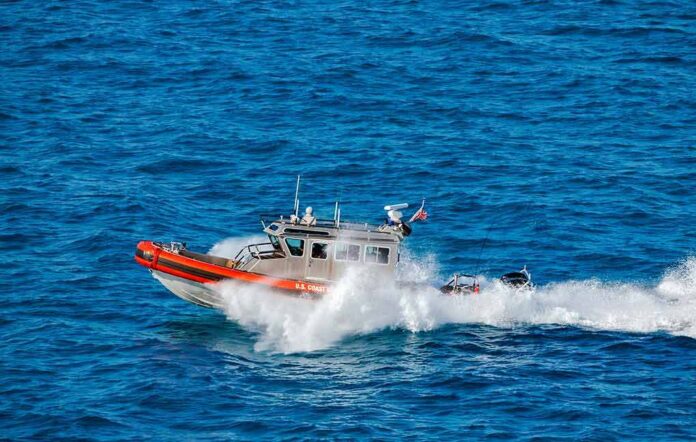
Coast Guard command centers received a distress call around 1:00 a.m. from a vessel saying it was sinking. Air and surface crews headed to an area about 140 miles west of Ensenada and found people in the water. Crews hoisted 16 survivors and flew them to San Diego hospitals for treatment. Officials said exposure and other injuries were treated upon arrival. One person had wounds consistent with a shark bite, according to reporting from the Associated Press.
Reporters with NBC 7 San Diego said the rescued group consisted of Mexican nationals. The Coast Guard described rapid deployment by helicopter and coordination with regional partners. The location, far offshore and outside United States waters, added time and distance to every decision. Medical evacuation by helicopter was used to speed care once survivors were found. Agencies emphasized the priority was saving lives in rough, remote seas.
Expanded Search As More People Believed Missing
Survivors told rescuers that others were still unaccounted for. Initial reports described a possible total of 27 on board, which would leave about 11 missing. Officials later stressed the total passenger count had not been confirmed. Even so, the search scaled up. The Coast Guard and United States Navy deployed two helicopters, a fixed-wing aircraft, a cutter, and a Navy combat ship. The Mexican Navy launched its own operation from Ensenada to widen coverage.
Search planners faced a moving target. Winds, currents, and time in the water change where people drift. Crews worked the last known position and expanded outward. Aircraft flew patterns to spot life jackets, debris, or flares. Surface ships closed on sightings for hoists or recoveries. The lack of a recovered vessel made the job harder. Without a hull or manifest, teams relied on survivor accounts and debris fields to judge how far to push the grid.
What We Know And What Officials Are Still Verifying
Reporters said the boat sank before rescuers arrived, and the type of vessel was not clear. That gap limits how much investigators can say about cause. Weather, overloading, mechanical failure, and collision all remain possible in general terms. Authorities have not released a formal finding on cause. They have also not confirmed a final passenger list. Those steps take time as interviews, hospital records, and consular outreach are reconciled across two countries.
Baja California Boat Capsizing Leaves 11 Missing After 16 Rescued https://t.co/6KguDQjEYE
— DarrenH (@darrenHEYCEL) October 18, 2026
The route off Baja has seen dangerous trips in recent years. Public reporting shows maritime smuggling incidents in Southern California surged since 2017, with at least 23 deaths recorded by 2023, though the true toll is likely higher. In 2021, a panga tied to a federal case broke apart near Point Loma, killing three; the captain later received an 18-year sentence. Those cases show the risk at sea, but they do not, by themselves, prove what this specific boat was doing.
Sources:
military.com, nbcsandiego.com, mdjonline.com