

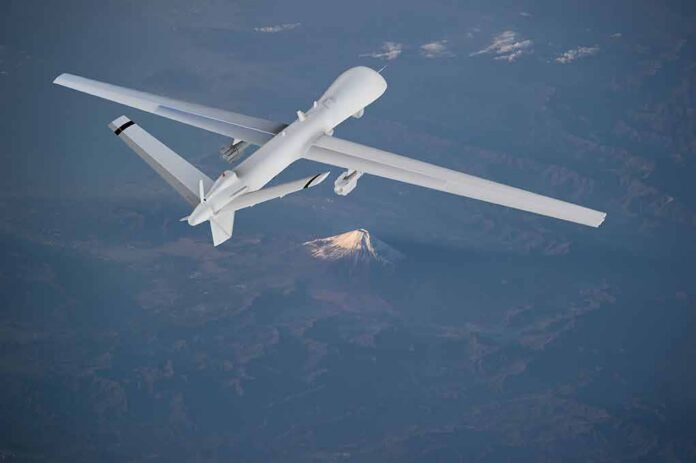
A private company’s speed cap on a war-zone internet lifeline grounded Ukraine’s fastest drones and exposed how little control the public has over critical tools of war.
Story Highlights
- Ukrainian officials say a new 100-mph limit cut drone links mid-flight, stalling missions.
- President Volodymyr Zelensky said the restriction persisted and asked U.S. officials to restore speeds.
- Elon Musk said Ukraine violated Starlink’s terms by using it for offensive drone strikes.
- Conflicting accounts over who set limits show blurred lines between private power and public war aims.
What Ukraine Says Happened On The Battlefield
Ukrainian defense officials reported that a new speed threshold cut connections at about 160 kilometers per hour, or 100 miles per hour. They said drones and other assets lost service once they crossed that mark. Advisers said units got no advance warning, and several missions were disrupted. Reports linked the cap to guidance problems for high-speed drones used to intercept incoming threats and to coordinate strikes and defenses.
President Volodymyr Zelensky said the restriction continued to affect operations. He said Secretary of State Marco Rubio promised to review the issue within two to three days. Zelensky said Ukrainian testing still showed the same speed limit in place. Those claims supported earlier accounts that the change began suddenly and had clear frontline effects, rather than being a minor technical glitch or test.
What Musk And SpaceX Say About The Limits
Elon Musk said Ukraine’s military broke Starlink’s rules by using the commercial service for offensive drone strikes. He said Starlink is a civilian system meant for civilian or defensive use. He said SpaceX closed a loophole that had allowed offensive uses. He also pointed to Starshield, which he said is owned and controlled by the United States government, with limits set by the military and the president, not SpaceX alone.
Those statements left a key tension in public view. Reports and quotes often mixed Starlink and Starshield, which have different owners and rules. That muddied who had authority over speed, altitude, and other limits on any given day. The overlap fueled a blame game while Ukraine said drones still lost links at higher speeds. The record did not show logs that could settle which network, contract, or decision triggered the cap.
Washington’s Denials And The Ongoing Gap
United States officials denied ordering the slowdown. Secretary of State Marco Rubio said no one at the White House gave such an order. The White House echoed that line, while Ukraine continued to report connectivity limits. Fact-checkers called claims that President Trump or a White House official ordered the slowdown unproven. The dispute focused attention on politics while front-line crews still faced a practical cap that operators said hurt missions.
Reports also conflicted over whether speeds were later restored. Some statements from President Trump and later from Zelensky suggested service returned to prior levels, yet other Ukrainian officials told outlets the 100-mile-per-hour cap remained. That contradiction made it hard for outside observers to judge duration and impact with confidence. The lack of shared technical data kept the public stuck between quotes and counter-quotes.
Why This Matters Beyond Ukraine
This fight highlights a larger shift in war. Commercial networks now act like military infrastructure. When a private firm can change a setting and disrupt a battlefield, the chain of command gets blurry. SpaceX holds key data and control, while governments and allies depend on the service. That imbalance limits transparency. It also feeds the view on left and right that powerful players act first and explain later, while citizens and even soldiers live with the fallout.
For 10 days, Ukraine's fastest drones lost their link mid-flight. On Saturday, the speed came back, and Musk blamed Ukraine's military
Since 14 October, Starlink and Starshield had cut out above 161 km/h, too slow for drones chasing Russia's jet Shaheds. Overnight into 24…
— GMan | GMan’s Chronicle (@FAB87F) October 25, 2026
Clear answers would help. Network-control logs could show the exact time, scope, threshold, and who set it. Contracts could clarify what rules applied and who had the right to change them. Independent tests could confirm the speed cutoff and its effect on drones. Until then, the record supports two narrow points: Ukraine faced real operational pain at high speeds, and private control over a public war tool left accountability cloudy at best.
Sources:
military.com, newsweek.com, aljazeera.com, kyivindependent.com, edition.cnn.com, nbcnews.com, snopes.com, fakti.bg