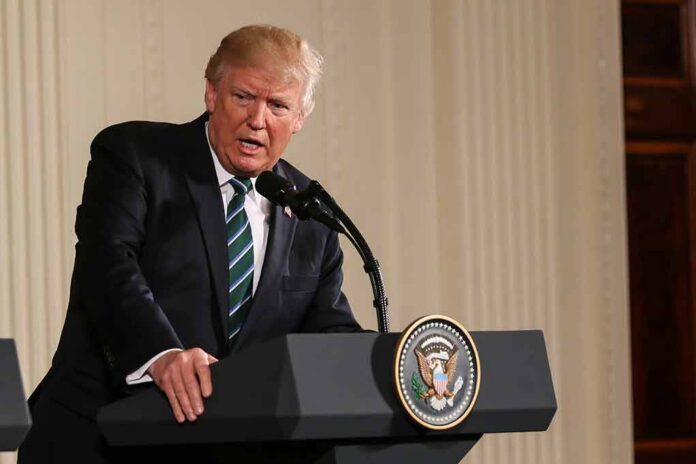
At a dinner meant to honor press freedom after an assassination attempt, President Trump turned the spotlight on media bias, political hypocrisy, and his own record in office.
Story Snapshot
- The dinner was rescheduled after a gunman tried to kill President Trump at the April event.
- Trump praised law enforcement and some journalists while sharply criticizing others.
- He mixed jokes and personal jabs with claims about his administration’s accomplishments.
- The night highlighted a bigger fight over trust in the media and in government “elites.”
A High-Risk Dinner Returns After an Assassination Attempt
The rescheduled White House Correspondents’ Dinner took place in Washington only months after the first event was cut short when a gunman opened fire at the Washington Hilton, in what officials say was an attempt to assassinate President Trump and target his administration. Reporters, cabinet members, and over two thousand guests had been evacuated in April, reviving memories of the 1981 attempt on President Ronald Reagan at the same hotel. Trump pushed for the dinner to be held again, framing it as a show that “must go on” despite the danger.
From the start of his remarks at the rescheduled dinner, Trump tied the night to themes of courage, public service, and press freedom. He thanked the Secret Service and singled out the law enforcement officer wounded in the April attack, noting that the agent’s bulletproof vest likely saved his life. He also praised hotel staff for calmly helping guests get to safety. That framing resonated with many Americans who feel ordinary workers and first responders carry the real weight while Washington power brokers argue and posture.
Trump’s Blend of Praise, Criticism, and Self-Defense
Trump then turned to the press in the room, saying that “a lot was learned” from the shooting and that he did not want to see the dinner canceled because it celebrates freedom of the press. At the same time, broadcasts of the speech show him taking swipes at specific journalists and political rivals while touting his accomplishments. He joked about public figures’ weight and intelligence and mocked coverage he saw as unfair, while also telling journalists they do “an amazing job” when they report honestly. This mix of flattery and attack matched his long-running “fake news” theme.
For many viewers, that clash felt familiar. Trump has spent years saying much of the media is biased and part of a corrupt “elite,” while national outlets often frame his attacks as a threat to press freedom. At this dinner, reporters described his speech as rambling and vicious, heavy on insults and potshots rather than detailed evidence. Supporters, however, pointed to his willingness to confront powerful networks face-to-face and his insistence that bias and double standards in coverage help hide deeper government failures. The same words were heard as either a needed reality check or another norm-breaking tirade.
Accomplishments, Grievances, and a Divided Audience
Trump also used the ballroom stage to highlight what he called major wins of his administration, from economic gains to tougher action on border security and crime. Clips show him linking these accomplishments to his America First approach and contrasting them with years of what he calls “globalist” policies that left working families behind. Yet the event format made it hard to separate hard numbers from punchlines. The dinner is built around satire and humor, not formal policy speeches, so many of his claims came wrapped in jokes about opponents and late-night hosts.
Critics argue that this style lets leaders slip serious accusations into comedy without fact-checking in real time. They note that Trump’s jabs at named journalists and rivals did not come with detailed proof, even when he accused them of spreading false stories. On the other hand, the sources available do not provide a full transcript of every line he delivered that night, and they rarely walk through each claim to test it against records or statistics. That gap fuels frustration on both sides: conservatives see headlines calling the speech “unhinged” without addressing the substance, while liberals see sweeping attacks on the press without clear evidence.
What the Night Reveals About America’s Trust Crisis
Beyond the jokes, the dinner underscored a deeper problem that reaches far past Trump himself: millions of Americans no longer trust either the media or the political class to tell the truth or put citizens first. The event is supposed to honor the First Amendment and watchdog journalism, yet many see it as an elite party where politicians and reporters mingle while regular people struggle with high prices, insecure jobs, and broken promises. For years, Trump has used that feeling to argue that major outlets are part of a “deep state” defending their own power.
President Donald Trump took aim at Senator Adam Schiff during his speech at the White House Correspondents' Dinner, calling him "Watermelon Head" and making a series of personal remarks that drew attention from the audience.
Watch the moment as Trump delivers the comments during… pic.twitter.com/INlFpi4btc
— APT News (@APT__News) July 25, 2026
Journalists and many liberals see the same night very differently. They point to past dinners where presidents joked about rivals but did not attack the press itself as “fake” or “disgraceful,” and they warn that this kind of language can chill honest reporting. Still, even some on the left now question whether large media companies and the permanent government really face consequences when they fail. When a president turns a press-freedom gala into a public trial of media credibility, he is tapping into a shared suspicion across the political spectrum: that the people in charge — in newsrooms and in Washington — are playing by their own rules while the country drifts off course.
Sources:
youtube.com, nbcnews.com, presidency.ucsb.edu, govinfo.gov, theguardian.com, ntd.com, obamawhitehouse.archives.gov, democrats.senate.gov, thehill.com