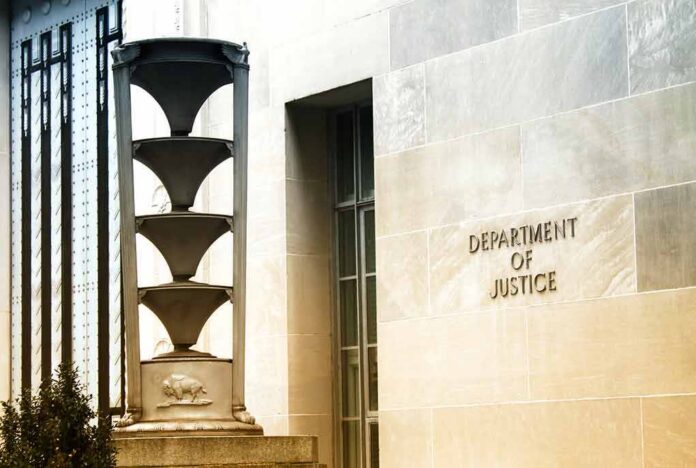
Federal prosecutors say an ex-OpenAI engineer planted a hidden recorder in an executive conference room used for sensitive briefings, then kept in touch with a Saudi royal as travel plans formed around him.
Story Highlights
- Federal complaint alleges a covert audio device was hidden in an OpenAI executive meeting room.
- Prosecutors charged the ex-employee under a federal wire interception statute and reported an arrest and court appearance.
- Government filings cite frequent contact with a Saudi royal and one-way family tickets paid by a Saudi military member.
- Reports say the device was concealed in toilet paper and plugged into a television’s USB port; no proof of successful recordings is public.
Federal Allegations Center on a Hidden Recording Device
Federal prosecutors in California charged former OpenAI engineer Abdulrahman Alfozan with using or attempting to use a device to intercept oral communications. The criminal complaint, unsealed October 13, describes a covert recorder placed in an executive conference room at the company’s San Francisco office. The device was allegedly tucked into toilet paper and plugged into a television’s rear USB port. The room hosted leadership and government briefings, raising stakes for what could have been captured.
The Department of Justice reported that agents arrested Alfozan on October 9, and that he made an initial court appearance. Prosecutors brought the case under the federal law that bans using electronic or mechanical devices to intercept oral conversations. The charge does not require proof that audio was exfiltrated, only that the device was used or that an attempt was made. The complaint frames the act as a serious workplace and national security breach.
Saudi Links Raise Flight Risk Concerns for the Court
In a later filing seeking to keep Alfozan detained, prosecutors pointed to frequent communications with an unnamed Saudi royal family member. They also said a Saudi military member paid for one-way tickets for Alfozan’s wife and son to leave the United States. The itinerary reportedly set travel from San Francisco to Saudi Arabia through Istanbul on October 12, three days after the arrest date listed by the government.
Those facts, prosecutors argued, showed outside support and a clear risk that the family, and possibly the defendant, could flee. The filing did not identify the royal or the military member, so the public record does not show their roles or intent. The defense has distinguished the recording charge from trade secret theft or acting as a foreign agent, arguing the claims are out of character for Alfozan, according to media reports.
What Is Known—and What Is Not—About Potential Impact
Reports summarizing the complaint say investigators traced weeks of planning that included queries to an artificial intelligence chatbot and a productivity agent. That planning, prosecutors claim, led to the placement of the device in the executive room. Public materials do not show that any meeting audio was actually captured or sent to anyone. OpenAI has also said it found no evidence of model weights, source code, or customer data theft in its internal checks, according to reporting.
US prosecutors say an ex-OpenAI engineer accused of planting a recording device in an executive conference room appears to have received considerable support from the Saudi government.
They are asking a judge to keep him detained as a flight risk.https://t.co/rbfaQL6Tjg
— E Ibrahim (@EE_Ibrahim23) October 19, 2026
This case spotlights a broader insider-threat problem that cuts across politics and industries. Research has found that insiders account for a meaningful share of electronic crimes, while most incidents trace back to negligence rather than malice. Yet even a single malicious insider can do great damage, especially inside firms that control high-value technology and hold sensitive talks with government leaders. The OpenAI allegation shows how a basic device, not a complex hack, can endanger trust and security.
Why This Matters for Both Sides of America’s Debate
Americans across the spectrum worry that powerful institutions fail to safeguard what matters. Conservatives point to national security and elite carelessness. Liberals point to corporate power and weak guardrails. A hidden recorder in a room used for high-level briefings blends both fears. It suggests lapses at a leading artificial intelligence company, and it hints at foreign ties prosecutors say increased flight risk. The court, not the headlines, will test those claims, but the warning is already clear.
Sources:
cbsnews.com, justice.gov, bbc.com, cnbc.com, latimes.com, abc.net.au, wired.com, nytimes.com, academia.edu, ejournal.yasin-alsys.org