Rallies are not polls; they are performance and proof-of-life rolled into one, and in Durant, Oklahoma, the evidence was unambiguous: supporters turned out early, stayed through bad weather, and voiced unfiltered admiration for President Trump as a leader they see as hardworking, loyal to them, and synonymous with the country itself.
At a Glance
- Despite steady rain, supporters lined up hours before doors opened, treating attendance as a statement of loyalty and enthusiasm.
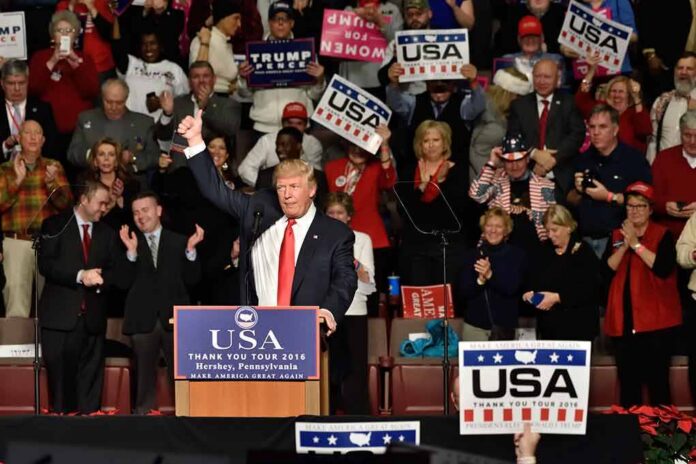
- On-site interviews captured the fusion of pro-Trump and patriotic sentiment, with chants and slogans framing support for him as support for the United States.
- The rally served a practical purpose: mobilizing voters for allied Republican candidates and causes in a state Trump has repeatedly carried by large margins.
- Counter-protests existed but were comparatively small; the dominant visual story remained crowd energy inside and outside the venue.
What Happened: A Rally Built to Showcase Enthusiasm and Loyalty
Durant’s Choctaw Event Center became a field test of the core political commodity rallies are designed to manufacture and display: enthusiasm. Hours before the program began, local reporters documented lines of attendees braving the rain to secure entry, describing “numerous supporters” who arrived early and waited in place to ensure they would hear the president in person. This pre-rally devotion matters. In political fieldwork, willingness to endure inconvenience—weather, time, travel—often predicts a campaign’s ability to translate attention into turnout, volunteering, and peer-to-peer advocacy. On-site quotes in Oklahoma media captured the mood with blunt clarity: supporters explicitly tied their praise for Trump to patriotic identity, pivoting easily from “I support Trump” to “I support the U.S.A.” and familiar chants.
Inside, the event executed the standard choreography of modern campaign production: local and national figures offering testimonials, a color guard and anthem to frame the stakes, and a cascade of issue touchpoints—taxes, crime, border security, manufacturing—that align personal admiration for the principal with policy preferences and down-ballot choices. Oklahoma affiliates streamed the program and positioned it as a mobilization push ahead of November, reinforcing the central function of such stops: convert visible enthusiasm into votes for a party slate.
Why Oklahoma, Why Now: Geography, Venue, and Midterm Strategy
The choice of Durant was not incidental. The venue sits in deep-red terrain and near the Texas border, allowing the Republican National Committee to draw from a large catchment area across state lines while highlighting friendly state leaders and contested regional issues. That structure mirrors past strategic stops, where organizers weigh venue capacity, road access, and cross-border media reach to maximize both bodies in seats and impressions through local news. The Choctaw Event Center’s scale, and its protected indoor setting, also neutralize some weather risk while concentrating energy for broadcast and social clips. In short, the selection reflected a familiar campaign logic: go where you dominate, fill the frame with friendly voters, and let the pictures travel.
Bad weather is usually the nemesis of political events; here, persistent rain became a prop rather than an obstacle. Coverage emphasized that attendance and anticipation held despite downpours, a visual trope campaigns welcome because it telegraphs commitment at a glance. Doors-and-lines footage functions as political B-roll with narrative punch: it suggests inevitability without a single word spoken from the stage.
What Supporters Said—and What That Signals
The on-the-ground quotes captured by Oklahoma outlets distilled a broader pattern that researchers of campaign spectacle recognize: the merging of personal loyalty and national identity. The supporter who said, “I support Trump, and I support the U.S.A.,” then shifted to a MAGA chant offered the sound-bite version of this fusion. Such utterances work as movement shorthand; they compress politics into a loyalty signal that is legible to fellow supporters and opponents alike. That dynamic is why campaigns invest in repetition rituals—chants, call-and-response lines, and emblematic slogans—because they reinforce in-group cohesion and make the event itself a memory that can be told and retold across social networks and communities.
This is also why rallies feature local validators—statewide officials, candidates, and recognizable community voices—to translate national themes into locally resonant stakes. Oklahoma coverage framed the stop as a rally for GOP candidates and causes; organizers used the shared space of admiration for Trump to lift allied names and initiatives that benefit from the attention dividend a presidential visit brings.
The Counter-Scene: Protests and the Optics Game
Durant did have opposition activity, as is typical of presidential visits. Local reporting described a small, organized protest near the event site; it registered as a presence, not a challenge to the central narrative of the day. This asymmetry is not new. Rally coverage, especially for polarizing figures, tends to devolve into a contest over frames: dominant images of packed rooms and palpable enthusiasm on one side; visuals of protest lines and dissent signage on the other. The question is seldom who is right; it is whose images saturate the evening news and social feeds. In Durant, the balance of available footage and quotes skewed clearly to the rally’s intended tableau—large, friendly, weather-defying crowds with straightforward admiration for the principal.
The logic behind this contest of optics has been studied for years: journalists select crowd images and emotional cues that capture attention, and campaigns seek to furnish them with the most persuasive material possible. Both sides know that enthusiasm signals can shape perceptions of momentum and viability, especially among low-information voters who use crowd visuals as heuristics for political strength.
Mechanics of a Modern Rally: From Door Times to Down-Ballot Lift
Operationally, the Durant stop followed a familiar script. Tickets were free and distributed online—useful for contact capture and follow-up outreach even if seats are first-come, first-served. Door times and program schedules create a runway for local media to set the scene with footage of growing lines and interviews from the queue; that is when the most authentic expressions of supporter sentiment surface, and it is precisely where reporters noted the most visible admiration for Trump’s leadership and work ethic. Inside, the run-of-show stitched together local concerns and national priorities, all in the service of sending attendees home not just affirmed but activated—bring a neighbor, vote early if available, and contribute labor or money before Election Day.
For the campaign, this is as much logistics as it is message. The data harvested from sign-ups, the earned media from local outlets, and the short-form clips that supporters propagate afterward constitute the durable value of a rally day. The chants and quotes are memorable because they compress that value into sharable form—and because they anchor the narrative that the candidate’s coalition is not just alive but energized.
President Trump Speaks at Durant Rally, Highlights Oklahoma Energy, Family Farms and Economy https://t.co/UArLOPYYJF pic.twitter.com/yPX00QVlAh
— Ron Hays (@Ron_on_RON) October 2, 2026
What to Watch Next
In Oklahoma, rallies like this do not seek conversion; they seek consolidation and amplification. Expect the Durant event to ripple outward in three ways. First, localized turnout effects driven by fresh contact lists and renewed volunteer commitments. Second, fundraising and social metrics that spike off the back of strong visuals. Third, message discipline: the same lines, chants, and claims will reappear in subsequent stops, training the audience—both in-room and online—to repeat them. None of this guarantees electoral outcomes, but it does ensure that the campaign’s most valuable resource—visible, insistent enthusiasm—remains on display where cameras and voters can see it.
Sources:
facebook.com, koco.com, kosu.org, yahoo.com, ksl.com, news9.com, nbcnews.com