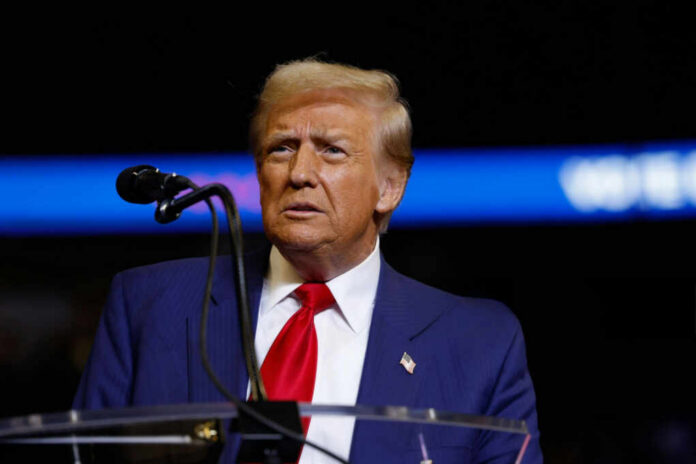
With war questions hanging in the air, President Trump still flew to a closed-door donor dinner—fueling fresh debate over whether Washington’s priorities match what voters are living through.
Story Snapshot
- President Donald Trump traveled to Charlottesville, Virginia, on April 10, 2026, for a MAGA Inc. fundraiser at Trump Winery.
- Reporters confronted Trump en route about the administration’s ongoing Iran-related conflict, which critics frame as a “war-of-choice.”
- The trip marked Trump’s first return to Charlottesville since the 2017 “Unite the Right” controversy, reviving old local tensions and national narratives.
- Local activists and Progress Virginia organized opposition while early voting was underway in Virginia, adding an election-season edge to the visit.
Charlottesville Trip Blends Fundraising and Crisis Politics
President Donald Trump traveled from Washington, D.C., to Charlottesville on April 10, 2026, for a political fundraising stop at Trump Winery, a business associated with the Trump family and nominally owned by Eric Trump. Local reporting described the schedule as including a MAGA Inc. meeting and a roundtable dinner. The visit landed at a politically sensitive moment, with reporters raising questions about the administration’s Iran-related crisis while Trump headed to the event.
That basic juxtaposition—foreign-policy pressure and private fundraising in the same news cycle—captures a broader frustration many Americans share: leaders can appear pulled more by campaign machinery than by day-to-day governance. Supporters argue political operations are a constant reality in modern Washington, while critics see it as proof the system is built to keep power circulating among well-connected insiders. The available accounts do not provide detailed transcripts of the exchange with reporters, limiting a full assessment of what was asked and answered.
Reporters Press Trump on Iran as Details Remain Sparse
Media commentary outlets reported that Trump faced questions from reporters about the Iran situation while traveling to the Charlottesville fundraiser. Critics described the conflict as a “war-of-choice,” but the research provided includes no direct quotes from Trump in response and no detailed breakdown of what prompted the confrontation beyond the existence of an ongoing international crisis. Without a fuller record of the questions and answers, claims about the substance of the exchange remain difficult to verify from the available material.
For conservatives who prioritize peace through strength, the missing detail matters. Voters typically want clarity on objectives, costs, and end states when U.S. power is used abroad—especially after years of public skepticism shaped by Iraq and Afghanistan. For liberals wary of military escalation, the same lack of transparency raises parallel concerns about accountability. In practical terms, the episode shows how fast foreign policy can become political theater, with headlines shaped as much by optics as by hard information.
A Return to a City Still Defined by 2017 Tensions
Trump’s visit also carried local historical weight. It was his first return to Charlottesville since the 2017 Unite the Right rally and the death of Heather Heyer, an event that left enduring scars and drove years of political messaging about Trump’s response. Activists highlighted those memories as a reason to oppose his appearance, while supporters viewed the stop as a normal presidential trip to a private venue. Either way, Charlottesville again became a national stage for America’s cultural and political divide.
Activists Attack the Winery and MAGA Inc., Spotlighting Trust Issues
Progress Virginia, through interim executive director Ashleigh Crocker, publicly argued Trump’s visit served “no public purpose,” and criticized the winery’s labor practices and the effects of tariffs on the wine industry. Those claims were presented as advocacy messaging, not adjudicated findings, in the research provided. The same source also described MAGA Inc. in harsh terms, illustrating how political nonprofits and super PAC-style groups have become lightning rods for voters who believe influence is routinely bought and sold.
The broader implication is not confined to one party: Americans across the spectrum increasingly suspect that fundraising and institutional self-preservation drive decision-making more than practical problem-solving. With early voting underway in Virginia, both parties had incentives to nationalize the moment—Republicans to energize their donor network and Democrats and aligned groups to portray the administration as distracted or ethically compromised. That’s a familiar cycle in 2026: politics runs continuously, even when governance demands focus.
Trump Confronted Over War By Reporters On Way to Fundraiser at His Winery https://t.co/tbDnSNtNuH
— Mediaite (@Mediaite) April 11, 2026
For voters trying to separate signal from noise, the key fact pattern is straightforward: the Charlottesville trip happened, the fundraiser proceeded, and reporters did challenge Trump over Iran during the travel window. Everything beyond that—whether the clash shows misplaced priorities, justified scrutiny, or media-driven spectacle—depends on details that are thin in the current public record. If additional transcripts, pool reports, or official statements emerge, the political meaning of the moment may change quickly.
Sources:
Trump is coming to Charlottesville TODAY (April 10) Let’s show him how unwelcome he is
The Daily Show Finds “Progress” In McKinney: “Nobody Is Dead”
President Donald Trump set to attend event in Charlottesville on Friday at Trump Winery (April 2026)