

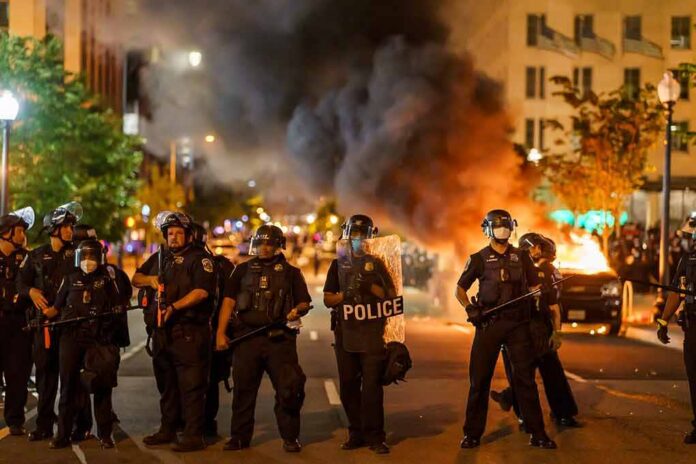
France ordered localized night curfews after town halls burned and businesses were looted during a violent weekend.
Story Snapshot
- France’s prime minister told local officials to impose “partial” curfews after two nights of unrest.
- The goal is to stop more rioting and protect businesses without a nationwide lockdown.
- The government said curfews are a narrower step than a state of emergency, which remains a backup.
- At least one northern city, Denain, adopted a 9 p.m.–6 a.m. curfew covering adults and minors.
Government Moves To Contain Violence Without Full Emergency
French Prime Minister Sébastien Lecornu asked local authorities on Monday to impose “local and partial” curfews after a weekend of violent protests, looting, and attacks on public buildings. Lecornu said the aim was to prevent further rioting while protecting businesses at risk from nighttime vandalism. He rejected a blanket lockdown, saying it was “out of the question” to place all of Paris under curfew. He also said a national state of emergency could be used later if needed.
Officials framed the step as targeted and temporary. Reports said the Interior Ministry and prefects would consult with mayors to shape each order. The government’s message stressed speed and flexibility over uniform rules. The approach mirrors past French responses to urban unrest, which often rely on local tools first. The decision followed images of burned town halls and smashed storefronts that spread over the weekend, raising pressure to show control on Monday night.
What Will Curfews Look Like On The Ground
Lecornu did not list every city or spell out exact hours at the time of the announcement. He said details would come from local decrees after talks with municipal leaders. That means curfews can vary by neighborhood, time window, and scope. One northern example came fast: the mayor of Denain announced a curfew from 9 p.m. to 6 a.m., covering both adults and minors for several nights. That order signaled how strict some towns may be during peak risk hours.
Officials linked the policy to a clear goal: stop nighttime flash mobs, protect shops, and ease the strain on police. They argued a curfew is more focused than nationwide limits and could be lifted as calm returns. The government did not present data on expected impact during the rollout. Supporters say curfews limit movement and make it easier to spot offenders. Critics often ask if bans on gatherings or stronger policing might work as well with fewer side effects.
Why This Matters Beyond France
France has used movement limits before when unrest spikes. In 2005, widespread riots led the government to rely on a 1955 emergency law that enabled curfews and broader police powers. That history shows curfews can be part of restoring order. It also shows how quickly tools can expand under emergency rules if violence spreads. Today’s plan is narrower than a national emergency, yet leaders kept that option on the table if local steps fail.
For readers in the United States, the lesson is about power and tradeoffs. Leaders often reach for fast tools when streets burn and shops are looted. People on the right worry that elites use crisis to grow the state. People on the left worry about unequal enforcement and harm to peaceful residents. Both see a pattern: when government waits too long to act, the fix can be blunt. When it moves fast, details lag and trust suffers. France is walking that tightrope now.
What To Watch Next
Watch which cities post formal decrees, including maps, hours, and exemptions for work and emergencies. Note how police enforce the rules and whether arrests fall during curfew hours. Track whether businesses reopen and whether fires, assaults, and looting drop in hot spots. If violence continues, the government may escalate to a state of emergency with broader powers, as mentioned by Lecornu. If calm returns, local orders could be rolled back within days.
In a departure from promises made yesterday by President Macron not to impose curfew, the 🇫🇷French Prime Minister Sébastien Lecornu today announced “limited" and "localised" curfews in response to the nationwide riots.
The formerly know “student protests” escalated the last… pic.twitter.com/A04loew0jI
— Dovydas Vitkauskas (@Dovydas44444) October 19, 2026
Also watch for hard numbers. Clear incident counts by city and time of night will show if curfews line up with when violence peaks. That evidence matters for trust. If officials publish timely data and narrow orders, they may prove curfews can be sharp tools, not blunt ones. If not, the move risks feeding a belief shared by many citizens across ideologies: that those in charge change the rules first and explain the plan later.
Sources:
insiderpaper.com, france24.com, reuters.com, bostonglobe.com, pbs.org, charter97.org