

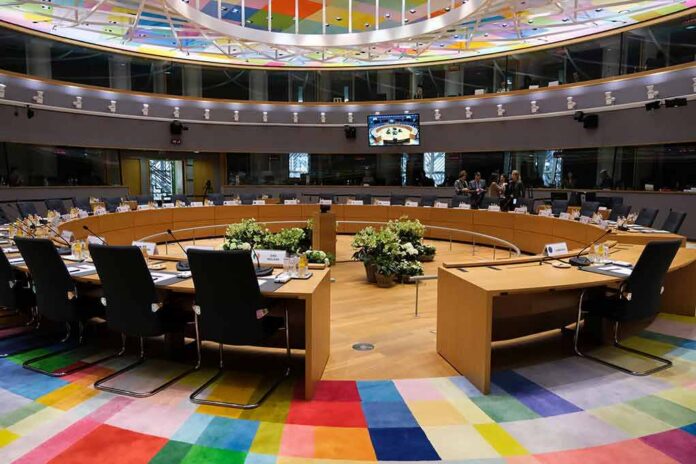
Europe says it is ready to sit down with Moscow on Ukraine, but Moscow now signals Europe must first prove its value to join the talks.
Story Snapshot
- European leaders pushed for a direct role in Ukraine peace talks and named a team to represent Europe.
- United States envoys said Europe would be included in the next meeting, and Ukraine welcomed that step.
- Russia acknowledged Europe’s stake in security talks, yet stopped short of confirming the format.
- Kremlin officials tied European participation to “constructive” intentions, keeping control over who gets in.
Europe Moves From Demands To A Named Representation
European leaders said they would no longer accept talks about Ukraine that cut Europe out. They argued the war hits European security, energy prices, and budgets. European Council President António Costa identified a structure to represent Europe. It would include European Union institutions and five nations: France, Germany, Italy, Poland, and the United Kingdom. This moves Europe’s stance from a general demand to a concrete plan for a seat at the table.
European governments framed the step as basic fairness and hard security. They said decisions on borders, sanctions, and weapons affect their people and must not be made without them. Officials pointed to earlier formats where Europe had a role. They cited the Normandy Format, which brought France and Germany into talks after 2014. That history gives Europe a basis to be inside the talks again, even if past efforts fell short of a lasting peace.
Washington And Kyiv Signal Openness To Europe Joining
United States envoys in Moscow told reporters that Europeans would join the next round. That statement suggested a wider table after initial meetings with Russia and Ukraine. Ukraine’s President Volodymyr Zelenskyy welcomed Europe’s entry. He hoped the agenda would cover a ceasefire and steps to calm the front. Those signals showed alignment between Kyiv and Washington on Europe’s presence, at least in principle.
For many in Europe, that message sounded like overdue respect. The continent has borne refugee flows, defense costs, and economic shocks. Leaders argued that any ceasefire or security deal will live or die in Europe. If aid, sanctions, and border security will enforce any future deal, Europe needs real input. Backers say this is not about pride. It is about building an agreement that can be carried out by those who must carry the weight.
Moscow’s Mixed Signals Keep The Gate Half Open
President Vladimir Putin said Russia had proposed contacts with Europeans to clarify their position. He also said Europe could not be left out of any discussion on European security. Those lines recognized Europe’s stake. Yet key Kremlin voices then said the format of the next meeting had not been agreed with Russia. That created uncertainty over who would attend and on what terms.
Kremlin spokesman Dmitry Peskov added conditions. He said any broader talks would depend on Europe showing real intent and readiness to contribute. That framing keeps control in Moscow’s hands. It lets Russia judge whether Europe’s role will be symbolic or substantive. It also risks turning a promised seat into a test Europe must pass before entering the room.
What “Full Role” Means And Why It Matters To Voters
European officials talked about a “seat at the table,” but the mandate is not yet public. No document sets veto power, co-sign rights, or control over security guarantees. Without that, participation can mean listening rather than deciding. That gap worries people on both left and right. They fear big powers will make choices while others watch, and that costs and risks will fall on regular families, not on elites.
❗️Security advisers from Germany, France and the UK could travel to Moscow as early as November for talks with the Kremlin on a possible peace settlement in Ukraine, Radio Free Europe/Radio Liberty reports, citing several anonymous sources. Putin's aide Yuri Ushakov reportedly…
— NOELREPORTS 🇪🇺 🇺🇦 (@NOELreports) November 20, 2026
For Americans, the stakes are simple. If Europe helps shape and enforce any deal, the burden on United States troops, taxpayers, and energy markets could fall. If Europe is sidelined, Washington may carry more cost and blame. For Europeans, a true role could protect borders, limit energy shocks, and set clear rules for aid and sanctions. The wrong kind of role could turn them into check writers without real say, which many already resent.
The Road Ahead: Participation, Authority, And Implementation
The story now turns on four linked questions. Participation asks who sits in the meeting. Representation asks who speaks for Europe. Authority asks who can commit to terms. Implementation asks who will enforce promises once the cameras leave. Past frameworks show that getting a chair is only step one. Power comes from a clear mandate, money, and the means to enforce a ceasefire on the ground if one is reached.
Sources:
afp.com, bbc.com, reuters.com, lemonde.fr, edition.cnn.com, charlotteobserver.com, dw.com