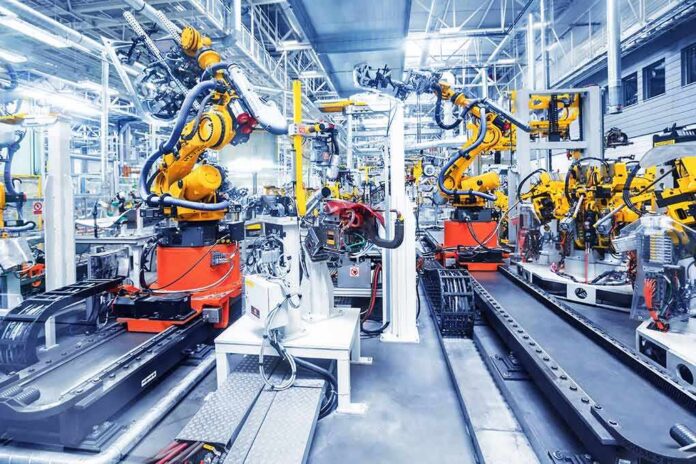
As robots spread through American factories and warehouses, evidence shows they are quietly cutting union power and reshaping who gets affordable goods—and who gets left behind.
Story Snapshot
- Robot adoption is strongly linked to falling union membership and weaker worker bargaining power.
- Automation displaces many middle-class, often union, jobs even as it promises lower prices and higher productivity.
- Unions often fight robots to protect older skilled workers, which can push more of the pain onto younger and less educated workers.
- Some unions are now trying to shape how artificial intelligence and robots are used, rather than ban them outright.
Robots, Unions, and the Affordability Promise
Researchers tracking robot use across regions find a clear pattern: places with more robots see union strength drop. In one large study, higher exposure to robots was tied to sharp declines in union density and a shift from union-heavy industries to sectors where unions are weak or absent. This matters for affordability because unions have historically pushed up wages and benefits in manufacturing, which also raised costs. As companies automate, they can cut labor costs and promise cheaper goods—but at the cost of union jobs.
Another line of research looks at individual workers in routine jobs, like assembly or basic machine operation. Union members in these roles are more likely to stay employed, avoid long stretches of unemployment, and keep somewhat higher earnings over time than similar non-union workers. In plain terms, unions cushion the blow of automation for many workers. That protection, though, can also slow down how quickly firms change job structures, which frustrates business leaders and some economists who want faster productivity gains.
How Automation Hits Jobs and Union Membership
National studies estimate that nearly half of United States jobs could be automated within about twenty years as smart machines improve. One widely cited figure suggests that each additional robot per thousand workers in a local economy is linked to around 5.6 jobs lost, mostly in middle-class occupations where union membership has traditionally been high. These are not fringe gigs; they are the kind of stable jobs many Americans relied on to buy a home, raise a family, and climb into the middle class.
At the workplace level, automation does more than cut jobs; it changes who gets hired and who leaves. Detailed data show that when establishments adopt automation, it tends to replace senior, skilled production workers with younger, less skilled workers—unless there is a union. Where unions exist, they work to block this shift, protecting incumbent, often older members and limiting the churn in hiring and firing. This defense helps those already inside the union but can make it harder for young workers to get a foothold, and it can shrink overall employment for low-educated youth when robot exposure is high.
Why Unions Fear Robots—and Why Economists Push Back
Union leaders worry that robots undermine strikes and bargaining by allowing companies to keep operating with fewer union workers. Classic research notes that automation can erode solidarity, create more technical jobs outside the bargaining unit, and let corporations reorganize across industries in ways unions struggle to match. When firms can keep production running during a strike using machines or non-union staff, the union’s main source of leverage—stopping work—gets weaker. Critics of unions say that this shift is “efficient,” because it reduces what they view as costly work stoppages.
Economists on the pro-automation side stress that higher productivity from robots can expand the overall economy and, in theory, lower prices for consumers. Their argument is simple: if companies can make more goods with fewer workers, costs fall and families can afford more. But this view often glosses over who bears the pain in the transition. Several studies show that the union decline linked to robots is driven by jobs moving out of unionized manufacturing into less unionized sectors, not by workers suddenly abandoning unions inside those factories. So the fall in unionization is less a free “choice” and more a result of entire job categories disappearing.
Unions Are Divided: Resist, Adapt, or Control the Tech
Union attitudes toward automation are not all the same. Research on union politics finds that unions with narrow, specialized memberships are more likely to resist automation because they internalize more of the job loss and fewer of the benefits. In contrast, unions that represent a wide mix of occupations sometimes accept or even support automation when they can secure improved conditions, job security, or better pay for the workers who remain. This split helps explain why some unions fight robots tooth and nail while others focus on shaping how technology is rolled out.
In the artificial intelligence space, major unions and allied groups now say they do not oppose technology itself; they oppose unregulated, one-sided use that hurts workers. The American Federation of Labor and Congress of Industrial Organizations (AFL-CIO) has launched a Technology Institute to study and guide artificial intelligence, and unions in hospitality and entertainment have bargained for rules on when employers can introduce new tech, how they can track workers, and what jobs must be protected. These efforts hint at a middle path: instead of banning robots, unions seek contracts that guarantee notice, retraining, job protections, and fair sharing of productivity gains.
What It Means for Democrats, Republicans, and Ordinary Voters
All of this plays out against a political backdrop where Democrats talk about affordability and working families, while Republicans push national strength and competition with countries like China through faster automation. Corporate and political leaders frame robots and artificial intelligence as essential for security and staying ahead, which makes union worries sound like old-fashioned resistance to progress. Yet the research shows their fears are not imaginary: robot adoption really is linked to job loss in union-heavy sectors and to a measurable drop in union density. That mix of real harm and promised gains feeds the sense on both left and right that the system favors large firms and political elites over regular workers.
Sources:
reason.com, economics.virginia.edu, degruyter.com, static1.squarespace.com, docs.iza.org, committees.parliament.uk, aflcio.org, medialibrary.uantwerpen.be, journals.sagepub.com, conversioncapital.com, sixdegreesofrobotics.substack.com, wol.iza.org