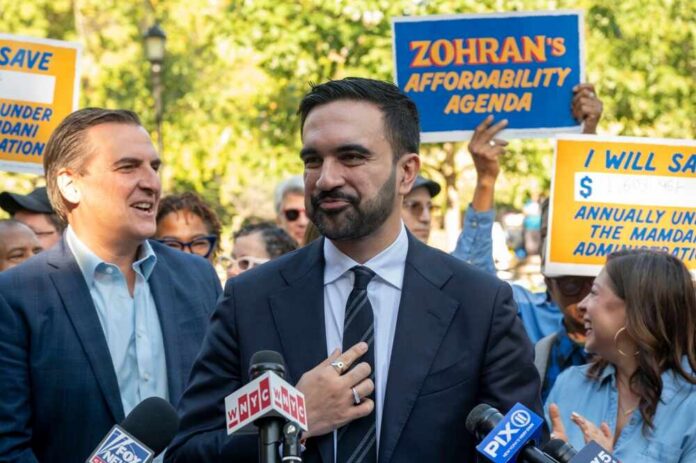
New York City’s newly elected mayor is proposing $4.2 billion in homeless services spending — even as he warns the city faces a “historic” budget crisis — and taxpayers on both sides of the aisle are asking the same question: how does that add up?
At a Glance
- Mayor Zohran Mamdani is pushing a $4.2 billion homeless-services budget while simultaneously declaring the city is in a “historic” fiscal crisis.
- New York City’s own preliminary fiscal year 2027 budget totals $127 billion across all funds, with large portions already locked into education, pensions, and debt service.
- The city is already drawing down its Rainy Day Fund and Retiree Health Benefits Trust to close budget gaps, raising questions about fiscal sustainability.
- Critics note the city already spends an estimated $80,000 per homeless person annually, yet homelessness remains a persistent and visible problem across the five boroughs.
A City Caught Between Crisis and Spending
New York City Mayor Zohran Mamdani has proposed dedicating $4.2 billion to homeless services even as city officials acknowledge a significant budget gap. New York City’s Office of Management and Budget has outlined a $127 billion All Funds plan for fiscal year 2027, but that plan includes drawing down $980 million from the Rainy Day Fund in fiscal year 2026 and $229 million from the Retiree Health Benefits Trust in fiscal year 2027 — signs of a city already leaning on financial reserves to stay afloat.
For everyday New Yorkers — whether they lean left or right — the optics are jarring. A mayor who ran on fixing broken government is now proposing one of the largest homeless-services budgets in the city’s history while simultaneously warning that the fiscal situation is dire. That contradiction is fueling frustration across the political spectrum, not just among conservatives who oppose the spending, but also among progressives who question whether billions of dollars are actually solving the problem.
What the Budget Actually Shows
The city’s preliminary fiscal year 2027 budget is dominated by structural obligations that leave little room for major new discretionary spending. Education through the New York City Department of Education, social services, pension contributions, and debt service consume the lion’s share of existing appropriations. These are largely fixed costs that grow year over year regardless of political will. Adding a large homeless-services commitment on top of that structure means either cutting elsewhere, raising revenue, or borrowing — none of which are painless options.
Governor Kathy Hochul has publicly stated she is done raising taxes, drawing a hard line that limits the state’s willingness to bail out city spending plans. That position puts Mamdani in a difficult spot: he must either find cuts in an already strained budget or defend a large homeless-services allocation without a clear funding source. The absence of a detailed, publicly available line-item breakdown of what the $4.2 billion would actually fund — shelters, outreach, supportive housing, rental assistance, or administrative overhead — makes it nearly impossible for the public to evaluate the proposal on its merits.
The $80,000 Question Nobody Wants to Answer
Critics of New York City’s homeless policy have long pointed to a striking figure: the city reportedly spends approximately $80,000 per homeless person annually. If accurate, that number raises a legitimate question that both conservatives and liberals should be asking — where is all that money going, and why hasn’t it produced better outcomes? Street homelessness remains visible throughout Manhattan, Brooklyn, and the outer boroughs, and shelter capacity disputes continue to generate lawsuits and community protests.
Zohran Mamdani Wants NYC to Spend $4.2 BILLION on Services for the Homeless After Claiming City is in 'Historic' Budget Crisis = lol https://t.co/UT8YfXMExT #gatewaypundit via @gatewaypundit
— Frizz (@FrizzTm) May 23, 2026
A recent legal battle in the East Village illustrates exactly how these tensions play out on the ground. Residents sued after city officials moved to relocate a men’s homeless shelter from Bellevue Hospital into their neighborhood, arguing the city was making siting decisions without adequate community input. That fight is a microcosm of a broader problem: billions of dollars in homeless-services spending have not resolved the underlying crisis, and neighborhoods are increasingly pushing back against policies they had no voice in shaping. Whether Mamdani’s $4.2 billion proposal would change that dynamic — or simply pour more money into a system that has struggled to deliver results — remains an open and urgent question that city officials have yet to answer with hard evidence.
Sources:
[1] Web – [PDF] The City of New York Preliminary Budget Fiscal Year 2027 – …
[2] Web – Sam T. Pirozzolo | NYC Votes