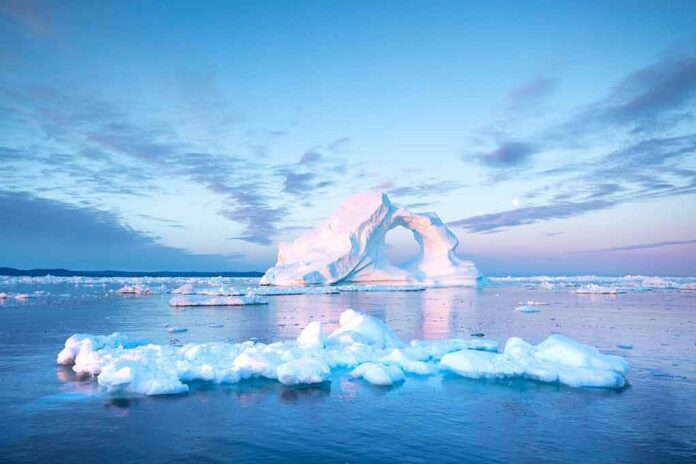
Freshwater from Greenland’s melting ice is helping set up fiercer European summer heatwaves months later, according to new research.
Story Highlights
- Studies link North Atlantic freshwater surges to hotter, drier European summers.
- Reported pattern: the hottest, driest summers often follow big Greenland meltwater releases.
- Proposed chain: meltwater shifts ocean temperatures and nudges the jet stream toward heatwaves.
- Scientists still debate parts of the mechanism and how well models capture it.
What the new studies say about the Greenland–Europe link
Researchers reported that freshwater anomalies in the subpolar North Atlantic are tied to warmer, drier European summers in the following year. The 2024 peer‑reviewed paper describes how stronger freshwater events sharpen winter sea surface temperature fronts, which can affect the atmosphere and steer summer patterns over Europe. Science outlets summarized a clear signal: many of Europe’s hottest and driest summers came after large Greenland meltwater pulses, pointing to a repeatable setup for extreme heat.
Coverage explains a plausible chain of cause. Greenland melt adds cold, fresh water to the North Atlantic. That freshening can reshape local ocean temperatures and pressure. The changes then influence the jet stream’s path, which can stall hot, dry weather over western and southern Europe. The same reporting says this link may help predict high‑impact summer heat and drought months ahead, offering time for planning by farmers, power grids, and health services if confirmed.
How strong is the evidence, and what remains uncertain
The 2024 journal study rests on observations and reanalysis, not only on models, which strengthens its real‑world tie. Still, parts of the public record describe an emerging line of work. Some scientists highlight gaps, like the exact role of the North Atlantic “cold blob” and how much of it comes from Greenland melt versus other drivers. Others note that climate models can miss narrow freshwater inputs, which could make them underplay this pathway’s impact if the mechanism proves robust.
Separate modeling work looks beyond summer heat and into the Atlantic overturning current. Those studies find Greenland meltwater worsens the long‑term weakening driven by greenhouse gases but does not cause sudden, irreversible collapse this century. The research describes weakening that continues but remains non‑abrupt and reversible on century scales in tested setups, which tempers apocalyptic claims while keeping long‑run risks on the table.
Why this matters for everyday life, energy, and trust in institutions
European heatwaves strain power grids, hit crops, and push hospitals to the limit. If freshwater signals can flag higher summer risk months in advance, water managers and grid operators can move faster. Farmers can choose hardier crops or shift planting windows. Cities can stage cooling centers and target help for the elderly. Early warnings save money and lives when the signals are reliable, even if they do not catch every event.
People across the political spectrum worry that leaders react after the damage is done. This line of research points to practical foresight rather than slogans. But it also exposes a gap many Americans resent: models and agencies may miss real‑world risks, then shrug when families pay higher food and energy bills. Transparent methods, open data, and clear limits would build trust. Accurate seasonal guidance would also help markets price risk before shocks hit wallets.
What to watch next: validation, replication, and usable forecasts
Scientists say the next steps are clear. First, publish full methods and datasets for the newest studies so others can test them. Second, run independent checks using other models and observations to confirm that freshwater anomalies raise the odds of European heat and drought. Third, measure each link in the chain, from meltwater to sea temperatures to jet stream shifts, to prove cause, not just correlation. Progress on these fronts will decide how quickly agencies fold this signal into forecasts.
Sources:
newscientist.com, courrierinternational.com, gmao.gsfc.nasa.gov, meetingorganizer.copernicus.org, climate.copernicus.eu, nature.com