While political institutions continue to divide Americans on nearly every issue, a small Massachusetts community drew national attention after hundreds of strangers gathered to honor a 98-year-old World War II veteran who reportedly had no known living family.
Story Snapshot
- Local veteran officials put out a public call for mourners after learning a 98‑year‑old World War II Navy veteran had no known living family.
- Hundreds of strangers, along with police, firefighters, and fellow veterans, packed a church in Hanson, Massachusetts, to honor him. [1][3]
- The veteran, John Bernard Arnold III, served in the United States Navy during World War II and spent his later years in a veterans home. [1][2]
- The emotional turnout highlights how regular Americans still rally to honor service while political and bureaucratic institutions often fail living veterans. [1][3]
A Final Salute For A Veteran Who Had “No Known Family”
Hanover and Hanson Veteran Services in Massachusetts posted a public plea on social media asking people to attend the funeral of World War II Navy veteran John Bernard Arnold III, explaining that he had “no known living family” to be there for his final goodbye. [1][2] That simple notice, shared at a time when many Americans feel ignored by distant elites, sparked a powerful response from ordinary citizens who decided a man who served his country would not be buried alone.
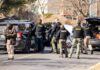
On the day of the funeral at Saint Joseph the Worker Church in Hanson, reporters on the scene described pews filled with mourners and a line stretching down the sidewalk as people waited to get in. [1][3] Coverage consistently refers to “hundreds” of attendees, though some accounts offer higher estimates, underscoring that the exact headcount is uncertain while the scale of the response is not. [1][3] What is clear is that the call resonated far beyond a small circle of acquaintances.
Who Was John Bernard Arnold III?
News reports identify Arnold as a 98-year-old Navy veteran originally connected to East Bridgewater, Massachusetts, who served during World War II.[1][2] According to obituary information and local coverage, he graduated from Rogers High School in Newport, Rhode Island, and later attended Rhode Island State University before entering military service.[1] Reports state that Arnold never married and had no children, while both of his parents died many years earlier.[1][2]
He reportedly passed away on May 6 after spending much of his later life in a veterans care facility, where staff members and fellow residents became his primary social community.[2] Caregivers and acquaintances interviewed by local media recalled Arnold sharing stories about serving aboard a Navy vessel and traveling throughout parts of Europe and the Mediterranean during the war.[1] For many readers and attendees, the image of a wartime veteran reaching the end of his life without close family nearby resonated deeply amid broader concerns about aging, loneliness, and the treatment of former service members in modern America.
Community Response In A Time Of Distrust
People who attended the funeral described a broad cross‑section of the community: veterans, police officers, firefighters, emergency medical workers, and civilians who heard about the service from local media or social media posts. [3] News footage shows American flags, a police escort, and citizens standing at attention as Arnold’s casket was taken to Cedar Knoll Cemetery in Taunton. [1][2] One veteran told a television crew, “We’ll never let one of our veterans pass without being honored and sent off with respect and dignity.” [3]
That kind of statement resonates in a country where both conservatives and liberals increasingly feel that powerful institutions talk about “supporting the troops” but often fail them in practice. Many older Americans still remember scandals at the Department of Veterans Affairs (VA), long wait times for care, and bureaucratic indifference to mental health and homelessness among former service members. Events like Arnold’s funeral highlight a contrast: while agencies and politicians struggle to deliver basic competence, local communities can still mobilize quickly when they sense a moral obligation. [1][3]
What This Moment Reveals About America Now
Stories of strangers attending funerals for isolated veterans are not new, but they strike harder in an era when citizens on both the left and right believe the system is rigged for the well‑connected. Sociologists have observed that when older adults die without close family, religious institutions, neighbors, and veteran organizations often step in to make sure they are not forgotten. [1][2] For many, that feels closer to the country’s founding ideal of shared duty than anything coming out of Congress or federal agencies today.
🕊️ FINAL SALUTE: He had no known family left, but hundreds of strangers made sure WWII veteran John Bernard Arnold III was never alone. A packed funeral served as the ultimate thank you to a 98-year-old hero. True American spirit on display. 🇺🇸✨
— Fiona Smith (@nidisdnikki) May 19, 2026
At the same time, the coverage around Arnold’s funeral shows both the power and limits of viral, feel‑good narratives. Reporters agree that the turnout was large and that people came to honor a man they never met, but the exact number of attendees and the details of his service rely on secondary reporting and a single public notice, not official records. [1][3] None of that changes the core fact that ordinary Americans stepped up when asked. It does suggest that if we can still unite to honor a forgotten veteran, we might also demand that the institutions which claim to represent us live up to the same standard of respect and responsibility.
Sources:
[1] Web – Hundreds Attend Funeral Of WWII Veteran With No Known Living …
[2] Web – Public invited to funeral for WWII veteran with ‘no known family to …
[3] YouTube – Community honors World War II veteran laid to rest with no known …