

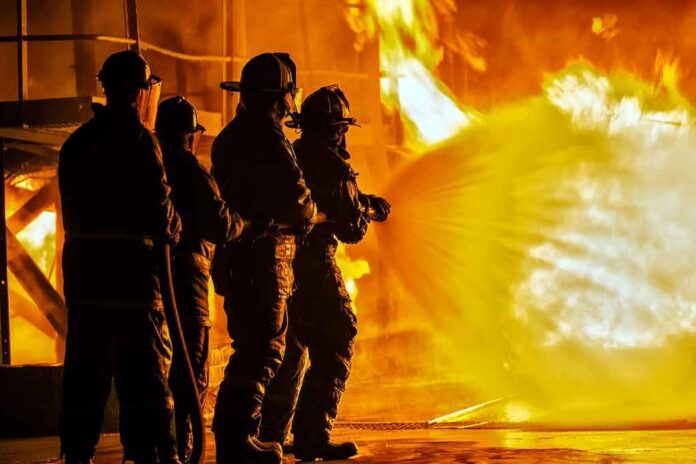
Six people died after a fast-moving house fire tore through a Sunset Park home before dawn, collapsing the stairs and trapping families inside.
Story Snapshot
- Fire at 653 58th Street killed six people; several others were hurt
- Firefighters arrived within minutes; alarms rose to three as flames spread
- Main staircase partially collapsed; crews used a portable ladder for rescues
- Cause under investigation; a lithium-ion battery was found at the scene
What happened on 58th Street
New York City firefighters rushed to 653 58th Street in Sunset Park around 1:43 a.m. after a 911 call reported a house fire. Crews found the first and second floors burning hard as smoke filled the block. Officials said four adults died at the scene. Two more people died at a hospital after being pulled out alive but in critical condition. Reports varied on injuries, with seven to nine people hurt, including firefighters and civilians.
Fire commanders raised the incident to three alarms as more units arrived. News outlets reported the response drew more than 200 firefighters and emergency medical workers. The first and second stories were fully involved, and the fire damaged parts of the structure. Flames also affected an adjacent building, adding to the complexity of the attack. Crews knocked back the main body of fire before 2:40 a.m., then searched for victims and hidden embers.
Why escape and rescue were so hard
Responders said the main staircase inside the home partially collapsed during the blaze. That collapse cut off the most direct path for people trying to get out and for firefighters trying to reach bedrooms. Crews threw a portable ladder between floors to move in and out. That pivot cost time and added risk while smoke and heat grew. Reports also described a second-floor collapse, which made interior movement more dangerous and slowed rescues.
The fire’s speed and the layout of the building added to the danger. Narrow halls and interior stairs can act like chimneys when doors are left open or fail, pulling heat upward in seconds. Firefighters train for these conditions, but a collapse forces them to change plans on the fly. In Sunset Park, they split teams between attacking the fire and searching for people despite unstable floors. That is high-risk work even with many companies on scene.
What is known—and what is not—about the cause
Officials said the cause remains under investigation. A hazardous materials team responded after a lithium-ion battery was found at the scene. Outlets reported that fire marshals are examining whether that battery played a role. Early reports used careful language, calling the battery a possible or suspected factor. No final finding has been released. This distinction matters because cause drives future safety steps for homes and for city policy.
New York City has struggled with lithium-ion battery fires in recent years. City data and briefings show officials have worked to cut deaths tied to these batteries through education and enforcement. News reports this year have also tracked spikes in battery-related fires, especially tied to e-bikes, even as some safety gains held. Investigators will review burn patterns, debris, and device records before naming a cause, which can take time.
Why this hits a nerve across the city
Working families in dense neighborhoods face the sharpest risks from fast fires. Multi-story homes, shared spaces, and packed rooms leave little margin when a blaze starts at night. People on the right and the left often agree on this: the system reacts after tragedy, not before. They see slow building fixes, uneven code enforcement, and mixed signals on battery safety as symptoms of a government that too often misses basic duties while focusing on politics.
Six people killed in house fire on 58th Street in Sunset Park Brooklyn Staircase collapse inside. Cause under investigation @1010WINS pic.twitter.com/TKKs3dYXUi
— glenn schuck (@glennschuck) November 5, 2026
Practical steps can save lives while officials finish the probe. Close doors, keep clear exit paths, and store devices away from stairs and sleeping areas. Use certified chargers and follow maker guidance. In older homes, check smoke alarms and add them on every level. Firefighters reached this fire in minutes and still faced a deadly scene. In a crisis, the choices made hours and months earlier—by owners, tenants, and regulators—set the limits on survival.
Sources:
patch.com, cbsnews.com, fox5ny.com, geo.tv, brooklyn.news12.com, nyc.gov