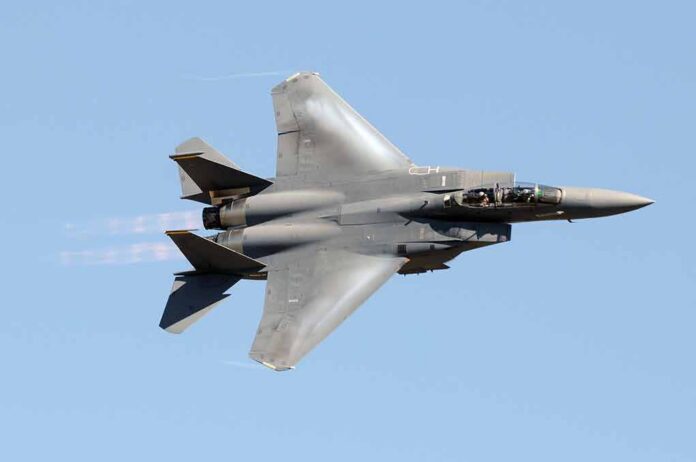
The Air Force’s new F-47 fighter is built not just to beat China’s jets, but to avoid repeating the contract and design trap that let Boeing lose the F-35 and left the Pentagon dependent on one company for a generation.
Story Snapshot
- Boeing’s X-32 design missteps helped it lose the 2001 Joint Strike Fighter contest to Lockheed’s X-35, shaping how the F-35 program unfolded.
- The F-35 contract gave Lockheed Martin control of key technical data, limiting competition and driving long-term costs and frustration inside the U.S. government.
- The Air Force’s new F-47 NGAD fighter, awarded to Boeing, is structured to keep data rights, diversify suppliers, and avoid another “winner-takes-all” monopoly.
- Early secret test jets, modular upgrades, and new contract terms aim to fix the pattern of cost overruns, dependency, and opaque decisions that anger citizens across the political spectrum.
How Boeing Lost the F-35 and What That Meant
Back in 2001, the Pentagon chose Lockheed Martin’s X-35 over Boeing’s X-32 in the Joint Strike Fighter contest, a decision that created today’s F-35 Lightning II fleet. Boeing’s X-32 used a direct-lift thrust‑vectoring system that pushed hot exhaust near the engine intake, which test pilots said caused recirculation, heat issues, and weaker thrust. The demonstrator also relied on a heavy one‑piece delta wing that made it impossible to show short takeoff and vertical landing and supersonic flight in one configuration, unlike the X‑35.
Those choices were partly driven by cost and changing Navy requirements, but they left Boeing flying a prototype that no longer matched its planned production aircraft. Lockheed’s X‑35 instead used a shaft‑driven lift fan and proved a historic short takeoff, supersonic dash, and vertical landing in one flight, helping seal the win. Official downselect documents remain classified, yet most mainstream accounts say Boeing’s design compromises and inability to show all missions in one jet were the key reasons it lost.
The F-35’s Data Trap and Government Frustration
When Lockheed won the Joint Strike Fighter contract, the Pentagon failed to secure full intellectual property rights and technical data for the F-35. That meant the U.S. government did not own the detailed design information needed to let other firms compete for maintenance, upgrades, and software work on equal footing. As the fleet grew into the thousands of jets worldwide, only Lockheed could bid on much of the sustainment work, creating what critics call a “monopoly by contract” that drove costs and limited flexibility.
By 2021, Lockheed held a multi‑billion‑dollar support deal and negotiations over future sustainment grew tense enough that the U.S. government backed away from talks in 2024. This fueled anger not just among budget hawks but across the public, who saw another example of Washington locking itself into a single corporate supplier. Many citizens already believed defense programs favored big contractors and hid real tradeoffs, and the F‑35’s cost overruns and data‑rights problems seemed to confirm that fear of a “deep state” serving itself more than taxpayers.
Designing the F-47 NGAD to Avoid Past Mistakes
Fast forward to the Next Generation Air Dominance fighter: the Air Force has now awarded Boeing the contract for a sixth‑generation jet designated the F‑47, meant to replace the F‑22. Top officials stress that NGAD was built from the start to fix what went wrong with the F‑35. Reports say the government is keeping far stronger data rights, aiming to control the technical information so more than one company can compete to sustain and upgrade the jet over its life. This is a direct answer to the earlier decision that gave Lockheed long‑term control of the F‑35’s ecosystem.
Air Force Chief of Staff Gen. David Allvin says experimental NGAD “X‑planes” have been flying for years, logging hundreds of hours to prove key technologies before the main contract. Boeing’s demonstrator reportedly flew as early as 2018, with Lockheed’s following in 2022, giving engineers time to find problems and fix them while the aircraft was already flying. That early, secret work is meant to cut risk, limit later redesigns, and avoid the sort of rushed changes and mismatched requirements that hurt Boeing’s X‑32 in the 1990s.
What Makes the F-47 Different – and Why It Matters
The F‑47 is planned as a long‑range, stealthy air‑superiority jet built around Pacific combat needs, with a combat radius near 1,000 nautical miles and multiple autonomous drone “wingmen.” Officials promise better range, stealth coatings that are easier to maintain, and a design that can accept modular upgrades over time instead of locking in one contractor’s solution. The Air Force plans to spend about $20 billion in the first five years of development, and cost concerns remain serious, but leaders claim the new structure will allow more competition on support contracts than the F‑35 ever did.
For citizens frustrated with both parties and with huge programs that seem to serve defense giants first, NGAD is a test of whether Washington can learn. The same government that once let a single company own the data for America’s main fighter now says it will own the F‑47’s technical backbone and invite more players to the table. The stakes go beyond jets: this is about whether the federal government can break patterns of opaque deals, one‑sided contracts, and long‑term dependency that undermine trust in the system itself.
Sources:
19fortyfive.com, twz.com, en.wikipedia.org, youtube.com, facebook.com, secretprojects.co.uk, aerospaceweb.org, reddit.com, migflug.com