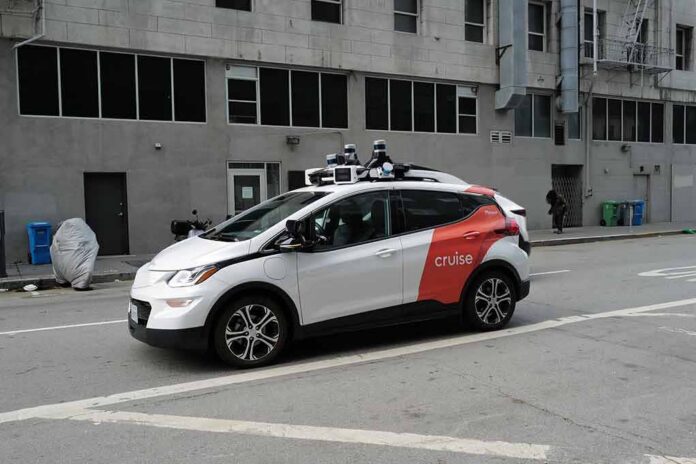
Federal regulators just picked Amazon’s Zoox as the first company allowed to run paid robotaxis with no steering wheel or pedals on U.S. streets, raising big questions about who the government is really looking out for.
Story Snapshot
- Zoox won the first-ever U.S. commercial exemption for a purpose-built robotaxi without human controls, letting it charge for rides.
- The National Highway Traffic Safety Administration (NHTSA) capped deployment at 2,500 vehicles per year for two years and added special reporting rules.
- The same program had already cleared Zoox for demonstration use in 2025 while closing an earlier safety probe.
- This move shows Washington fast-tracking Big Tech’s driverless cars while many Americans feel basic safety and fairness are taking a back seat.
Trump administration makes Zoox the commercial robotaxi trailblazer
Under President Trump, the National Highway Traffic Safety Administration used a special exemption program to name Amazon-owned Zoox the front-runner in the U.S. robotaxi race. The agency granted Zoox the first-ever commercial exemption for a purpose-built robotaxi, a shuttle-like vehicle with four inward-facing seats and no driver controls. Zoox says this ruling gives it federal approval to charge for rides, turning its test service into a paid business once state and city regulators sign off.
NHTSA’s decision sits on top of an earlier step the agency took in 2025, when it issued Zoox a demonstration exemption and closed an investigation into the company’s self-certification claims. That earlier action let Zoox showcase its custom robotaxis on public roads but not collect fares. The new commercial exemption goes further, opening the door for a true robotaxi business model while keeping the vehicles officially unsellable to private buyers for now.
What the exemption allows—and where the limits are
The exemption lets Zoox deploy self-driving vehicles that break several long-standing Federal Motor Vehicle Safety Standards written for human drivers. These standards normally require things like a steering wheel, pedals, mirrors, and certain crash protections designed around a front-facing driver seat. Zoox argued that an automated driving system would handle all driving tasks and that some human-focused equipment no longer made sense on a vehicle built only for riders.
Even with that flexibility, NHTSA did not hand Zoox a blank check. The agency limited the fleet to 2,500 robotaxis per year for two years, creating a maximum of 5,000 vehicles under the exemption. Officials added extra reporting requirements for crashes or cases where the vehicles stop in the wrong place on the road. The agency also said it can revoke the exemption if major safety problems show up, at least in theory keeping a hand on the brake as the technology rolls out.
Safety claims, missing details, and public trust concerns
NHTSA Administrator Jonathan Morrison said Zoox’s systems meet or exceed the performance of a compliant vehicle, and that the agency found the robotaxis “as safe as” vehicles that follow the normal rules. That is a strong statement, especially for cars with no way for a human to grab a wheel in an emergency. But the public record does not yet show the full technical report behind that claim, such as detailed crash tests, simulations, or long-term road data.
Zoox points to years of testing, including free rides on public roads in Las Vegas and San Francisco, as proof that its safety approach works. Still, outsiders cannot easily check how many miles the cars have driven, how often they needed remote help, or how they compare to human drivers in real-world crashes. That lack of hard numbers feeds worries for both conservatives and liberals who already see a federal government that talks about safety while hiding key information behind closed doors.
Big Tech, deep state fears, and the future of everyday driving
For many Americans, the most striking part of this story is not the gadget news—it is the pattern. A giant corporation tied to Big Tech wins a special pass from Washington to bend long-standing safety rules, while ordinary drivers still pay high insurance bills and face crumbling roads. Zoox’s win under a fast-track exemption program looks to some like another case where regulators help shape a market for powerful companies instead of focusing first on protecting regular people.
🚖 Amazon's Zoox Wins First US Approval for Fully Driverless Paid Robotaxis
1. Amazon subsidiary Zoox has secured an exclusive exemption from the NHTSA to deploy purpose-built, fully driverless robotaxis without human controls on public roads.
2. The milestone approval will…— Bobbi – News for You (@bobbi_news) July 31, 2026
Supporters say this is how the United States stays ahead in innovation and that capped, closely watched projects are the safest way to test robotaxis at scale. Critics see a different picture: an agency cutting red tape for steering-wheel-free cars while offering little clear proof that it can or will slam the door if things go wrong. Both right and left can agree on this much—the government’s choice to crown a front-runner in the robotaxi race, with limited public evidence, fits a growing belief that elites in Washington and Silicon Valley are driving the future of transportation without ordinary Americans in the front seat.
Sources:
reason.com, zoox.com, reuters.com, finance.yahoo.com, techcrunch.com, automotiveworld.com, transportation.gov