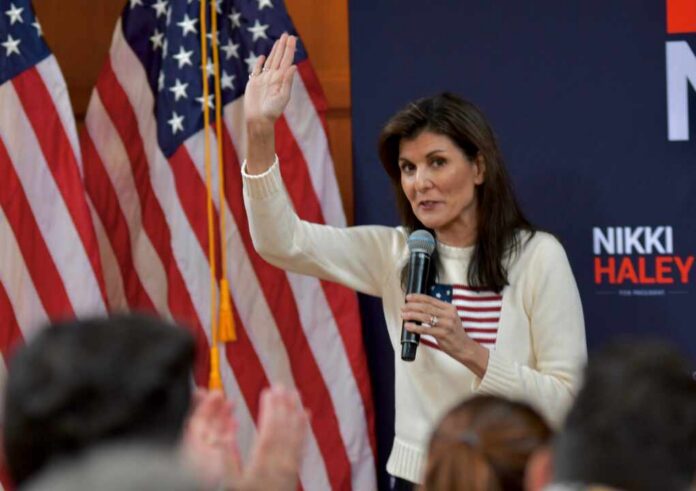
Nikki Haley is warning President Trump that sending U.S. forces to the Middle East without forcing Iran’s regime to truly change could turn strength into surrender.
Quick Take
- Haley urged Trump to make Iran policy a “legacy-defining moment,” pressing for either a tough deal or force that ends Tehran’s enrichment, missiles, and proxy funding.
- Trump said talks with Iran were “very good,” while also confirming an armada is heading to the region and a second deployment is possible.
- Iran’s foreign minister called the talks a “good start” but rejected negotiating over ballistic missiles, a core U.S. and Israeli concern.
- Trump met with Israeli Prime Minister Benjamin Netanyahu as Israel remains focused on preventing Iran from reaching nuclear-weapons capability.
Haley’s Demand: No Half-Measures That Leave the Regime Standing
Nikki Haley used a Feb. 10 Fox News interview to push President Donald Trump toward an Iran endgame that goes beyond symbolism. Haley argued the U.S. should not deploy major resources and then accept an outcome where the Iranian regime stays intact with its nuclear know-how, ballistic missiles, and regional proxy network still functioning. She framed the choice as negotiations or force, but insisted the objective must be decisive.
Haley’s core list of demands was direct: end nuclear enrichment, curb or end the ballistic missile program, stop funding proxies, and halt suppression of Iran’s people. Those priorities matter because they map onto the regime’s leverage—deterrence through missiles, influence through militias, and control at home through coercion. The available reporting does not provide new casualty figures or specific evidence for “slaughter” claims, but it does reference repression and protest crackdowns.
Trump’s Two-Track Posture: Talk Like a Deal, Move Like a Deterrent
President Trump publicly signaled optimism after U.S.-Iran nuclear talks, saying Iran “wants to make a deal very badly,” while also keeping the pressure unmistakable. Trump told Axios he had sent an armada toward the Middle East and was considering another deployment, signaling the U.S. is prepared to back diplomacy with force. That combination—negotiations plus visible military posture—creates leverage if demands are clear and enforceable.
At the same time, the research shows a key sticking point: Iran rejects U.S. demands related to ballistic missiles. Iran’s foreign minister, Abbas Araghchi, described the talks as a “good start” and indicated negotiations would continue, but the missile refusal suggests Tehran wants sanctions relief without dismantling capabilities that threaten U.S. forces and allies. For American voters tired of endless foreign policy games, that gap is the test of whether talks are real or merely time-buying.
Israel’s Role and the Netanyahu Meeting: Alliance Coordination in Real Time
Trump’s meeting with Israeli Prime Minister Benjamin Netanyahu added urgency because Israel views Iran’s nuclear progress as an immediate national-security threat. Prior reporting notes Israel conducted strikes on Iranian nuclear sites last summer, underscoring that Israel is willing to act when it believes red lines are crossed. Haley specifically emphasized coordinating with Israel and warned against any U.S. strategy that deploys resources while leaving Iran’s leadership able to rebuild.
For conservatives, the principle at stake is straightforward: deterrence works only when America’s commitments are credible and objectives are not diluted by bureaucratic drift. The research does not document specific details of the Trump-Netanyahu discussion beyond its high stakes and focus on Iran (and Gaza), but the timing aligns with Trump’s military deployments and Haley’s warning that the moment can be lost if Washington settles for partial concessions.
What’s Known, What’s Not: Hard Constraints on the Public Record
The current reporting gives a clear picture of the political push inside Trump-aligned circles and the diplomatic contours, but it leaves gaps that matter. There are no independent details here on the scale of Iran’s domestic violence or protest casualties at this moment, and there are no verified terms of any draft deal. What is documented is the strategic mismatch: U.S. demands reportedly include missiles, while Iran is explicitly rejecting missile negotiations.
How the U.S. deals with Iran will be a legacy defining moment for President Trump. pic.twitter.com/ItF5BHvWY6
— Nikki Haley (@NikkiHaley) February 11, 2026
Haley’s argument, as reported, ultimately comes down to leverage and follow-through: if the U.S. projects power but accepts a narrow agreement that leaves missiles, proxies, and repression untouched, Tehran keeps the tools that destabilize the region and threaten American interests. Trump’s challenge is to convert naval deployments and diplomatic momentum into concrete, enforceable outcomes—without drifting into another open-ended commitment that voters have rejected for decades.
Sources:
https://www.foxnews.com/media/nikki-haley-urges-trump-make-iran-action-legacy-defining-moment-before-leaving-office
https://www.foxnews.com/world/trump-netanyahu-meet-white-house-high-stakes-talks-iran-gaza-plan
https://cbsaustin.com/news/nation-world/nikki-haley-pushes-president-donald-trump-to-weaken-iran-supreme-leader-ali-khameni-make-this-a-legacy-defining-moment
https://kmph.com/news/nation-world/nikki-haley-pushes-president-donald-trump-to-weaken-iran-supreme-leader-ali-khameni-make-this-a-legacy-defining-moment
https://fox23maine.com/news/nation-world/nikki-haley-pushes-president-donald-trump-to-weaken-iran-supreme-leader-ali-khameni-make-this-a-legacy-defining-moment
https://abcnews.com/International/nikki-haley-iranian-regime-notice-crackdown-protests/story?id=52170807
https://www.aol.com/articles/nikki-haley-urges-trump-iran-014949655.html