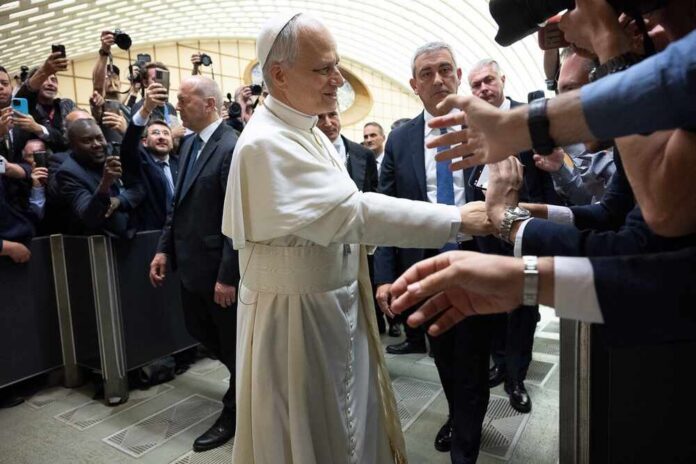
Pope Leo XIV’s condemnation of capital punishment collides head-on with the Trump administration’s aggressive push to expand federal execution methods, exposing a stark divide between religious doctrine and government justice policy that leaves Americans questioning who truly values human life.
Story Snapshot
- Pope Leo XIV forcefully condemned capital punishment during an April 23, 2026 press conference, urging U.S. abolition while returning from Africa
- Trump’s Justice Department simultaneously announced expansion of federal execution methods including firing squads, electrocution, and gas chambers
- The timing highlights tensions between Vatican teaching on life’s sanctity and the administration’s pledge to resume executions after Biden commuted 37 death sentences
- Catholic doctrine now declares the death penalty “inadmissible” in all circumstances, challenging conservative support for capital punishment
Vatican Challenges Federal Execution Expansion
Pope Leo XIV issued an unambiguous rejection of capital punishment on April 23, 2026, aboard the papal plane returning from Africa. His statement emphasized that human life remains sacred “from conception to natural death,” directly addressing both Iran’s recent executions of opposition members and America’s renewed embrace of the death penalty. The pontiff’s timing proved remarkable: his condemnation arrived as the Trump administration’s Justice Department announced plans to implement firing squads, electrocution, gas chambers, and lethal injections for federal executions, reversing Biden-era restrictions that had commuted 37 death row sentences.
Church Doctrine Versus State Retribution
The Catholic Church’s evolution on capital punishment creates uncomfortable questions for many conservative Americans who value both their faith and tough-on-crime policies. Pope Francis revised the Catechism in 2018 to declare the death penalty “inadmissible” under all circumstances, arguing that human dignity persists even after serious crimes. Pope Leo XIV reinforced this teaching in his April 24 message to DePaul University, marking the fifteenth anniversary of Illinois abolishing executions. He stated that dignity is “not lost even after serious crimes,” advocating for effective imprisonment that allows redemption while protecting society.
This doctrinal stance conflicts with the Trump administration’s approach to federal justice. The Justice Department justified expanding execution methods by citing drug shortages that hampered lethal injections and the need to “strengthen” the death penalty. The administration rescinded Biden’s moratorium and pledged to resume executions for heinous federal crimes. For conservatives who support capital punishment as righteous retribution against murderers and terrorists, the papal position seems disconnected from street-level realities where victims’ families demand justice and deterrence remains a compelling argument.
Government Priorities Questioned
The clash between religious teaching and federal policy exposes deeper frustrations about government priorities that resonate across the political spectrum. Many Americans, whether supporting or opposing the death penalty, question why Washington focuses on execution methods while broader criminal justice failures mount. Violent crime continues plaguing communities, recidivism rates remain high, and prison conditions often fail both rehabilitation and public safety goals. The administrative effort required to implement firing squads and gas chambers—complete with legal challenges and logistical complexities—raises questions about whether these resources serve Americans better than reforms addressing root causes of crime.
Pope Leo condemns capital punishment amid US execution push. A timely call for mercy and due process in shaping justice systems. Read more: https://t.co/xCG3pTU316 #Pope #CapitalPunishment #HumanRights #Justice #ReligionAndPolicy: https://t.co/2sqod7SGEx
— Global Banking & Finance Review (@GBAFReview) April 24, 2026
The timing during the U.S.-Iran war adds another layer of complexity. Pope Leo’s condemnation addressed Iran’s execution of thousands of protesters alongside America’s execution expansion, drawing moral equivalence that many conservatives find offensive. Yet his consistency on life issues—from conception through natural death—challenges both sides to examine their own selective applications of principle. As the federal government prepares to resume executions with methods many consider archaic, millions of Americans wonder whether their elected representatives truly prioritize justice or simply political positioning that satisfies bases while failing to address systemic problems making communities less safe.
Sources:
Pope Leo’s Africa trip, Iran war, and capital punishment condemnation – The Inquirer
On way back to Rome, Pope Leo condemns state executions in Iran – Crux Now
Pope urges US, Iran to return to peace talks, condemns capital punishment – Mid-Day
Pope urges US, Iran to return to peace talks, condemns capital punishment – Korea Times
Pope Leo condemns capital punishment amid US execution push – Global Banking and Finance