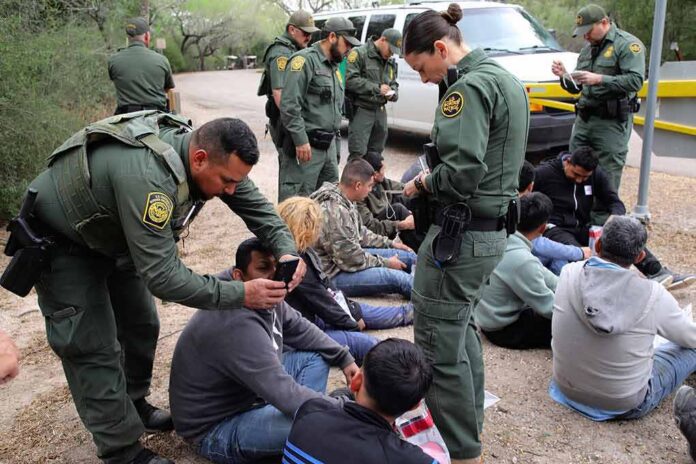
The Justice Department’s new opinion lets U.S. troops detain migrants as “trespassers” near military zones along the southern border, edging military power deeper into civilian enforcement.
Story Snapshot
- Justice Department lawyers said military personnel can detain suspected trespassers just outside National Defense Areas.
- Federal judges earlier threw out many similar trespass cases for lack of notice and proof.
- Thousands have faced add-on trespass counts since last year, expanding criminal exposure for migrants.
- Analysts warn this pushes border control further into military-style authority without Congress acting.
What DOJ Authorized And Where It Applies
The Justice Department’s Office of Legal Counsel said military personnel may arrest and briefly detain migrants accused of trespassing just outside National Defense Areas at the border. The opinion says this does not violate the Posse Comitatus Act because commanders have statutory power to protect defense sites and people on them. The policy ties authority to Defense Department control over defined areas. The opinion also frames the detentions as protective, not general policing of immigration law.
The opinion arrives as the administration relies more on military-controlled zones to manage crossings. The government has designated strips and buffer areas near key infrastructure as military sites to deter smugglers and channel foot traffic. Supporters say this improves safety for service members and protects equipment. Critics argue the step moves immigration control into a military space where the executive branch can act fast with less oversight by Congress.
Why Courts Dismissed Earlier Trespass Cases
In 2025, a federal magistrate judge dismissed about 100 cases that charged migrants with trespassing in a newly formed military zone in New Mexico. The court said prosecutors did not prove the migrants had fair notice of the restricted area or understood the boundaries, which is needed for a criminal case. The judge also flagged gaps in signage and language access at the time of arrest. Those rulings forced a reset in how and where charges could stick.
Since then, the administration pursued additional misdemeanor counts that accuse migrants of trespassing on military property on top of illegal entry cases. The Texas Tribune reported at least 4,700 migrants faced such add-on charges since last April. That figure shows how prosecutors used trespass as a force multiplier to raise legal risk and potential jail time, even as courts tested the limits of the approach. The new Justice Department opinion may seek to shore up that strategy’s legal footing.
The Posse Comitatus Line And DOJ’s Rationale
The Posse Comitatus Act generally bars the Army and Air Force from enforcing domestic law without clear approval from Congress or the Constitution. Legal analysts have long said direct detention of civilians by the military risks crossing that line. The Justice Department’s opinion aims to fit within an exception. It argues that detaining trespassers tied to site protection serves a core military purpose, which differs from broad immigration policing. That distinction will likely face tests in court.
Policy experts say border militarization is not only about troops on the ground. It often includes military-style hardware, surveillance tools, and legal carve-outs that expand authority in gray zones. Those changes can speed enforcement and shift power toward the executive branch when Congress is gridlocked. The long-term concern is institutional: temporary exceptions can harden into new norms that outlast the crisis that justified them.
What It Means For Communities On Both Sides
Border towns want order, clear rules, and safe streets. Ranchers and residents near crossing corridors face theft, property damage, and stress. The new opinion promises faster action when people cross into controlled areas. That may bring short-term relief by deterring activity near defense sites. But if signage, notice, and language access remain weak, courts could again reject cases, and locals will see little change beyond more uniforms and more confusion.
For migrants, add-on trespass charges stack on top of entry violations, raising the cost of a failed crossing. For service members, the opinion puts them closer to hands-on detentions, which many commanders view as risky and outside their core mission. For the country, the move deepens a pattern: when Washington cannot agree, presidents use tools that sit just inside the lines. Over time, both left and right worry that lines move while no one in power fixes the root causes.
Sources:
cbsnews.com, immpolicytracking.org, military.com