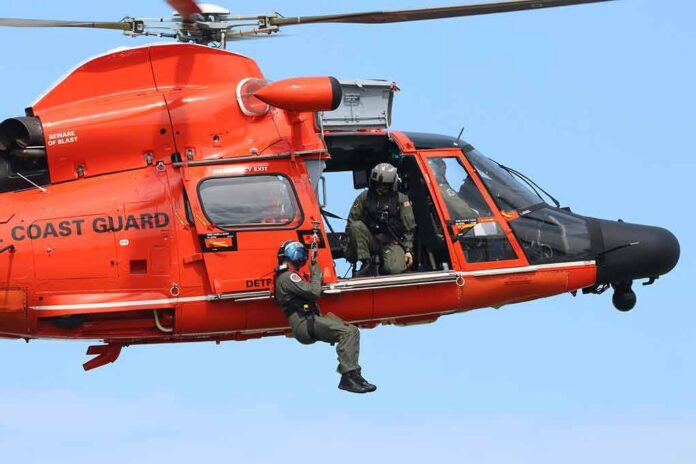
Search crews found a confirmed debris field off Nantucket after a medevac jet with six aboard vanished en route to Boston, and the race for survivors is on.
Story Snapshot
- U.S. Coast Guard confirmed debris from the missing Gulfstream G100 south of Nantucket.
- The jet lost contact with air traffic control early Saturday while flying from Bermuda to Boston.
- Federal Aviation Administration issued a search-and-rescue alert around 1:20 a.m. Eastern time.
- Authorities are focusing on locating possible survivors as search grids expand.
What Authorities Confirmed So Far
The U.S. Coast Guard said it located and confirmed a debris field from a Gulfstream G100 medical flight south of Nantucket on Saturday night. The aircraft was carrying six people and failed to arrive in Boston after departing Bermuda. Coast Guard units shifted quickly from broad-area searching to focused grid sweeps once debris was found. Officials said the search for survivors continued into the night. The debris confirmation anchors the search area and guides next steps for rescue teams.
The Federal Aviation Administration (FAA) alerted rescue authorities after the aircraft missed check-ins and lost contact. An FAA spokesperson said a search-and-rescue alert went out at about 1:20 a.m. Eastern time, triggering a multi-agency response. That timing allowed Coast Guard aircraft and cutters to reach a probable location window before currents spread debris further. Early notification is a key factor that can raise survival odds in overwater emergencies, according to national search and rescue planning guidance.
Timeline: From Loss of Contact To Debris Discovery
Air traffic controllers lost contact with the flight in the early morning hours as the jet headed toward Boston. The Coast Guard’s Northeast region began air and surface searches off Massachusetts near Nantucket after being notified of the missing aircraft. Through the day, search aircraft flew grid patterns while surface vessels scanned for debris and possible life rafts. By nightfall, crews reported a debris field confirmed to be from the missing aircraft, narrowing the likely impact zone for rescue efforts.
Local outlets reported Coast Guard assets adjusting their grid patterns as new information arrived from federal aviation officials and radar traces. That shift reflected standard search-and-rescue practice: define the last known position, estimate drift, then refine the box as sightings occur. Once debris was confirmed, aircraft broke from wider sweeps to tighter orbits over the highest-probability area. That approach follows national search protocols designed to move fast under changing conditions at sea.
Why Medevac Flights Face Added Risk
Medical evacuation flights often depart at night and fly long legs over water under time pressure to deliver care. Safety investigators have documented higher risk during night operations and in poor weather for medical missions, especially when urgency can push crews to continue despite degrading conditions. Over open ocean, communications gaps, fast-changing weather, and limited diversion options can compound trouble. That is why early alerts, strong tracking, and quick search launches matter in these events.
In overwater incidents, decisive answers usually come days later. Investigators look for locator beacons, flight recorders, and wreckage patterns to learn what failed and when. Short beacon life and strong currents can complicate recovery. Search leaders plan for this by setting grids, modeling drift, and re-tasking aircraft as new data arrives. For families and the public, that lag can be hard, but it reflects how evidence emerges after ocean crashes, not a lack of effort by responders.
The Stakes For Trust and Accountability
This case touches a shared worry across the country: when minutes matter, do systems work as promised? Here, controllers reported the loss of contact, the FAA issued an alert, and the Coast Guard surged assets to the scene. That chain of action is what the public expects government to do well. People on the left and the right often doubt federal focus and follow-through, but swift rescue steps here show how a clear mission and simple lines of command can still function.
The Coast Guard now saying it has found a debris https://t.co/27fM0SycLs air ambulance vanished over the Atlantic early Saturday morning. There were six people on board…four crew members from Canada and two passengers from Bermuda..
The plane was flying from Bermuda to Boston's… pic.twitter.com/9WsH8nxBHM— Worldwide News Network (@WorldwideNNX) October 4, 2026
Families want answers, and taxpayers want proof that safety lessons stick. The next phase will test both. Investigators will try to recover recorders and key parts to learn if weather, systems, fuel, or human factors played a role. Rescue teams will keep searching while there is any hope of survivors. Officials should keep updates plain and timely. Straight facts, delivered fast, help a weary public see competence rather than confusion in a hard moment.
Sources:
thespec.com, cbsnews.com, wionews.com, abcnews.com, aviationlawgroup.com, tsb.gc.ca, dco.uscg.mil, latimes.com, nbcboston.com