President Donald Trump’s directive to resume nuclear testing has reignited a debate reminiscent of the Cold War, raising questions about global security and the future of arms control.
Story Overview
- Trump orders the Pentagon to resume nuclear testing, citing parity with Russia and China.
- Announcement made before a summit with Chinese President Xi Jinping.
- First U.S. directive to resume nuclear tests since 1992.
- Potential for increased geopolitical tensions and arms race.
Trump’s Bold Nuclear Directive
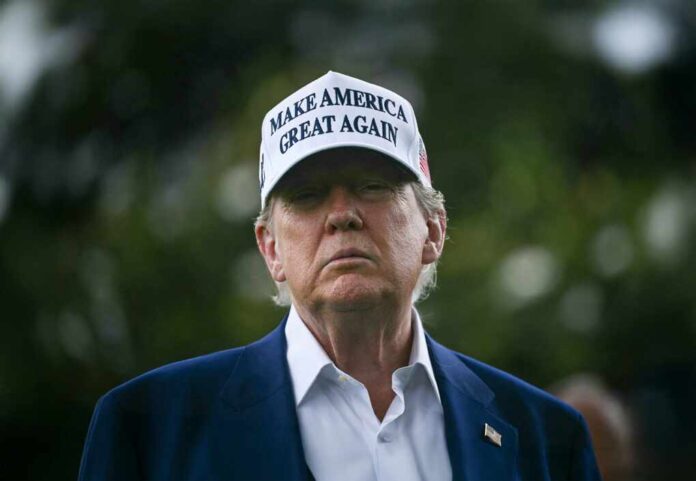
In October 2025, President Donald Trump instructed the Pentagon to resume nuclear weapons testing, a move not seen since the end of the Cold War. Trump’s announcement, made via social media, specifically pointed to the nuclear capabilities of Russia and China as justifications for the U.S. to match their testing efforts. This decision, coming just before a significant meeting with Chinese President Xi Jinping, marks a notable shift in U.S. nuclear policy and has sparked widespread debate.
The decision to resume testing is seen as a response to the modernization efforts of Russia and China, who, like the U.S., are signatories to the Comprehensive Nuclear-Test-Ban Treaty (CTBT) but have not ratified it. This treaty, established in 1996, aimed to curb nuclear proliferation, yet lacks enforcement due to the absence of ratification by key players. Trump’s move highlights the ongoing strategic competition among these nuclear powers.
Historical Context and Treaty Challenges
The U.S. last conducted a nuclear test in 1992, adhering to a de facto moratorium influenced by the CTBT. Despite North Korea being the only nation to conduct tests since the 1990s, the evolving geopolitical landscape has prompted renewed concerns about nuclear parity. The CTBT’s unratified status by major powers leaves its future uncertain, especially as Trump’s directive challenges its principles and global nonproliferation norms.
U.S. military and defense sectors now face the task of preparing for potential tests, balancing operational readiness with the diplomatic implications of breaking from long-standing international agreements. This complex scenario underscores the delicate power dynamics between the U.S., its allies, and rivals like Russia and China.
Implications and Reactions
The potential resumption of nuclear testing by the U.S. could have significant short-term and long-term implications. Short-term impacts include diplomatic backlash and increased tensions at international forums. In the long term, it risks undermining global nonproliferation efforts and sparking a renewed arms race. The directive has also raised environmental, health, and political concerns, further polarizing opinions within the U.S. and among international allies.
The financial costs of reactivating testing infrastructure are considerable, and the social and political ramifications could be profound. As defense industries may see a rise in activity, nonproliferation advocacy groups are likely to intensify opposition efforts, highlighting the broader consequences of this policy shift.
Expert Opinions and Perspectives
Nuclear policy experts warn of the destabilizing effects that resuming testing could have on existing arms control regimes, potentially prompting reciprocal actions by Russia and China. Defense analysts argue that advances in verification technologies and simulation may reduce the need for physical testing, yet acknowledge the political signaling involved. The debate features diverse viewpoints, with some advocating for testing to demonstrate strength, while others caution against the risks.
Trump’s Call to Resume Nuclear Testing After Decades Revives a Cold War Debate https://t.co/sAAhKPKyjB via @NYTimes
— Anthony DiMarco Fund (@DimarcoFund) October 31, 2025
As the international community awaits further developments, the decision to restart nuclear testing remains contentious. It challenges the integrity of arms control frameworks and highlights the complexities of contemporary geopolitical relations. The global implications of this directive will likely unfold in the coming months, shaping the discourse on nuclear policy and security.