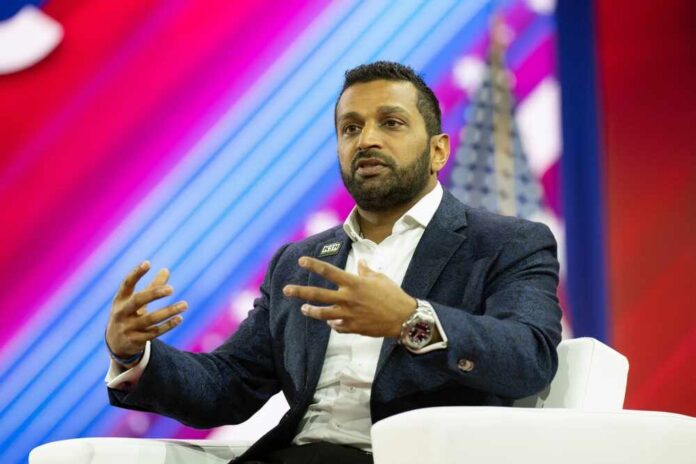
A high-stakes defamation lawsuit is turning a familiar Washington fight—anonymous leaks vs. public accountability—into a courtroom test with the FBI director at the center.
Quick Take
- FBI Director Kash Patel filed a $250 million defamation lawsuit after The Atlantic published allegations of erratic behavior and excessive drinking, claims he flatly denies.
- Patel and Acting Attorney General Todd Blanche used a DOJ press conference to blast the report’s reliance on anonymous sources and to defend Patel’s leadership.
- A key dispute involves a computer login incident: Patel denied being “locked out” publicly, while his lawsuit reportedly acknowledges a routine technical issue.
- The clash underscores a broader trust problem: Americans across the spectrum increasingly doubt institutions—government and media alike—will police themselves.
What Patel Is Suing Over—and What He’s Saying Publicly
FBI Director Kash Patel is attempting to move his dispute with the press from cable-news soundbites to federal court, filing a $250 million defamation lawsuit tied to a report portraying him as paranoid, prone to heavy drinking, and erratic in high-level interactions. At a Department of Justice press conference, Patel rejected the allegations outright and framed the story as another politically motivated media attack on Trump-era officials.
Patel’s public posture has been combative and categorical. He told reporters he was not intoxicated on the job and cast the press as a “fake news mafia,” signaling he intends to fight on both the legal and political terrain. He also emphasized that he plans to remain in his role as long as President Trump and the attorney general want him there, an important reminder that the White House ultimately controls his tenure.
DOJ’s Defense: Anonymous Sources and a Familiar Credibility Problem
Acting Attorney General Todd Blanche stood alongside Patel and criticized the report’s sourcing, arguing the claims were “suspicious” and “blatantly false” while stressing the difficulty of evaluating accusations attributed to unnamed insiders. That line of attack matters because the underlying report relies on interviews with more than two dozen people described as familiar with Patel’s conduct. Without public names, readers are asked to weigh institutional reputations and patterns rather than verifiable, on-the-record testimony.
For Americans who already believe Washington runs on protected insiders—career officials, political operatives, and influential media gatekeepers—this is the worst possible setup: serious allegations, filtered through anonymity, landing on an already polarized public. Conservatives tend to see a repeat of earlier leak-driven controversies that targeted Trump-aligned figures, while many liberals argue anonymity is necessary when insiders fear retaliation. The result is less clarity, not more, and the public’s faith in both institutions continues to erode.
The Login Incident Contradiction That Keeps Fueling Questions
One detail has drawn unusual attention because it is concrete enough to be checked, yet still contested: a computer login problem. The report described Patel as panicking over a routine technical issue and interpreting it as evidence he was being fired by the White House. At the press conference, Patel pushed back hard on the framing, denying he had been “locked out,” while reporters pressed him on whether his legal filing described the incident differently.
Why the Olympics Beer Video Became Political Ammunition
Separately, a February 2026 video showing Patel drinking beer in a U.S. Olympic men’s hockey locker room after a gold-medal win over Canada has circulated as part of the broader narrative. Patel has defended that moment as an ordinary American celebration, not evidence of workplace misconduct. The clip matters less as proof of anything at the FBI and more as a reminder of how quickly culturally charged images become political weapons—especially when paired with allegations that are harder for the public to independently verify.
What This Fight Signals About Power, Accountability, and Public Trust
The immediate stakes are personal and institutional: Patel’s credibility, The Atlantic’s reporting standards, and DOJ’s willingness to publicly stand behind the FBI director. Longer-term, the lawsuit could influence how aggressively major outlets rely on anonymous sourcing when reporting on high officials, and whether top appointees see defamation litigation as a viable tool to push back. Limited public details are available so far on evidence, witnesses, or timelines beyond the lawsuit’s filing and the press conference exchanges.
For a country already fatigued by inflation-era belt-tightening, distrustful institutions, and nonstop political warfare, the broader takeaway is uncomfortable: when elite conflicts play out through leaks, anonymous quotes, and televised shouting matches, Americans are left guessing who is telling the truth. If courts force clearer fact-finding, that could serve transparency. If the dispute stays trapped in partisan narratives, it will likely deepen the sense—left and right—that the system protects itself first.
Sources:
FBI chief Kash Patel hits back at ‘fake news’ following bombshell report
Patel press conference: DOJ briefing turns fiery as FBI chief rejects bombshell report