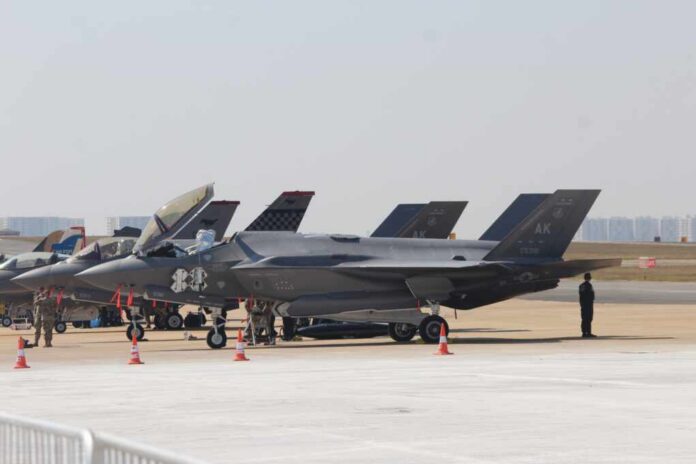
America’s most expensive fighter is now at the center of a hard question for taxpayers and warfighters alike: are F-35s being delivered with ballast “weight plates” where a critical radar should be?
Quick Take
- Multiple defense outlets report some U.S. Air Force F-35A Lot 17 jets were delivered without the planned AN/APG-85 radar, using ballast in the nose to keep the aircraft balanced.
- The reported gap traces to delays and integration problems with the new APG-85 radar, including cooling, power demands, and structural incompatibilities with the older APG-81.
- The Air Force has publicly denied receiving F-35s “without radars,” creating a transparency dispute that Congress is now scrutinizing.
- Rep. Rob Wittman has pointed to bulkhead and mounting differences that make quick radar swaps difficult, while delivery details remain classified.
What “Weight Plates” Really Signal in a High-End Fighter Program
Reporting in 2025 and early 2026 described U.S. Air Force F-35A aircraft from Lot 17 arriving without the intended AN/APG-85 radar, with ballast installed in the nose to preserve center-of-gravity balance. The “weight plates” framing is eye-catching, but the underlying issue is more serious: a jet built around a new radar architecture can’t simply drop in the older set if the airframe structure and mounts don’t match. That turns a schedule delay into a capability dilemma.
Why the U.S. Air Force Is Delivering F-35 Stealth Fighters with “Weight Plates” Instead of Radarshttps://t.co/oz3ZQOQGSU
— 19FortyFive (@19_forty_five) February 12, 2026
Outlets emphasizing the visual element also cautioned that “gym-style” plates seen in photos may not be flight-qualified hardware. The practical point remains: if radar installation is delayed, the aircraft still has to be handled, moved, and tested safely, and that often requires temporary ballast. The controversy is not that weight is used—aircraft programs do that—but why a frontline fighter would be in limbo over a core sensor in the first place.
Why the APG-85 Delay Matters: Power, Cooling, and Physical Fit
The APG-85 is described as a next-generation gallium nitride radar designed to support the F-35’s Block 4 modernization path, with improved detection, tracking, and electronic warfare performance. The same reporting ties the delays to familiar acquisition pain points: cooling and power constraints, supply chain friction, and engineering integration. A key detail from congressional oversight is that structural differences—such as bulkhead changes and radar mounting incompatibilities—complicate swapping the older APG-81 into jets prepared for APG-85 hardware.
Those integration realities matter because they limit easy “just install the old radar” workarounds. Lockheed Martin leadership flagged schedule risk in 2025 and discussed proactive steps aimed at later production lots. The public timeline in the reporting points to APG-85 fielding shifting from Lot 17 to Lot 20, with expectations landing in 2027. If that schedule holds, the program faces a multi-year window where production and modernization timelines do not line up cleanly.
Conflicting Public Narratives: Reports vs. Air Force Denial
The biggest open issue is not whether ballast exists, but what exactly the Air Force accepted and how it defines “received.” After early reporting asserted radar-less deliveries, the Air Force later denied receiving F-35A Lot 17 aircraft without radars. At the same time, other coverage continued to cite observations and sourcing that suggest at least some aircraft were delivered with ballast in place of the planned radar configuration. Classified delivery terms and acceptance criteria limit what outside analysts can verify.
That gap between what’s reported and what’s officially stated is where oversight becomes essential. When details are classified, the public cannot easily distinguish between “delivered without the new radar but with an interim solution,” “delivered but not formally accepted,” or “delivered with a radar different from what was expected.” Each scenario has different readiness implications. Without clearer explanations, Americans are left with headlines instead of accountability—an outcome that never serves constitutional self-government well.
Readiness and Accountability Questions Congress Will Keep Pressing
Even under the most charitable interpretation, a fighter’s radar is not an optional accessory. Reporting frames this as a “radar gap” that could affect detection and tracking until the APG-85 enters service in later lots, potentially slowing the broader Block 4 and TR-3 modernization push. Congress has already shown interest, with Rep. Rob Wittman discussing the technical constraints and emphasizing the importance of the upgraded radar’s capability. That focus is likely to intensify as budgets and timelines collide.
Why the U.S. Air Force Is Delivering F-35 Stealth Fighters with “Weight Plates” Instead of Radarshttps://t.co/XAvj275Cj4
— Harry J. Kazianis (@GrecianFormula) February 12, 2026
For a conservative audience that watched years of Washington spending without results, this story lands as a familiar frustration: huge price tags, shifting schedules, and tight-lipped bureaucracy. The available reporting does not prove bad faith, and it does not settle the dispute created by the Air Force denial. It does, however, underline why transparent congressional oversight and measurable delivery standards matter—especially when national defense depends on systems that must work on day one, not after another round of delays.
Sources:
Why the U.S. Air Force Is Delivering F-35 Stealth Fighters with “Weight Plates” Instead of Radars
Tyndall AFB showcases innovation with new F-35 weighing methods
Reports Suggest F-35s Delivered Without Radar
Are F-35s Being Delivered To The USAF Without Radars? Sure Seems Like It
Air Force Now Denies Receiving F-35s Without Radars