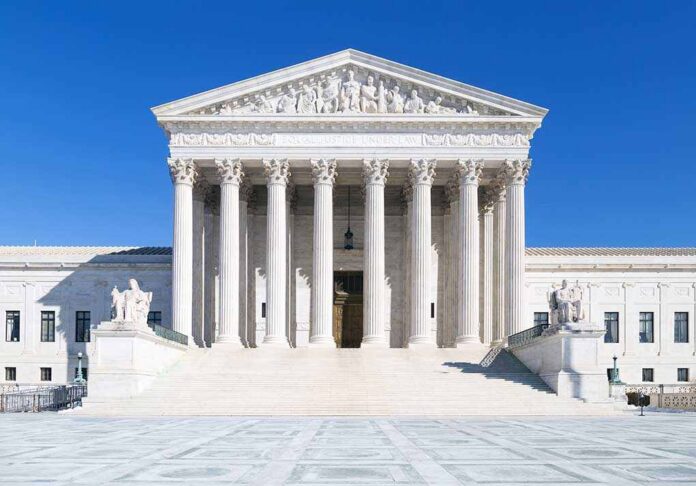
The Supreme Court refused to review President Trump’s appeal, leaving a $5 million civil judgment in the E. Jean Carroll case fully in place.
Story Snapshot
- The Supreme Court denied review of Trump’s appeal, keeping the $5 million verdict intact.
- A later rehearing request confirmed the initial denial and was also rejected.
- The denial ends Supreme Court review and shifts focus to payment and enforcement.
- A separate $83 million Carroll case remains on a different track.
What The Supreme Court Did And What It Means
On June 29, 2026, the Supreme Court declined to hear President Trump’s bid to overturn a $5 million civil verdict in favor of E. Jean Carroll, leaving the jury’s finding of liability and damages in place. Denying review does not endorse the lower court’s reasoning. It means the justices chose not to take the case. In practical terms, the lower court’s decision stands, and the path clears for enforcement actions to continue unless another court steps in.
After the denial, Trump filed a petition for rehearing. His filing cited Supreme Court Rule 44.2 and asked the Court to reconsider its order or hold the case while a related matter moved forward. The petition itself confirms the June 29 refusal happened and shows his team sought a second look. The Supreme Court’s public docket lists the case and reflects the petition’s status, tying the timeline together from denial to rehearing and back to finality.
How The Rehearing Attempt Played Out
Trump’s rehearing request followed standard procedure, which allows a party a brief window to ask for reconsideration after a denial. Reports show his initial rehearing filing needed a correction before the Court accepted the corrected version, confirming the matter was properly before the justices. On August 17, 2026, the Court again declined to take up his challenge, marking a second rebuff and leaving the $5 million judgment intact for enforcement steps in the trial court.
Some reports described collection amounts around $5.6 million after the initial verdict figure of $5 million. The available sources in this set do not include the trial court’s interest and cost breakdowns, so the reason for the difference is not documented here. The key point supported by the record is that the underlying $5 million civil award remained enforceable after the Supreme Court refused review and then declined rehearing.
Where This Fits In The Larger Legal And Political Picture
This dispute follows a common Supreme Court pattern. A denial of review, and especially a denial of rehearing, usually signals only that the Court will not intervene, not that it agrees with the lower court’s analysis. That choice leaves the jury’s verdict and the appeals court’s ruling in place, which shifts the fight to timing, payment, and any remaining trial court motions. For many readers, that can feel like process over clarity.
US Supreme Court Denies Trump's Rehearing in Carroll Case
The US Supreme Court denied Trump's rehearing request on Monday. The request was about the E. Jean Carroll case.
Carroll is a writer. The court gave no explanation for its decision.
This keeps a $5 million judgment… pic.twitter.com/fLQtRZVwiH
— KlearNewsDaily (@KlearNewsDaily) August 17, 2026
The case also sits alongside another Carroll judgment for defamation, which totals about $83 million, and has its own separate path and filings. That larger case is distinct from the $5 million judgment the Court left standing here, but headlines can blur them. Coverage shows both matters moving on different tracks, which can confuse the public conversation about what was decided and what remains open. Keeping the cases separate helps explain what changed this week and what did not.
Why This Matters Beyond The Courtroom
For people across the political spectrum, the steady rise in legal battles around public figures can feel like proof that power, money, and connections rule the system. This ruling does not change who writes the laws or how long cases take. It does show how process often decides outcomes long before anyone sees a clear yes or no. Denials without explanation are normal at the Supreme Court, but they leave citizens guessing, which fuels distrust of distant institutions.
Sources:
scotusblog.com, cnn.com, reuters.com, thehill.com, cnbc.com, supremecourt.gov